

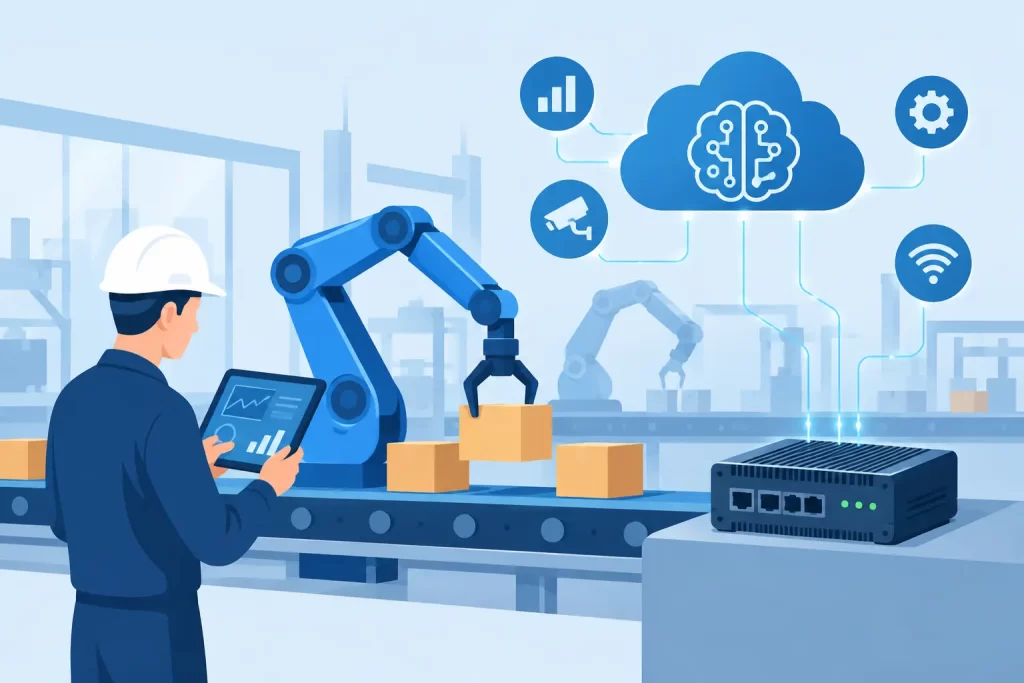
A defect traveling at conveyor speed, a bearing beginning to develop an irregular vibration signature, or an acoustic event inside a production cell cannot wait for a round trip to a remote data center. The most consequential industrial AI trends are therefore not centered on larger general-purpose models. They are centered on where recognition runs, how quickly it produces a decision, and whether the resulting system can operate reliably beside machinery.
For automation engineers and OEMs, AI value is increasingly measured in milliseconds, watts, integration effort, and false-decision rates. A model that performs well in an isolated test environment may still be unsuitable if it introduces network dependency, cannot process live signals deterministically, or requires hardware that is impractical to deploy at scale.
Industrial AI Trends Move Intelligence to the Edge
Edge deployment is becoming the default architecture for industrial sensing tasks that require immediate action. Cameras, microphones, accelerometers, and other sensors create continuous streams of data. Sending every frame or sample to centralized infrastructure increases bandwidth use, latency, and exposure to communication interruptions.
The practical alternative is to place trained recognition capability close to the source. An embedded controller can classify an image, identify an acoustic pattern, or detect a vibration anomaly locally, then send only the result, event record, or selected evidence upstream. This architecture reduces the amount of data that must move through the network while keeping the control loop close to the physical process.
This does not eliminate the role of servers or cloud systems. Centralized infrastructure remains useful for fleet-level reporting, long-term data retention, model governance, and cross-site analysis. The trend is toward a divided architecture: edge devices perform time-critical perception and response, while server systems provide aggregation, supervision, and engineering support.
The appropriate split depends on the application. A slow batch-quality analysis may tolerate centralized processing. A safety-related interlock, high-speed sorting decision, or real-time equipment alarm usually cannot.
Trainable Recognition Is Replacing Fixed Rules
Industrial automation has long relied on deterministic thresholds and carefully engineered rules. Those methods remain effective when the signal is stable and the failure mode is well defined. For example, a temperature limit or a simple position check may need no learned model at all.
The limitation appears when signals vary naturally. Surface appearance changes with lighting and material batches. Acoustic signatures shift with load, enclosure geometry, and background machinery. Vibration patterns combine speed, mounting conditions, wear, and process variation. Writing and maintaining fixed logic for every valid and invalid condition becomes difficult.
A major trend is the use of trainable controllers that can learn representative patterns directly from application-specific samples. Rather than forcing every recognition problem into a large dataset and a long retraining cycle, engineering teams can build a classifier around the operational states that matter: acceptable product, recurring defect classes, normal machine condition, early degradation, or anomalous behavior.
Training speed matters here because industrial environments change. A revised component, a new material finish, or a different operating mode can make an existing recognition boundary less reliable. Systems that support practical retraining allow engineers to adapt the inspection or monitoring logic without redesigning the entire automation layer.
Trainability does not mean uncontrolled learning in production. Industrial implementations require known datasets, versioned recognition configurations, acceptance testing, and a defined rollback path. The objective is adaptable recognition with traceable engineering control.
Multimodal Monitoring Becomes a Design Requirement
Machine vision remains a major industrial AI application, but visual data is only one part of machine condition and process awareness. Many faults produce evidence first in vibration, sound, current draw, pressure behavior, or another nonvisual signal. The next generation of monitoring systems is therefore built to work across multiple sensing modalities.
A packaging line illustrates the point. Vision may verify label placement and package integrity. An acoustic channel may identify an abnormal pneumatic event. Vibration analysis may reveal a developing mechanical issue in a drive assembly. Each sensor addresses a different failure mechanism, and together they provide better operational coverage than any single source.
This does not require combining every signal into one complex model. In many installations, separate classifiers are easier to validate and maintain. Their outputs can then be combined through industrial control logic or supervisory software. The right architecture depends on the physical process, the rate of change, and the consequence of a missed event.
The key trend is architectural rather than cosmetic: industrial AI platforms must accept free-form signals, not just prepackaged image data. They must also make it practical to acquire, label, review, and replay recorded samples. Recorded data is essential for validating whether a recognition decision reflects a genuine process condition or a transient artifact.
Deterministic Performance Matters More Than Peak Benchmarks
Many AI evaluations emphasize throughput, parameter counts, or benchmark accuracy. Industrial deployment introduces different questions. Can the system maintain response time under continuous load? Does power consumption remain compatible with an embedded enclosure? Can the controller operate without a GPU workstation? Will recognition remain stable when a network is unavailable?
These constraints are driving renewed interest in specialized AI hardware acceleration. Dedicated neural hardware can deliver high-speed pattern recognition with substantially lower power and a smaller deployment footprint than general-purpose computing platforms designed for broad workloads.
For edge automation, predictable behavior is often more valuable than the highest theoretical performance. A controller that produces a consistent response within the required cycle time can be engineered into a machine. A more computationally demanding system with variable response time may create integration risk, especially where decisions must synchronize with motion, rejection mechanisms, alarms, or programmable logic controllers.
Hardware format also affects adoption. Some projects require a compact embedded board for direct installation in equipment. Others need PCIe integration inside an industrial computer, while field deployments may benefit from a standalone vision and signal-analysis unit. NeuroTechnologijos addresses this requirement through NT Adaptive controllers in formats including .VASS, PCIe, and Raspberry Pi-compatible implementations, allowing recognition hardware to align with the host system and installation constraints.
Explainable Operation Becomes a Practical Engineering Need
Industrial AI is not required to explain every internal mathematical step to be useful. It does, however, need to give engineers enough evidence to validate decisions and troubleshoot exceptions. A rejection event should be associated with an image, signal segment, classification result, timestamp, and relevant machine state where possible.
This is particularly important for condition monitoring. If a system identifies a vibration pattern as abnormal, maintenance teams need to compare the event against baseline samples, operating speed, load conditions, and previous trends. An alarm without supporting context is likely to be ignored or treated as a nuisance.
Practical explainability also supports commissioning. Engineers need to know whether a false positive originated in sensor placement, lighting, mechanical noise, insufficient training samples, or an overly broad class definition. The most effective systems combine recognition output with captured evidence and tools for reviewing live and recorded data.
Cybersecurity and Lifecycle Control Are Part of the AI System
As AI becomes embedded in operational technology, it inherits the lifecycle demands of industrial control systems. A trained recognition model is a production asset. It needs controlled distribution, documented versions, access management, and compatibility testing when hardware or software changes.
Network isolation can be an advantage of edge processing, but it does not remove the need for security discipline. Devices still require secure configuration, authenticated updates, defined interfaces, and clear ownership between automation, IT, and maintenance teams. The more directly an AI result influences control action, the more rigorous the validation process should be.
The same principle applies to model updates. A revised model may improve detection on one product variation while reducing performance on another. Testing should include representative process conditions, not only clean validation samples. Where the cost of a wrong decision is high, AI output may initially be used as an advisory signal before it is permitted to trigger automated action.
What These Trends Mean for Industrial Buyers
The procurement question is shifting from “Which AI model is most advanced?” to “Which recognition architecture can operate inside this machine, on this signal, at this cycle time?” That change favors systems designed around deployment conditions rather than demonstrations.
Technical buyers should evaluate the full path from sensor input to control output. This includes signal acquisition, local processing latency, power requirements, training workflow, evidence capture, hardware interfaces, and integration with existing PLC, SCADA, or industrial PC environments. Accuracy remains essential, but it is only one component of operational suitability.
The strongest industrial AI projects begin with a bounded recognition problem and a measurable decision requirement. Identify the pattern to detect, the available sensor evidence, the maximum acceptable response time, and the operational cost of false positives and false negatives. From there, the right edge architecture becomes an engineering decision instead of a speculative AI initiative.
Industrial AI will increasingly be judged where it matters most: at the machine, under real production conditions, when the system must recognize a changing pattern and act before the process moves on.
