

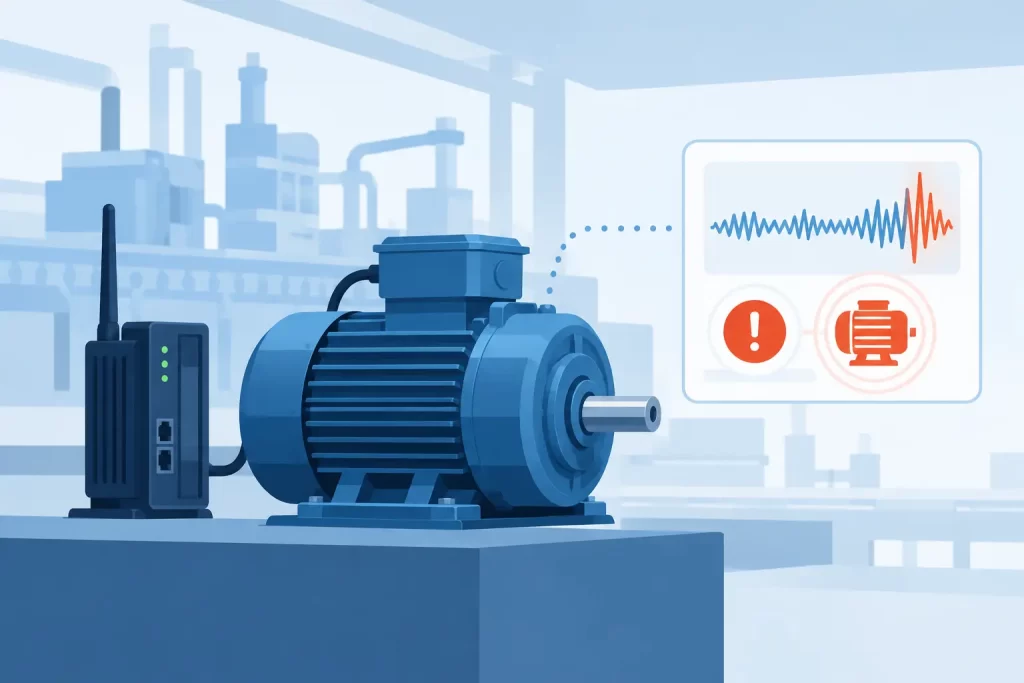
A motor rarely fails without leaving evidence first. Bearing wear changes the vibration spectrum. Rotor defects introduce characteristic current components. Misalignment raises mechanical load and temperature. The problem is that these signals are often subtle, intermittent, and buried in normal operating variation. Effective motor failure recognition turns those early changes into an actionable maintenance decision before a production line stops.
For industrial operators, the objective is not simply to label a motor as healthy or faulty. The objective is to distinguish a developing mechanical or electrical defect from normal changes in speed, load, product, ambient conditions, and machine state. That distinction determines whether maintenance is scheduled during planned downtime or triggered only after a costly unplanned event.
Why Motor Failure Recognition Is a Signal Classification Problem
Traditional condition monitoring commonly relies on fixed alarm thresholds. An overall vibration level above a defined value, for example, may initiate an inspection. This approach remains useful for clear and severe conditions, but it has limits. A motor can operate above its normal vibration baseline without being defective, while an early bearing fault may remain below an overall alarm threshold.
Motor failure recognition requires a more specific view of the signal. The system must identify patterns associated with fault modes rather than reacting only to amplitude. Depending on the machine and available sensors, those patterns can appear in vibration, acoustic emission, motor current, voltage, temperature, shaft speed, or process data.
This is especially relevant for variable-speed drives and equipment with changing duty cycles. The expected frequency content of a healthy motor at 1,200 RPM is different from that same motor at 1,800 RPM. A useful recognition system accounts for operating state, or it will generate alarms that maintenance teams quickly learn to ignore.
Common Motor Fault Signatures
Mechanical faults often begin in bearings, couplings, belts, gears, or mounting structures. Bearing defects can create repetitive impacts that appear at characteristic frequencies and harmonics. Misalignment may increase axial vibration and produce elevated components at running speed. Looseness can generate broadband energy, impacts, and harmonics that change as load rises.
Electrical faults have different signatures. Stator winding degradation can affect current balance, insulation behavior, and thermal response. Broken rotor bars may produce sideband frequencies in motor current analysis. Air-gap eccentricity can affect current and vibration patterns, although diagnosis requires care because similar features can arise from load or drive behavior.
No individual indicator is definitive in every installation. High vibration near a bearing frequency may point to bearing damage, but it can also result from structural resonance, lubrication conditions, or sensor mounting. Recognition accuracy improves when the system evaluates several features together and compares them with examples captured from the actual asset.
Selecting Signals for Reliable Recognition
Sensor selection should follow the expected failure mechanisms and the physical accessibility of the motor. Vibration is the primary source for many rotating-machine applications because accelerometers respond directly to impacts, imbalance, looseness, and resonance. Sensor position matters: a housing measurement near the drive-end bearing can reveal a different condition than a measurement on the non-drive end.
Motor current signature analysis is valuable when direct vibration sensing is difficult, such as sealed equipment, submerged pumps, or distributed motor fleets. Current sensing can also detect electrical and rotor-related behavior without modifying the mechanical assembly. However, current signals reflect the full motor-load-drive system. Load changes, inverter switching, and supply quality must be considered during model development.
Acoustic sensing can provide useful early indication for high-frequency bearing events or abnormal mechanical contact. It is often less invasive than mounting sensors on a machine, but plant noise, reflections, and nearby equipment create a more demanding recognition environment. Thermal signals are useful for identifying sustained overload, cooling failure, and insulation-related heating, though temperature typically changes more slowly than vibration or current.
The strongest architecture is frequently multimodal. A vibration classifier may detect a developing bearing condition while current data confirms that the motor load has not changed materially. A temperature rise can increase confidence that the condition requires intervention. More sensors do not automatically produce a better system, however. Each channel adds installation, calibration, synchronization, and maintenance requirements. The right design uses the fewest signals needed to separate meaningful fault states reliably.
Train Models Against Real Operating States
A model trained only on laboratory fault examples can perform poorly on a production machine. Real equipment experiences changing loads, starts and stops, process transients, environmental noise, mounting variation, and differences between nominally identical motors. These conditions should be represented in the training data whenever possible.
A practical training set begins with healthy operation across the expected operating envelope. Capture data at normal speed ranges, load conditions, product formats, and ambient temperatures. Then add known fault examples, maintenance findings, controlled test conditions, or expert-labeled events. For rare failures, a system can first learn the normal signature and identify departures that warrant review. This anomaly-detection approach is useful, but it should not be confused with definitive fault classification.
Labels must reflect maintenance reality. “Bearing fault” is often too broad if maintenance needs to know whether the issue is lubrication degradation, an outer-race defect, or a mounting problem. Conversely, overly granular labels create training classes with too few examples. The appropriate taxonomy depends on the action each classification will trigger.
Recognition performance should be evaluated by operating state, not only by an aggregate accuracy figure. A model that scores well overall but misses faults during low-speed operation may not protect the asset that matters most. False positives also require measurement. If operators receive repeated alerts that do not correspond to actionable conditions, confidence in the monitoring system declines rapidly.
Edge Deployment Changes the Response Time
Sending every waveform, audio stream, or high-rate sensor trace to a remote server can add bandwidth cost, latency, and dependence on network availability. It can also be unnecessary. Many motor monitoring decisions must be made near the equipment: flag an abnormal cycle, increase data capture, notify a PLC, reduce load, or stop a machine under defined protection logic.
Edge recognition places classification close to the sensor and control system. A local controller can acquire a signal, extract or recognize its pattern, and deliver a deterministic output without waiting for a cloud transaction. Historical data can still be retained for engineering analysis, model improvement, and fleet-level reporting, but the immediate decision remains available when connectivity is limited.
For embedded industrial deployments, compute efficiency is as important as recognition quality. A solution that requires a large server-class processor for every motor may be impractical for distributed equipment. Trainable neural hardware offers a different architecture: known signal patterns can be learned and recognized locally with low power consumption and very short response time.
NeuroTechnologijos applies this approach through NT Adaptive controllers and software modules designed for live and recorded signal analysis. Hardware formats including industrial standalone, PCIe, and Raspberry Pi-based implementations allow integrators to align deployment with panel space, host-system architecture, and existing automation infrastructure.
Integrating Recognition With Maintenance and Control
A recognition output has value only when it enters a defined workflow. For low-severity conditions, the system may create a maintenance notification and begin storing higher-resolution data. For a confirmed critical signature, it may send a discrete signal to a PLC, command a controlled speed reduction, or initiate an orderly shutdown. The response should be proportional to both fault confidence and process consequence.
Integration also requires traceability. Maintenance personnel need access to the event time, machine state, recognized class, confidence level, and supporting signal segment. This evidence helps technicians verify the finding and improves future training data. It also separates a real condition-monitoring system from a black-box alarm source.
Thresholds and model outputs should not bypass established safety systems. Protective relays, drive protections, and functional safety logic retain their roles. Pattern recognition extends those systems by identifying developing conditions earlier and with greater specificity, allowing maintenance teams to act before a hard protection limit is reached.
Designing for Long-Term Accuracy
Motor condition does not remain static after commissioning. Bearings are replaced, couplings are aligned, loads change, drives are retuned, and sensors are moved. Each change can shift the measured signal distribution. A recognition deployment therefore needs periodic validation and a controlled method for adding verified new examples.
Start with a limited group of representative motors rather than attempting a plant-wide rollout on day one. Verify sensor mounting, establish healthy baselines, compare outputs with technician inspections, and refine the fault classes that support actual decisions. Once the architecture proves reliable, it can be replicated across similar assets with appropriate local validation.
The most useful motor failure recognition system is not the one that produces the most alarms. It is the one that recognizes meaningful change early enough to give engineering and maintenance teams time to choose the right intervention.
