

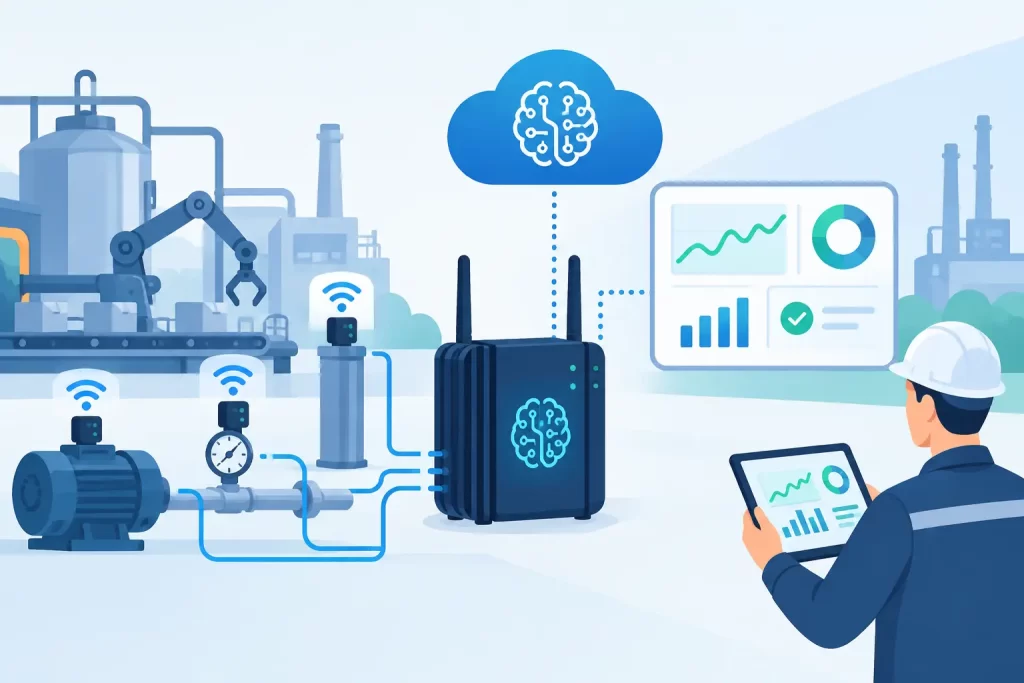
A bearing begins to develop a fault pattern long before a conventional alarm reaches its threshold. A camera may see a defect for only milliseconds as a part passes through a station. In both cases, sending every raw signal to a remote server introduces delay, bandwidth cost, and a new point of operational dependency. An AI sensor gateway moves recognition and decision logic closer to the source, where the signal is created and where the response is needed.
For industrial teams, the gateway should not be treated as a generic connectivity appliance with an AI label attached. It is an operational computing layer that acquires sensor data, conditions it, runs trained recognition models, and exchanges actionable results with control and supervisory systems. Its value depends on how consistently it performs those functions under the timing, environmental, and integration constraints of the production system.
What an AI Sensor Gateway Does
An AI sensor gateway sits between field sensors and the systems that consume decisions. Depending on the application, its inputs may include machine-vision cameras, microphones, accelerometers, vibration probes, current sensors, thermal sensors, or existing PLC and industrial network signals. The gateway converts incoming data into a form suitable for recognition and determines whether a learned pattern is present.
The output is usually much smaller than the input. Instead of transmitting continuous high-resolution video, the gateway can report a detected defect, an object class, a confidence value, a timestamp, and the relevant image frame. Instead of storing every second of acoustic data from a motor, it can identify an anomalous signature and issue an event for maintenance review. This reduction is not merely an efficiency measure. It makes real-time automation practical where raw data transport would be excessive or unreliable.
A capable gateway typically performs four functions in sequence: data acquisition, signal preparation, recognition, and communication. The recognition stage is the differentiator. Conventional gateways route data according to predefined rules. An AI-enabled device identifies patterns that are difficult to express as fixed thresholds, including surface defects, unusual vibration spectra, acoustic leakage signatures, or changes in machine behavior.
Why Edge Recognition Changes System Design
Cloud analytics remains useful for centralized reporting, model management, long-term trend analysis, and fleet-level comparison. It is not always the correct location for a production decision. A reject mechanism, safety interlock, or machine adjustment may need an answer in milliseconds. That requirement changes the architecture.
An edge-based AI sensor gateway keeps the recognition path local. The sensor delivers data directly to the gateway, the gateway classifies the signal, and the result is sent to a PLC, motion controller, SCADA system, or industrial application. Network connectivity can still support event logging and remote diagnostics, but it is no longer required for each inference.
This local architecture produces three practical benefits. First, latency becomes more predictable because the system does not wait for a round trip to an external service. Second, bandwidth is conserved because only events and selected evidence need to leave the site. Third, sensitive visual or acoustic data can remain inside the facility.
There are trade-offs. Edge hardware has finite processing, storage, and power capacity. A gateway designed for one high-speed inspection stream may not be suitable for many simultaneous cameras or a large transformer model. System designers should size the device around signal rate, model complexity, decision deadline, retention requirements, and available interfaces rather than assume that all edge AI workloads are alike.
Recognition Must Match the Sensor Physics
Industrial sensing problems are multimodal. A defect visible in a camera image may be inaudible and mechanically insignificant. An early bearing fault may appear first in an accelerometer or acoustic signal, with no visible indication at all. The gateway architecture should therefore begin with the physical evidence available at the machine.
For machine vision, the important factors include image resolution, frame rate, illumination stability, trigger timing, and the distance between inspection and actuation. A useful classification result delivered after the part has passed the reject station has no operational value. The gateway must receive, process, and communicate the result within the available machine cycle.
For vibration and audio monitoring, signal sampling rate and window length determine what frequencies and transient events can be detected. Preprocessing may include filtering, feature extraction, spectral transformation, or segmentation before classification. Fixed threshold alarms can still be appropriate for simple conditions, such as an absolute temperature limit. Trainable recognition becomes more valuable when normal operating behavior varies by load, product, speed, or machine state.
A gateway should also preserve context. A vibration pattern recorded during startup may be normal but indicate a fault during steady-state operation. Combining sensor data with PLC state, production mode, or rotational speed improves the relevance of recognition results and reduces nuisance alarms.
Hardware Architecture Determines Deployment Options
The phrase AI gateway often implies a software layer, but industrial performance is strongly shaped by hardware design. The processor or neural accelerator determines inference latency and energy use. Memory capacity affects model and buffer size. I/O options determine which sensors can be connected without adding separate conversion hardware. Enclosure, mounting, temperature range, and power supply requirements affect whether the device can operate near the asset it monitors.
For many pattern-recognition workloads, specialized neural hardware provides a different design path from general-purpose computing. Digital neural network technology can support very fast classification with low power consumption, particularly when the required task is trained recognition rather than large-scale generative processing. This approach is well suited to embedded systems that must classify signals continuously without depending on a GPU-equipped server.
NeuroTechnologijos applies this model through trainable NT Adaptive controllers based on NeuroMem digital neural network chips. Available hardware formats, including .VASS, PCIe, and Raspberry Pi implementations, allow the recognition capability to be placed in a dedicated industrial system, incorporated into a host computer, or embedded into a compact controller architecture. The correct format depends on the installation constraints and on where sensor acquisition, decision logic, and machine communication already reside.
Integration Is the Real Test of a Gateway
A recognition result is only useful when it reaches the right system in a usable form. Before selecting an AI sensor gateway, engineers should define the full decision path: sensor input, acquisition timing, inference target, output action, acknowledgment, event storage, and operator visibility.
In a defect inspection cell, the gateway may receive a triggered image, classify the part, and send a discrete or networked result to the PLC before the reject point. In predictive maintenance, it may classify a vibration segment, attach a severity level, and publish an event to a maintenance platform while preserving a sample of raw data for expert review. In acoustic monitoring, it may distinguish normal process noise from a leak, impact, or tooling issue and notify the line controller only when the pattern persists across defined windows.
Interoperability should be verified early. Relevant questions include whether the gateway supports the required camera or sensor interfaces, whether it can exchange data with the installed PLC and SCADA environment, how timestamps are synchronized, and how configuration changes are controlled. For OEMs, mechanical footprint, power budget, operating temperature, and long-term component availability can be as important as classification accuracy.
Model lifecycle also requires an engineering plan. Training data must represent normal variation as well as known fault or defect conditions. A model trained on one product finish, machine speed, or lighting condition may not transfer directly to another. Teams need a process to collect representative samples, validate performance against defined acceptance criteria, version the recognition configuration, and monitor false positives and false negatives after deployment.
Where AI Sensor Gateways Deliver the Most Value
The strongest applications are those where the signal is information-rich, the decision is time-sensitive, and conventional rules produce unreliable results. Examples include surface inspection, product classification, machine condition monitoring, abnormal sound detection, vibration-based fault recognition, and automated sorting of variable objects.
They are especially effective where a human operator currently watches a process continuously or reviews a large volume of recordings after an event. The objective is not to replace engineering judgment with a black box. It is to place repeatable pattern recognition at the point of operation, then provide technicians and engineers with evidence for exceptions that require investigation.
Not every sensing problem needs AI. If a calibrated limit switch, a simple threshold, or a deterministic vision measurement solves the problem with adequate reliability, it is usually the better choice. AI recognition earns its place when the relevant condition is a pattern, when conditions vary, or when rule-based logic becomes too complex to maintain.
Design for the Decision, Not the Demonstration
A successful deployment starts with one precise question: what action should occur when this pattern is recognized? That question defines the allowable latency, confidence threshold, output interface, evidence to retain, and fallback behavior if the gateway is unavailable.
Build the gateway around the production decision and the sensor physics, then validate it under real line speed, environmental noise, lighting variation, and operator workflows. When recognition is engineered as part of the control path rather than added as a remote analytics experiment, the system can turn raw industrial signals into decisions that arrive while they still matter.
