

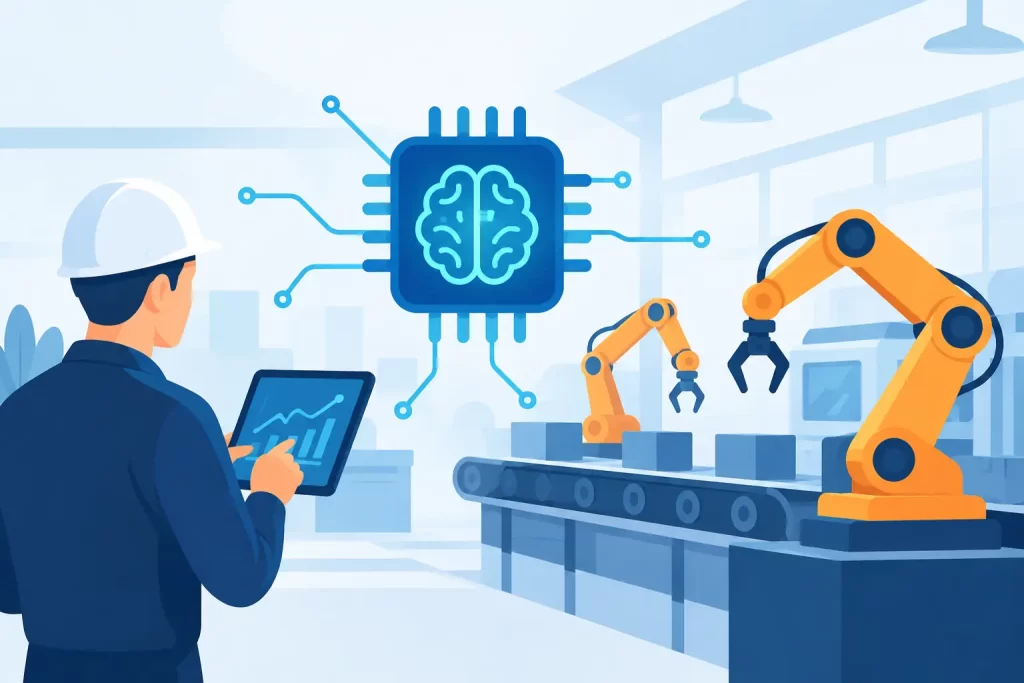
A production line does not have time to wait for a remote inference server when a damaged bearing changes its vibration signature or an unfamiliar surface defect appears in a camera frame. That is the practical answer to why use trainable neural hardware: it brings recognition and adaptation to the point where the signal is created, allowing an industrial system to act within the timing, power, and reliability limits of the machine.
For automation teams, the relevant question is not whether an AI model can achieve a strong benchmark score under controlled conditions. The question is whether the system can classify a live signal consistently, fit within an existing controller architecture, and remain serviceable after the production environment changes. Trainable neural hardware addresses that operational requirement differently from cloud-dependent analytics and general-purpose compute platforms.
Why Use Trainable Neural Hardware at the Edge?
Trainable neural hardware combines two functions that are often separated in conventional AI deployments: local learning and local recognition. A controller receives patterns from cameras, microphones, accelerometers, vibration sensors, or other sources, learns representative examples, and compares subsequent inputs against those learned patterns without sending every decision to a data center.
This matters when the source data is continuous and time-sensitive. A vibration sensor may produce a changing stream from a motor, gearbox, pump, or conveyor. An inspection camera may need to evaluate every part as it moves through a station. Audio monitoring may need to distinguish normal operation from a developing mechanical fault. In each case, delayed decisions can mean missed defects, unnecessary rejects, or equipment damage.
Edge deployment also reduces the dependency on network availability. Industrial networks are designed for control and safety first, not for carrying unfiltered video, audio, and high-frequency sensor data to a remote model. A local neural controller can make the immediate classification decision where the process runs, while higher-level systems retain only selected events, confidence information, trend data, or recordings for review.
Recognition latency becomes an engineering parameter
In a conventional architecture, raw data is acquired, packaged, transmitted, processed by a server or cloud model, and returned to the control system. Each stage introduces delay and possible variability. For monitoring applications, variable latency can be as problematic as average latency. A late fault notification has limited value if the machine has already moved beyond the point where intervention is possible.
Dedicated neural hardware shortens that path. Recognition is performed in the embedded controller or in a local server module close to the production system. The result can be passed directly to a PLC, supervisory application, alarm system, or machine control logic. This architecture supports deterministic integration even when the recognition task itself involves complex, free-form signals.
The objective is not merely faster AI. It is a shorter decision loop between sensing and action.
Train With Real Operating Conditions, Not Only Historical Data
Industrial signals rarely remain static. Lighting changes with seasons and maintenance work. A camera is repositioned. A new batch of material has a slightly different texture. A machine that is mechanically sound develops a new normal acoustic profile after a component replacement. Models trained only on a fixed historical dataset can require retraining, data labeling, and redeployment when these changes occur.
Trainable neural hardware is useful where operators or engineers need to establish new recognition classes near the machine. Instead of building a long data pipeline before any local adaptation is possible, the system can learn approved examples and recognize similar patterns during operation. This approach is particularly relevant for classification tasks where the required output is clear: acceptable versus unacceptable surface condition, normal versus abnormal vibration, known product type versus unknown item, or one acoustic event versus another.
That does not eliminate the need for disciplined data practices. Training examples must represent the range of normal variation that the system will encounter. A classifier taught only ideal examples can produce false alarms when operating conditions shift. Engineering teams still need acceptance criteria, test cases, recorded samples, and a process for validating recognition performance before a controller influences automated decisions.
The advantage is that these activities can happen closer to the operational problem. The learning cycle is measured in samples and machine behavior, rather than only in model-development iterations.
Hardware Architecture Changes the Deployment Equation
General-purpose CPUs and GPUs are valuable for development, large models, and broad analytics workloads. They are not automatically the best choice for every embedded recognition task. Their power draw, thermal requirements, operating-system dependencies, and software stack can be disproportionate when a machine needs focused classification from a limited set of sensor inputs.
Digital neural network hardware is designed to store learned patterns and perform comparisons directly in dedicated processing resources. The architecture is well suited to applications requiring high recognition throughput with low power consumption. Rather than repeatedly executing a large software model through a general compute pipeline, the controller performs pattern matching in hardware-oriented neural resources.
For an OEM or system integrator, this can simplify the physical design. A compact neural module can be added to an existing control cabinet, embedded computer, industrial PC, or sensor gateway without turning the application into a full server deployment. NeuroTechnologijos supports this approach with NT Adaptive formats including .VASS, PCIe, and Raspberry Pi-compatible hardware, allowing the neural function to match the host platform and integration constraints.
Deployment format is not a secondary choice
The right hardware format depends on where the recognition function belongs. A PCIe module can be appropriate when an industrial PC already manages acquisition and visualization. A standalone controller may better fit a distributed monitoring point where local I/O and independent operation are needed. An embedded board can serve an OEM design that must keep size, power, and bill of materials under control.
These choices affect maintenance as well as installation. Engineers should consider how training data will be introduced, how recognition results will be exposed to host software, how firmware and application logic will be managed, and what happens after a device replacement. Hardware selection is therefore part of the automation architecture, not a late procurement decision.
Multimodal Recognition Without a Cloud Bottleneck
Many industrial problems are not image-only problems. A machine can appear normal while its vibration spectrum indicates bearing wear. A packaging station may need image inspection plus acoustic confirmation that a mechanism completed its cycle. Material handling equipment may benefit from combining sensor states with video events. Trainable neural hardware provides a common recognition mechanism for images, live and recorded video, audio, vibration, and other unstructured signals.
A shared recognition approach does not mean every sensor should be forced into one model. Different signals require different acquisition rates, preprocessing methods, and decision thresholds. Video may need frame selection and region definition. Vibration may require windowing and feature preparation. Audio applications must account for background noise and microphone placement. The benefit is that a local platform can host the classification stage while allowing each sensing path to be engineered for its physical environment.
This is especially useful when the data itself is expensive to transport. Continuous high-resolution video and high-rate vibration streams can consume network capacity quickly. Processing locally means the network carries decisions and selected evidence rather than every raw sample.
Where Trainable Neural Hardware Delivers the Most Value
The strongest use cases have three characteristics: recognition must occur quickly, the signal originates near the machine, and operational conditions make centralized processing costly or unreliable. Surface defect detection, product sorting, machine condition monitoring, vibration-acoustic fault classification, access or object recognition, and event detection in live video all fit this profile.
There is also value in applications with limited labeled data. A facility may not possess thousands of examples for every abnormal condition, particularly for rare defects or faults. A trainable controller can be practical when a small set of representative patterns is sufficient for the required classification boundary. However, rare-event detection remains challenging. If the cost of a missed event is high, engineers should design conservative thresholds, use secondary rules or sensors, and validate the system against realistic failure modes.
Trade-Offs to Evaluate Before Selecting a Platform
Trainable neural hardware is not a replacement for every AI architecture. Large-scale vision models, complex language processing, fleet-wide optimization, and extensive historical analysis may be better handled by server or cloud infrastructure. In many facilities, the most effective design is hybrid: local hardware handles real-time recognition, while central systems store events, compare long-term trends, and coordinate updates across sites.
Model capacity is another consideration. Dedicated neural controllers are optimized for fast recognition of learned patterns, but capacity is finite. The number of categories, examples per category, input representation, and expected variation should be defined before deployment. A system that must distinguish a few well-characterized operating states has different requirements from one intended to recognize hundreds of visually similar products.
Integration must be evaluated at the same level of rigor. Confirm sensor interfaces, host connectivity, protocol support, enclosure conditions, power budget, electromagnetic environment, and fail-safe behavior. Recognition output should have a clear role in the control strategy. An alarm may be appropriate for an early deployment, while automatic rejection or machine shutdown may require additional validation, redundancy, and safety engineering.
The most useful starting point is a bounded operational decision: identify one signal, one recognition outcome, the required response time, and the cost of an incorrect result. From there, trainable neural hardware can be assessed as an engineering component that turns live machine data into local action, rather than as a broad AI experiment.
