

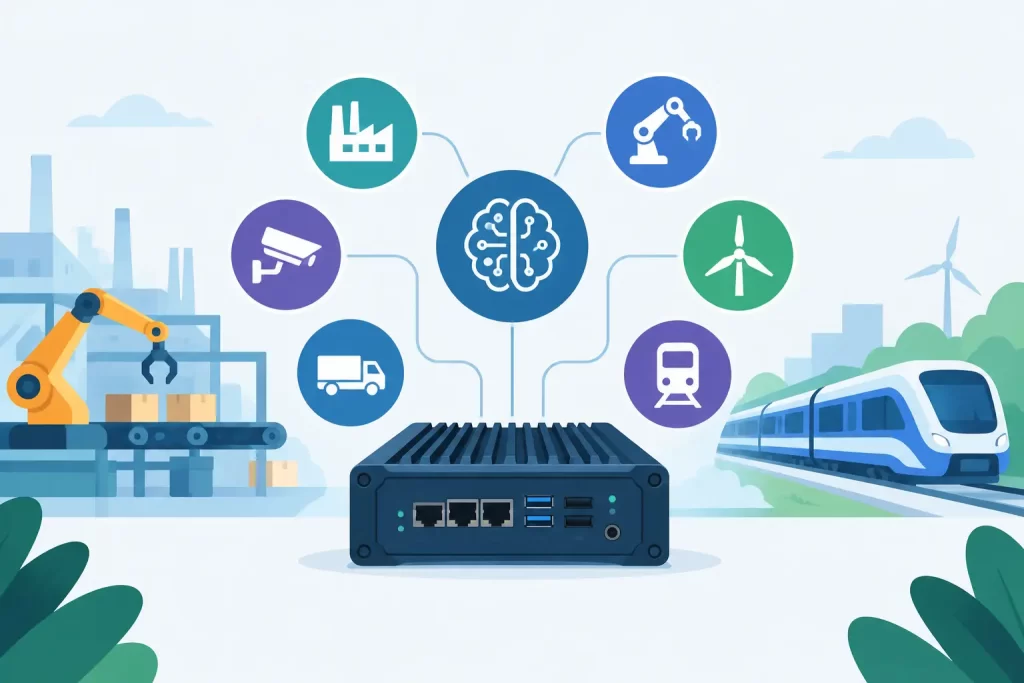
A camera identifies a surface defect. A vibration sensor detects an abnormal bearing signature. An acoustic channel captures a change in motor noise. In each case, the useful decision has to occur before the product moves downstream or the equipment reaches a damaging condition. Essential edge inference features determine whether an AI system can make that decision locally, within the available latency, power, and integration limits of an industrial installation.
Cloud analytics remains useful for fleet-level reporting, model development, and long-term data retention. It is not always the right execution layer for machine protection, sorting, inspection, or closed-loop control. Network availability, bandwidth costs, data governance, and response time can make remote-only inference impractical. The edge controller must therefore be evaluated as an operational component, not simply as a smaller server.
Essential Edge Inference Features Start With Deterministic Response
For industrial AI, average inference speed is less useful than bounded response time. A system that processes most frames quickly but periodically stalls can miss a defect, delay a reject signal, or disrupt a synchronized motion sequence. Engineers should examine end-to-end latency from signal acquisition through preprocessing, classification, decision logic, and output activation.
The acceptable latency depends on the process. A slow-changing condition-monitoring application may tolerate seconds between decisions. High-speed visual inspection or safety-adjacent equipment monitoring may require response times measured in milliseconds. The inference engine must sustain the required rate continuously, rather than reaching it only in a benchmark using ideal input data.
Determinism also depends on architecture. General-purpose processors can be effective when workloads are modest or model flexibility is the primary concern. However, operating-system scheduling, background services, thermal throttling, and variable memory access can introduce timing variation. Purpose-built neural hardware can reduce this uncertainty by keeping recognition operations close to the sensor and limiting dependence on resource-intensive software stacks.
Recognition throughput should be assessed alongside latency. A controller might classify one input rapidly but fail when several cameras, microphones, or vibration channels are active at once. Industrial specifications should state the expected input rate, feature size, number of classes or prototypes, and concurrent channels. Without that context, a speed claim is difficult to apply to a production line.
Low-Power Operation Is a System Requirement
Power consumption affects more than electricity use. It influences enclosure design, heat dissipation, component lifetime, battery feasibility, and where an AI controller can physically be installed. A compact device mounted near a sensor, inside an electrical cabinet, or on mobile equipment cannot assume the cooling capacity of a data center.
Low-power edge inference is particularly valuable when sensing is distributed across a facility. Consider dozens of vibration-monitoring nodes on pumps, motors, conveyors, and compressors. A high-power compute device at every measurement point increases wiring, cooling, and maintenance demands. An efficient controller makes a distributed architecture more realistic.
Engineers should distinguish active inference power from total operational consumption. Idle power, startup behavior, peak current, peripheral interfaces, storage activity, and temperature effects all matter. The intended duty cycle matters as well. A system that wakes periodically to classify a vibration sample has different requirements from a vision controller analyzing a continuous stream.
Low power is not an isolated goal. Aggressive power reduction can limit model capacity, input resolution, or output frequency. The appropriate target is sufficient recognition performance at the lowest practical energy cost for the specific sensing task.
Trainability Must Fit the Industrial Signal
Many industrial recognition problems do not begin with a large, clean, labeled dataset. A site may have only a limited set of known defect examples, and the normal operating state can vary by product, machine speed, material lot, ambient noise, or sensor placement. Edge inference platforms need a practical way to represent these conditions and update recognition behavior when the process changes.
Trainability at the edge can mean different things. In some systems, models are trained centrally and deployed to controllers. In others, an operator or engineer can teach reference patterns directly at the device. The latter approach is useful when each installation has its own acoustic signature, visual appearance, or vibration baseline.
A trainable neural controller should support clear separation between acquisition, training, validation, and live decision-making. Operators need to know what patterns were learned, what class or condition was assigned, and how the controller responds to unfamiliar inputs. If retraining requires an AI specialist and a long cloud workflow for every process adjustment, the system may be technically capable but operationally difficult to maintain.
Feature handling is equally important. Vision, audio, vibration, and other free-form signals have different preprocessing requirements. The controller or supporting software should provide a defined path from raw sensor data to the representation used for recognition. Hidden transformations make troubleshooting difficult when field performance differs from laboratory results.
Reliability Requires More Than Model Accuracy
A high validation score does not guarantee dependable operation on a factory floor. Lighting changes, lens contamination, electrical noise, mechanical vibration, sensor aging, and shifts in product presentation all affect input quality. The edge system must identify, tolerate, or report conditions that reduce confidence in its output.
Useful reliability features include input-quality checks, confidence thresholds, fault reporting, event logging, and defined fallback states. For example, an inspection controller may route uncertain parts to manual review instead of automatically passing them. A condition-monitoring system may flag an unknown signal pattern for investigation rather than forcing it into a known fault class.
Industrial deployment also requires predictable behavior after power loss, communication interruption, or system restart. Local inference should continue when a supervisory server is unavailable if the process depends on immediate decisions. At the same time, logs and stored examples should be available for later analysis when connectivity returns.
Hardware selection matters here. Industrial environments may demand tolerance for temperature variation, electrical interference, vibration, and long service intervals. The AI subsystem has to fit the reliability expectations of the surrounding automation equipment, including power supplies, I/O modules, sensors, and enclosures.
Interfaces Determine Whether the Controller Can Be Used
An edge AI system creates value only when its decision reaches the equipment that needs it. That requires compatible sensor inputs, industrial I/O, host interfaces, and software integration paths. A technically strong classifier that cannot exchange data with a PLC, industrial PC, camera, or existing control application creates unnecessary engineering work.
The required form factor depends on the deployment architecture. A server-connected controller may suit centralized multi-sensor analysis. A PCIe device can fit an industrial computer already used for machine control or vision processing. A compact embedded board can be appropriate where inference must sit directly beside the sensor. NeuroTechnologijos supports these different integration approaches through dedicated formats including server-attached, PCIe, and Raspberry Pi-based controller options.
Interoperability should also include the operational data path. Engineers need a way to configure classes, load trained patterns, monitor decisions, capture examples, and diagnose abnormal behavior. Where a system includes multiple recognition points, version control for learned models and configuration settings becomes necessary. Otherwise, two machines performing the same inspection may gradually behave differently without a clear record of why.
Security is part of integration, particularly when controllers connect to plant networks. Access controls, defined update procedures, network segmentation, and auditable configuration changes reduce the risk that a maintenance action or unauthorized connection changes recognition behavior in production.
Evaluate the Feature Set Against the Failure Mode
The best evaluation begins with the process failure that the AI system must prevent or detect. For defect inspection, define the smallest relevant defect, line speed, lighting range, camera position, and reject timing. For predictive maintenance, define the fault signatures, normal operating variations, sampling rates, false-alarm tolerance, and required warning interval.
Then test the controller with production-like data. Include dirty lenses, shifted sensor positions, background noise, load changes, and borderline examples. Test restarts and communication loss. Measure not only classification accuracy but also response time, missed events, false actions, power draw, and operator effort required to maintain the system.
This approach often reveals trade-offs early. A larger model may improve discrimination between similar conditions but exceed the response-time budget. A lower-resolution image may run faster but miss small defects. Local retraining may reduce commissioning time but require stronger controls around who can change the learned pattern set. There is no universal configuration, only an engineering fit between the inference platform and the process.
The useful edge controller is the one that makes a correct decision at the point where a delay, network dependency, or excess power budget would otherwise compromise the operation. Start with the physical process, specify the timing and failure conditions, and select features that remain dependable when the line is running rather than when the demonstration is staged.
