

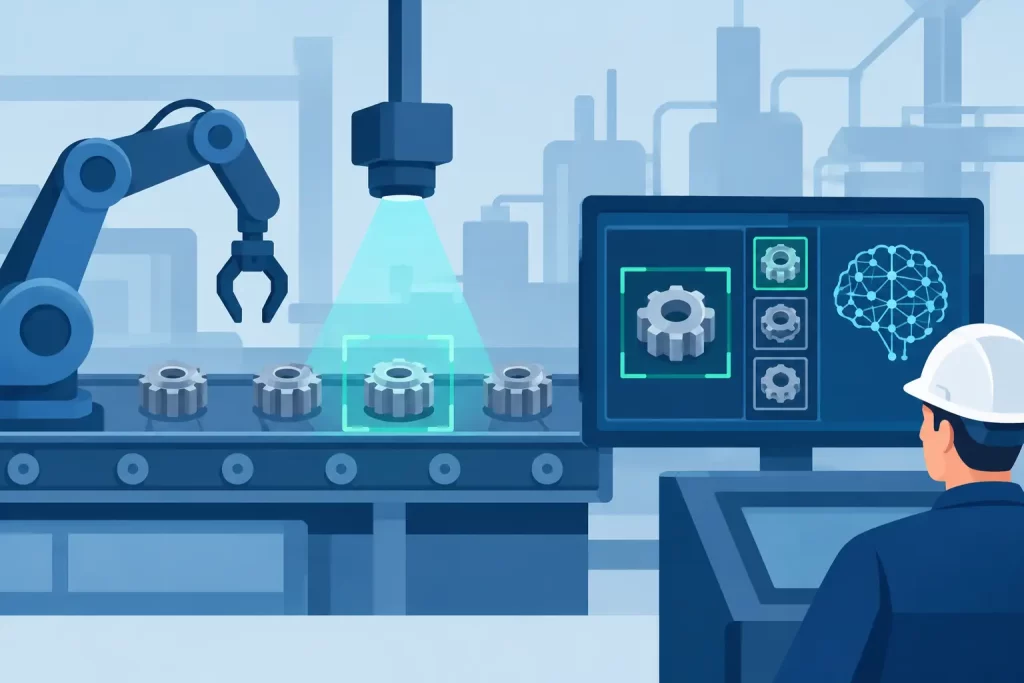
A bearing does not announce its failure in a maintenance log. It begins as a small shift in vibration energy, an intermittent acoustic signature, or a visual change that is easy to miss at line speed. Embedded pattern recognition gives industrial equipment a way to identify these changes where signals are produced, then issue a usable decision within the timing and power limits of the machine.
For automation engineers, the value is not simply adding AI to a sensor. It is creating a deterministic recognition path between a live signal and an action: classify a defect, flag an abnormal condition, reject a part, stop a process, or pass a result to a PLC, SCADA system, or supervisory application. The design must work continuously, tolerate electrical and environmental constraints, and remain practical to train and maintain.
What Embedded Pattern Recognition Actually Does
Embedded pattern recognition is the local classification of patterns from sensor data using hardware and software installed in, or close to, the monitored system. Inputs may include camera frames, recorded or live video, microphones, accelerometers, current sensors, pressure sensors, and other free-form analog or digital signals. Rather than transmitting every sample to a remote server for interpretation, the embedded controller evaluates the incoming data and returns a recognition result locally.
The result can be binary – acceptable or defective, normal or abnormal – but industrial deployments often require more useful categories. A system may distinguish among several product variants, identify different surface-defect types, recognize machine states, or assign vibration patterns to known fault conditions. The recognition output can include a category, confidence measure, timestamp, location, and associated process data.
This approach differs from conventional threshold monitoring. Thresholds are effective when a single measured value has a clear limit. They become less reliable when condition depends on relationships across frequencies, time windows, visual features, or multiple sensors. A motor may remain within its nominal temperature range while its vibration spectrum has already shifted toward a recognizable fault pattern. A camera may see a part whose overall dimensions are correct but whose texture indicates contamination.
Why Recognition Must Run at the Edge
Industrial processes are constrained by cycle time, network availability, data volume, and control-system safety. A high-speed inspection camera or acoustic sensor can generate more data than it is sensible to store or transmit continuously. Sending raw data off-site also introduces variable latency and makes the recognition path dependent on network conditions that are outside the machine’s control.
An embedded architecture keeps the first decision near the source. The controller acquires or receives the signal, applies any required conditioning, evaluates the learned pattern, and communicates the result through the interfaces used by the automation system. Only selected events, summaries, images, or diagnostic records need to move to server storage.
Low latency is not the only benefit. Local processing reduces bandwidth use and can simplify data-governance decisions when camera images, proprietary production details, or sensitive operational data are involved. It also allows monitoring to continue during intermittent connectivity. That does not eliminate the need for centralized systems. Server applications remain useful for fleet-level analysis, long-term trending, audit trails, model governance, and access to recorded data. The engineering decision is about where each function belongs.
The Recognition Pipeline Is More Than a Model
A dependable embedded implementation begins with signal definition. Engineers need to establish what constitutes a meaningful observation, how long the observation window should be, what sample rate is necessary, and how much natural variation is expected. These choices determine whether the controller receives information that separates classes rather than a stream of noise.
For image applications, this may mean controlling illumination, field of view, trigger timing, and part positioning. For vibration and audio, it may mean choosing sensor placement, mounting method, anti-alias filtering, sampling rate, and synchronization with operating speed or load. Poor acquisition cannot be corrected reliably by a more complex classifier.
The second stage is representation. Some systems classify raw or lightly conditioned signals directly. Others use derived forms such as spectral features, time-frequency maps, envelope signals, regions of interest, or selected image features. The appropriate representation depends on the failure mechanism and on the processing resources available. A repeating impact fault in rotating equipment may be clearer in an envelope spectrum than in the unprocessed waveform. A label-reading application may need image normalization and region selection before recognition.
The classifier then compares the observation with learned categories. Trainable digital neural network controllers are particularly useful when engineers need to establish recognition behavior from examples without building a large cloud-trained model for every variation. A representative set of labeled examples can teach known conditions, product types, or defect classes. The controller can then return a category at high speed with predictable local execution.
Finally, the output must be converted into an operational decision. A recognition result does not automatically justify stopping a production line. Control logic may require persistence across several samples, a confidence threshold, a comparison with process state, or escalation rules. For example, a single anomaly may create an inspection record, while repeated anomalies within a defined interval trigger a machine alarm. Separating recognition from action logic makes the system easier to validate and tune.
Where Embedded Pattern Recognition Fits Best
The strongest use cases have three characteristics: a recognizable signal pattern, a decision that benefits from immediate response, and an operating environment where moving all raw data is undesirable or impractical. Common industrial examples include:
- Visual inspection of assembly presence, orientation, surface condition, markings, packaging, and component identity.
- Vibration and acoustic classification for rotating machinery, pumps, gearboxes, fans, compressors, and cutting tools.
- Signal-based monitoring of electrical loads, process cycles, valve activity, pressure behavior, and actuator performance.
- Automated sorting and quality control where objects or conditions must be identified within a fixed cycle time.
The same hardware concept can serve very different sensing modes. A controller deployed with a camera may classify visual conditions; deployed with an acquisition chain, it may recognize audio or vibration signatures. This multimodal flexibility matters to OEMs and integrators that need a common local intelligence architecture across machine families.
NeuroTechnologijos applies this approach through trainable NT Adaptive controllers and hardware formats suited to standalone, PCIe, and Raspberry Pi-based integration. The right form factor depends on the host system, available interfaces, environmental requirements, and whether recognition must operate as an independent controller or as an accelerator inside a larger application.
Engineering Trade-Offs That Affect Results
Embedded recognition is not a substitute for system engineering. It works best when the classification task is bounded and measurable. A controller can rapidly recognize categories it has been trained to distinguish, but it cannot reliably identify every unknown condition without a plan for novelty handling. In critical monitoring applications, an unknown or low-confidence state should usually be handled explicitly rather than forced into a known class.
Training data is another practical constraint. Examples should cover expected operating variation: acceptable product variation, lighting shifts, machine speeds, loads, sensor-to-sensor differences, and realistic fault progression. Collecting only clean laboratory data can produce impressive test results and disappointing line performance. Conversely, gathering excessive data without clear labels can slow deployment without improving category separation.
There is also a trade-off between sensitivity and nuisance alarms. A defect detector tuned for maximum sensitivity may reject acceptable parts or generate maintenance alerts too frequently. A heavily filtered detector may miss early-stage faults. The right setting depends on the cost of a missed event, the cost of a false event, the ability to verify alarms, and the process response available.
Compute architecture matters as well. General-purpose processors offer flexibility, particularly for complex pre-processing and broader application logic. Dedicated neural hardware can provide lower power use and fast, repeatable recognition for trained categories. Many industrial systems use both: a specialized recognition device for local inference and a host processor for visualization, communication, storage, configuration, and business logic.
A Deployment Method That Reduces Rework
A productive project starts with a measurable decision, not with a model selection exercise. Define the classes, required response time, allowed false-positive and false-negative rates, process action, and acceptance test before collecting data. This establishes whether the application needs visual recognition, acoustic classification, vibration monitoring, or a combined sensing approach.
Next, validate acquisition at the intended installation point. Record signals during normal production and during known conditions of interest. Evaluate repeatability across shifts, operators, machines, and environmental changes. If the signal does not separate conditions consistently, adjust sensing and process controls before expanding the training set.
Train and test with data that has not been used to configure the system. Then test the full path: sensor trigger, acquisition, classification, controller output, PLC response, alarm handling, and event recording. Recognition accuracy alone is not a complete performance measure. A system that classifies correctly but misses the process window has not met the requirement.
After commissioning, retain selected examples and outcomes for review. These records support periodic retuning, investigation of rejected parts, and recognition of drift caused by wear, material changes, new suppliers, or altered production conditions. The goal is controlled adaptation, not uncontrolled model changes on a live line.
The most useful embedded recognition system is the one that turns a difficult signal into a timely, explainable machine decision. Start with the physical behavior you need to detect, design the sensing path around it, and make the local output fit the way operators and control systems already work.
