

A vibration signature that indicates bearing wear rarely looks identical from one machine to the next. The same is true for surface defects, acoustic events, packaging faults, and camera images captured under changing lighting. That operational variability is why use trainable pattern recognition is a practical engineering question, not an abstract AI discussion. Industrial systems need to recognize what matters in the signals they actually produce, at the speed and location where decisions are required.
Why Use Trainable Pattern Recognition in Industrial Systems?
Traditional automation is highly effective when conditions are fixed. A threshold can flag temperature above a limit. A rule can reject a part that fails a dimensional measurement. But many production and monitoring problems are not defined by a single value or a stable rule. They are defined by a pattern distributed across time, frequency, pixels, amplitude, or several sensor channels.
Trainable pattern recognition allows an engineer to provide representative examples of known conditions and build a classifier around those examples. Instead of specifying every mathematical feature and every possible exception in code, the system learns the distinguishing characteristics of the supplied patterns. This is particularly useful when the difference between normal and abnormal operation is visible to an experienced technician but difficult to express as a deterministic rule.
For an industrial buyer, the value is not simply that a system uses neural processing. The value is reduced dependence on long rule chains, faster adaptation to a specific process, and recognition that can be deployed close to the sensor. A controller can classify an incoming signal and pass a decision to a PLC, supervisory system, actuator, or alarm path without waiting for a remote service to respond.
Fixed Rules Still Have a Place
Trainable recognition does not replace conventional control logic. Thresholds, interlocks, safety circuits, and deterministic sequencing remain essential. The better architecture often combines them: deterministic automation handles known limits and process states, while a trainable classifier interprets complex sensory evidence that does not fit a simple rule.
For example, a vibration monitor may use a hard shutdown limit for dangerous amplitude while a trainable classifier distinguishes normal operating modes from early-stage imbalance, looseness, or bearing-related signatures. The threshold protects the machine immediately. Pattern recognition supplies earlier, more specific information for maintenance planning.
Train the Recognition System Around the Real Process
The central advantage of trainable pattern recognition is that the classifier can be taught using data from the installed environment. That matters because industrial data is shaped by machine geometry, sensor mounting, material variation, ambient noise, lens selection, illumination, product mix, and operating speed.
A generic model trained elsewhere may be a useful starting point, but it can also carry assumptions that do not hold on a particular line. An edge-based trainable controller gives the integration team a way to capture representative signal examples, label relevant categories, train the recognition behavior, and validate results against known conditions.
The training set does not need to be large merely for the sake of being large. It needs to represent the variation the controller will encounter. For a visual inspection task, that can include acceptable part orientation, normal cosmetic variation, reflective surfaces, and common defect types. For an acoustic classification task, it can include production noise, shifts in load, nearby equipment, and the sounds associated with the event of interest.
This approach also supports incremental improvement. When a new product variant, machine component, or operating mode is introduced, engineers can collect examples and assess whether the existing classes remain distinct. If they do not, the classifier can be retrained with the additional patterns rather than requiring a complete redesign of a rule-based inspection system.
Why Trainable Pattern Recognition Belongs at the Edge
A classifier is only useful if it delivers a decision within the process window. In a high-speed inspection cell, a delayed defect decision may arrive after the part has moved beyond the rejection station. In condition monitoring, data sent to a centralized platform may lose its immediate diagnostic value if connectivity is interrupted or latency is inconsistent.
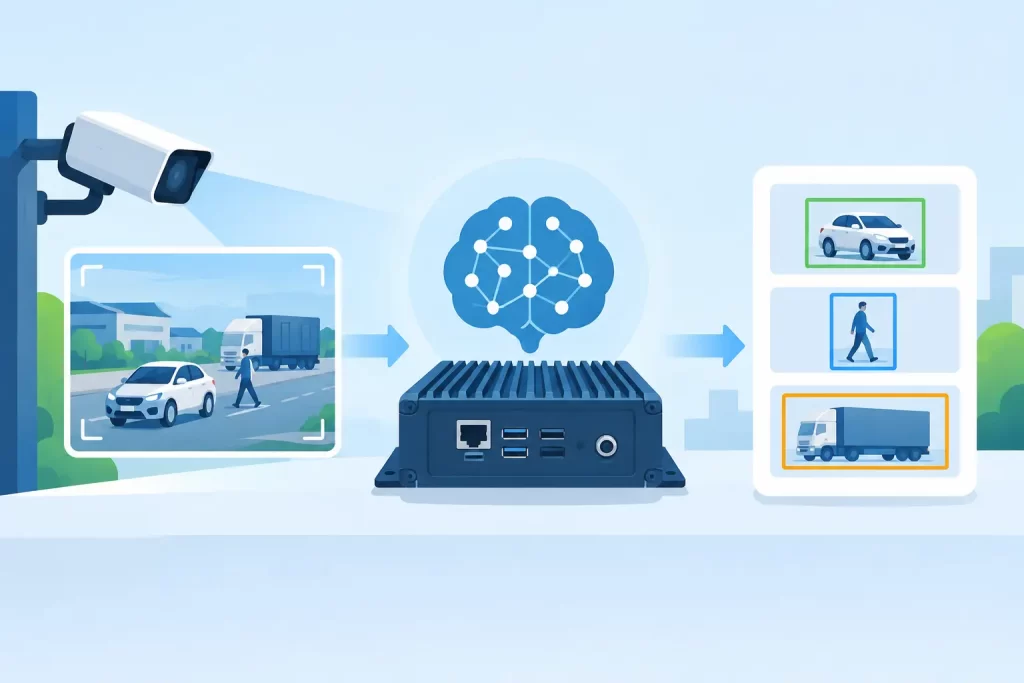
Edge deployment places recognition near the camera, microphone, accelerometer, or other sensor interface. This reduces the amount of raw data that must leave the machine and allows local systems to act on recognition results in real time. It can also simplify integration where network capacity is limited, data retention is restricted, or equipment must operate independently from cloud availability.
Low-power embedded processing is an equally important consideration. Many industrial monitoring points are distributed across equipment, and a recognition architecture that requires a high-wattage server or continuous video streaming for every sensing location may be impractical. Purpose-built neural hardware can perform classification with a smaller power and infrastructure footprint than a general-purpose compute stack sized for heavier model workloads.
NeuroTechnologijos applies this architecture through NT Adaptive controllers and supporting software that process images, video, audio, vibration, and other free-form signals. Available formats, including standalone, PCIe, and Raspberry Pi-compatible options, allow system designers to select an integration path that fits the existing control cabinet, industrial PC, or embedded equipment design.
Where the Technology Produces Measurable Value
Trainable recognition is most useful when patterns are meaningful but difficult to define exhaustively. The following applications share that characteristic:
- Visual inspection of surface defects, assembly presence, marking quality, object category, or packaging condition.
- Vibration and acoustic classification for machine condition monitoring, anomaly detection, and operating-state identification.
- Video-based recognition of process events, motion states, occupancy, or material flow conditions.
- Classification of sensor waveforms from electrical, hydraulic, pneumatic, or other process signals.
The common requirement is not a specific sensor type. It is the need to convert unstructured sensory data into a repeatable industrial decision. A useful output may be a class label, confidence value, alarm condition, reject command, or state signal supplied to the wider automation system.
The Trade-Offs Engineers Should Evaluate
Trainable pattern recognition is not a substitute for disciplined system design. Its performance depends on sensor quality, representative training examples, stable class definitions, and validation under real operating conditions. A poorly positioned accelerometer or inconsistent illumination can reduce recognition quality regardless of the classifier selected.
False positives and false negatives must also be evaluated in the context of the process. For a quality inspection station, false rejects affect yield and operator workload. Missed defects affect product quality and downstream cost. For predictive maintenance, an early warning may justify inspection, while an automatic shutdown may require a much higher confidence threshold and independent protective logic.
Class design is another practical constraint. Categories should map to actions that operators or control systems can take. If two fault modes require the same response, separating them may add training effort without operational value. Conversely, combining categories that demand different interventions can make the recognition output less useful than it should be.
Finally, process drift needs a defined maintenance path. Changes in materials, tooling, sensor placement, lighting, or production speed can alter the incoming patterns. A trainable system is well suited to adaptation, but only when teams periodically review samples, log exceptions, and update the trained categories when justified by evidence.
A Practical Deployment Sequence
Start by defining the decision, not the model. Specify what the system must recognize, how quickly it must respond, and what action follows each result. This prevents a monitoring project from collecting large volumes of data without a clear automation objective.
Next, select sensing hardware and collect examples during representative production conditions. Include normal variation as deliberately as fault examples. Then train the recognition categories, test them against data not used during training, and measure results at the required decision threshold.
The final integration stage should connect recognition outputs to the existing industrial environment through the appropriate I/O, industrial PC interface, or control software layer. Before production release, test communication failures, sensor disconnection, unexpected input patterns, and fallback behavior. Recognition should improve the control system without creating uncertainty about how the equipment behaves when data is unavailable.
The strongest trainable recognition projects begin with a narrow, high-value decision: identify this defect before packing, detect this acoustic event before damage spreads, or classify this machine state before it becomes downtime. Once that decision is reliable at the edge, it becomes a foundation for broader monitoring and automation.
