

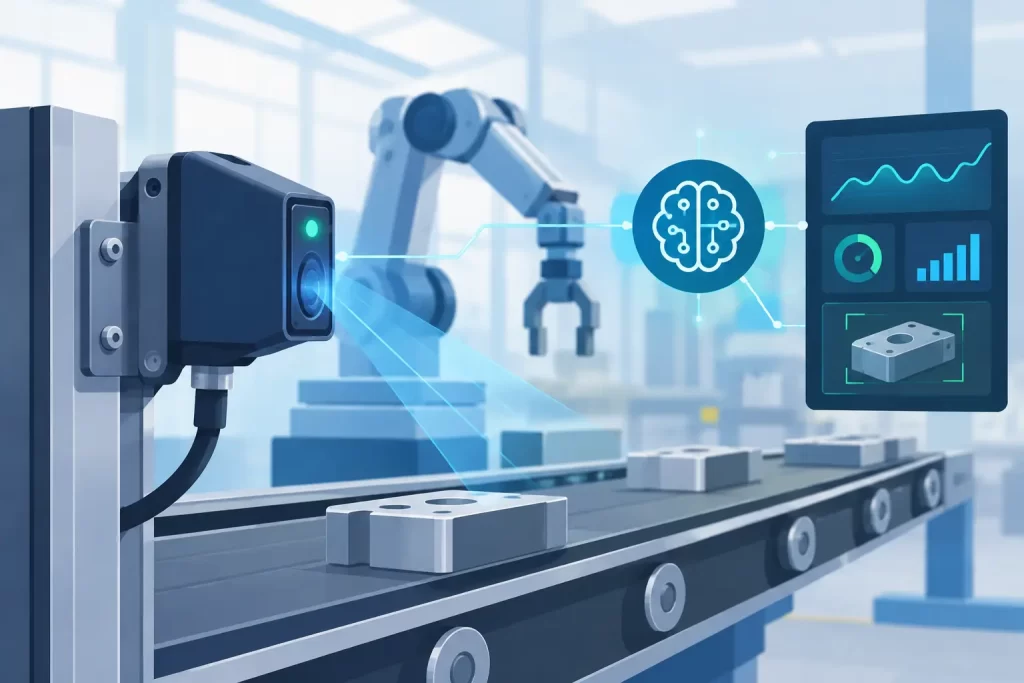
A camera can capture a defect, a microphone can capture bearing noise, and an accelerometer can capture vibration long before a conventional control system identifies a problem. The limiting factor is often not the sensor itself. It is the time, power budget, and computing architecture required to turn raw input into an actionable decision. AI sensor hardware addresses that gap by placing trained recognition capability close to the signal source.
For industrial automation teams, this is not simply a matter of adding AI to a sensor network. The hardware must acquire signals reliably, execute recognition within a known response window, communicate with existing controls, and continue operating under real production conditions. The right architecture depends on the signal, the required decision speed, the available interfaces, and the cost of a missed event.
What AI Sensor Hardware Actually Includes
AI sensor hardware is the physical computing layer that connects sensing to machine recognition. It may sit inside a camera system, next to an acoustic sensor, on a machine cabinet rail, inside an embedded device, or in an industrial PC. Its job is to receive data, prepare it for analysis, execute a trained recognition model, and return a result that a control system can use.
That definition matters because a sensor and an AI controller perform different jobs. A sensor measures light, sound, acceleration, temperature, current, or another physical property. An AI-enabled controller classifies patterns within that measurement. For example, a vibration sensor can report amplitude at defined frequencies. A trained controller can determine whether the resulting pattern is consistent with normal operation, imbalance, misalignment, bearing damage, or an unknown condition that requires inspection.
In practical systems, the hardware path often includes signal acquisition, filtering or feature preparation, neural recognition, decision logic, and industrial communications. The elements may be packaged together or distributed across devices. A machine vision inspection station, for example, may combine image capture and recognition in one enclosure, while a larger production cell may send camera streams to a local server fitted with an accelerator card.
Why Edge Processing Changes the System Design
Cloud-based analysis can be useful for centralized reporting, fleet-level learning, and archival review. It is less suitable when a decision must be made in milliseconds, when network availability is uncertain, or when continuous raw data transfer is impractical. Sending every video frame, audio sample, or vibration trace to a remote platform also creates bandwidth, retention, and security considerations.
Edge AI sensor hardware keeps the recognition loop local. The sensor data is processed near the machine, and the output can be a classification, a confidence level, an alarm, a count, or a control command. This reduces dependence on external connectivity and limits the volume of data that must leave the operational environment.
Low latency is only one advantage. Local processing can produce more predictable timing because the recognition path does not depend on network congestion or cloud service response. For applications such as high-speed sorting, defect rejection, access recognition, or machine shutdown interlocks, predictability can be as important as average inference speed.
There are trade-offs. Centralized systems can offer more compute capacity for large models and can simplify access to historical data across multiple sites. Edge systems require appropriate hardware selection at each deployment point and a clear process for updating trained recognition patterns. The strongest architecture is often hybrid: immediate recognition at the edge, with selected results and representative data forwarded for engineering review.
Recognition Hardware Is Not General-Purpose Compute
A general CPU can run machine learning workloads, but it is not always the best fit for continuous industrial recognition. Its performance may vary with operating system activity, concurrent applications, and software dependencies. Graphics processors offer high throughput for many workloads, but their power draw, thermal requirements, and deployment complexity may exceed what an embedded application needs.
Dedicated neural hardware takes a different approach. It is designed to execute recognition operations efficiently and with a defined hardware footprint. Digital neural network chips such as NeuroMem devices are particularly relevant where rapid pattern recognition and low power consumption are required without relying on a large software stack. The value is not only speed. It is the ability to bring trainable recognition into equipment that has limited space, power, cooling, or maintenance access.
Selecting AI Sensor Hardware for the Signal
The first engineering question is not which accelerator has the highest benchmark number. It is what must be recognized and how the decision will be used. Image inspection, acoustic classification, vibration monitoring, and mixed-signal control each impose different requirements on acquisition, preprocessing, timing, and interface design.
For vision, evaluate image resolution, frame rate, lighting variation, lens geometry, trigger timing, and the number of objects that must be assessed per cycle. A recognition controller may be fast enough, but the complete inspection cycle can still fail if image capture is inconsistent or if illumination changes shift the appearance of an acceptable part.
For audio and vibration, sampling rate and sensor placement are decisive. A bearing fault can produce a subtle spectral signature that is easily obscured by machine structure, mounting quality, or nearby equipment. The controller must receive a signal with sufficient fidelity before training can produce a useful classifier. In these applications, machine state also matters. A pattern that is normal during ramp-up may be abnormal at steady operating speed.
Integration requirements deserve equal attention. Industrial deployments may need discrete I/O for immediate signaling, Ethernet or serial communications for supervisory systems, PCIe for host-based processing, or compact embedded formats for OEM equipment. Power supply tolerances, enclosure design, electromagnetic conditions, temperature range, and service access should be defined before hardware is selected.
Trainable Controllers Fit Changing Production Conditions
Many industrial recognition tasks cannot be fully described with fixed thresholds. A surface defect may vary in shape and position. A machine may produce a normal acoustic signature that changes slightly between product variants. A process condition may emerge as a combination of features rather than one measurement exceeding a limit.
Trainable neural controllers are useful in these cases because they learn representative patterns rather than relying solely on manually coded rules. During training, engineering teams provide examples of acceptable and unacceptable states. The controller associates new input patterns with the learned categories and returns the closest recognized result.
This does not remove the need for engineering discipline. Training examples must represent expected operating variation, including changes in lighting, material batches, tool wear, speed, and background noise. Classes must be defined in a way that supports an operational decision. A category labeled “abnormal” may be useful for early warning, while maintenance planning may require separate categories for imbalance, looseness, and bearing wear.
Unknown-pattern handling is also essential. A controller should not be forced to classify every new signal as one of the known classes. In production, a low-confidence or unfamiliar result can be routed to inspection, data logging, or a safe fallback action. That approach prevents a recognition system from creating false certainty when the process has changed.
Deployment Formats Determine Integration Cost
The same recognition engine can be deployed in different hardware formats depending on the machine architecture. A self-contained controller is appropriate when sensing and decisions must remain local. A PCIe card can add neural acceleration to an industrial computer or server that already manages multiple cameras or signal channels. A compact embedded board can support lower-footprint systems, prototypes, or OEM designs that require direct integration with a host platform.
NeuroTechnologijos applies this principle through NT Adaptive controller formats including .VASS, PCIe, and Raspberry Pi implementations. The purpose of multiple form factors is not product variety for its own sake. It allows system integrators to place the recognition function where it best fits the existing control architecture, from standalone equipment to host-managed automation systems.
Hardware selection should therefore begin with deployment constraints. If the system needs to inspect several high-rate streams in one location, host-based acceleration may be appropriate. If it needs to make one fast decision beside a conveyor or motor, a dedicated local controller can reduce wiring and response time. If the goal is to embed recognition inside a new machine, board-level integration may provide the most efficient path.
Validate the Entire Recognition Chain
An AI sensing project is complete only when the full chain has been tested under operating conditions. Offline accuracy on a curated data set is useful, but it does not prove production performance. Validation should include live sensor behavior, realistic timing, electrical noise, communication delays, machine-state variation, and the action taken after a recognition result.
Measure false accepts, false rejects, unknown classifications, and decision latency. Review performance by operating condition rather than relying on one aggregate accuracy figure. A system that performs well on daytime images but fails under a lighting shift, or correctly identifies bearing noise only at one motor speed, is not ready for unattended control.
The final design should also define how new examples enter the training process and how approved recognition updates are released. Industrial AI hardware delivers its best value when recognition remains traceable, testable, and tied to a specific operational response.
The useful question is not whether a sensor can produce more data. It is whether the hardware can recognize the right pattern fast enough to change what the machine does next.
