

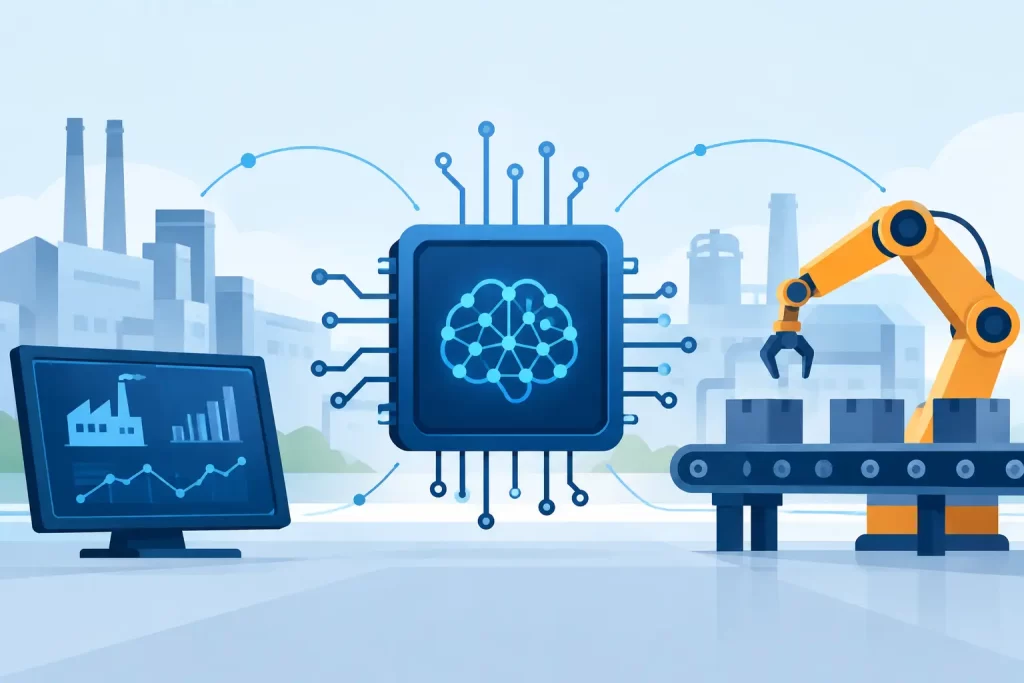
A production line does not have time to wait for a remote server to decide whether a surface defect is real, whether a bearing signature has changed, or whether an alarm sound requires action. Adaptive neural hardware places trained recognition directly beside the sensor and control system, where decisions can be made within the timing, power, and connectivity limits of the equipment.
For industrial automation teams, this changes the design question. Instead of asking how much data can be sent to a cloud model, engineers can ask which patterns must be recognized locally, how quickly an output must be produced, and how the controller will integrate with existing PLCs, cameras, microphones, and condition-monitoring equipment.
What adaptive neural hardware does
Adaptive neural hardware is dedicated computing equipment designed to recognize learned patterns from sensor data at the edge. The term adaptive matters because the recognition behavior is trainable. A controller can be taught examples of acceptable and unacceptable products, normal and abnormal machine states, or relevant and irrelevant acoustic events without requiring a conventional software development cycle for every classification rule.
This approach differs from fixed-function signal processing. A threshold rule can identify a vibration level above a specified amplitude. A trainable neural controller can distinguish between vibration signatures that have similar amplitudes but different frequency structure, timing, or combinations of features. That distinction is often what separates a useful maintenance alert from a stream of nuisance alarms.
The hardware also differs from a general-purpose AI server. Server-class GPUs can support complex training and high-throughput inference, but they introduce power, cooling, operating-system, and integration requirements that do not fit every machine enclosure. Dedicated neural hardware is intended for recognition workloads that must run continuously near the source of data.
Why edge recognition is an industrial architecture decision
Edge AI is frequently described as a latency benefit. Latency is important, but it is only one factor. In an operating plant, local recognition also reduces dependence on network availability, limits the volume of raw data moving across the network, and keeps a detection loop close to the actuator or supervisory controller.
Consider visual inspection of a moving assembly. If a camera observes a defect after a part has passed the reject station, a highly accurate classification is operationally worthless. The relevant metric is not model accuracy alone. It is the time from image acquisition to a reliable output that can trigger a reject mechanism before the product reaches the next process stage.
The same principle applies to vibration and audio monitoring. A local controller can classify a machine condition as data arrives and issue a status signal immediately. Recorded data can still be forwarded for engineering review, retraining, traceability, or fleet analysis, but real-time operation does not need to wait for that path.
Recognition speed is part of the control loop
An AI component should be specified as part of the full control loop: sensor acquisition, preprocessing, recognition, output signaling, and actuator response. A fast classifier cannot compensate for a poorly synchronized camera trigger, an overloaded communications channel, or an output interface that does not meet the required cycle time.
For this reason, industrial neural deployments must be measured in system-level terms. Teams should establish the maximum allowable decision time, the expected number of sensor channels, the input rate, and the required behavior when confidence is insufficient. A system that can abstain, request an additional sample, or route an item for manual review may be safer than one forced to classify every ambiguous event.
Power and thermal limits shape the deployment
Low-power operation is not simply a cost consideration. It affects enclosure design, heat dissipation, backup-power requirements, and the feasibility of installing intelligence in distributed locations. A neural controller mounted near a machine can avoid the wiring, cooling, and cabinet space required by a centralized compute platform.
The trade-off is that edge hardware has finite memory and recognition capacity. It is best suited to well-defined, repeatable tasks with bounded inputs and clear operational outputs. Very large models, open-ended language tasks, or workflows requiring broad contextual reasoning may remain more appropriate for servers or hybrid architectures.
Trainable recognition for free-form industrial signals
Many industrial data streams do not arrive in tidy database fields. They arrive as images, live video, recorded video, audio, vibration, waveforms, and mixed sensor patterns. Their useful indicators can be subtle, variable, and difficult to express as deterministic rules.
A trainable neural controller addresses this by learning from representative examples. In a vision application, the examples may include acceptable surfaces, scratches, contamination, missing components, and acceptable production variation. In a condition-monitoring application, examples may represent normal operation, imbalance, misalignment, cavitation, bearing wear, or process-specific transients.
Training data quality remains decisive. A controller trained only on clean, laboratory-style samples will struggle with production lighting changes, sensor drift, background noise, changes in material batches, and maintenance-related variation. The objective is not to collect the largest possible dataset. It is to collect data that represents the conditions under which the equipment will actually operate.
Engineers should also define class boundaries carefully. “Fault” is often too broad to be useful. A maintenance team may need separate outputs for conditions that require immediate shutdown, inspection during the next planned stop, or continued operation with increased observation. Recognition categories should map to actions, not just labels.
Adaptive neural hardware in a practical system
A complete industrial AI solution contains more than a neural chip. It requires a sensor interface, a method for preparing input data, a trainable recognition engine, output connectivity, configuration tools, and a way to monitor results over time.
In a typical architecture, cameras, microphones, accelerometers, or other sensors supply raw inputs to an edge controller. The controller converts those inputs into recognition-ready patterns and returns a classification, confidence measure, or digital output. A PLC, industrial PC, or automation system uses that output to reject a part, change a machine state, create an alarm, or store an event.
Server-based software has a different role. It can organize live and recorded data, support operator review, manage training examples, coordinate multiple controllers, and retain evidence for quality or maintenance analysis. The edge device remains responsible for the time-critical decision, while the server supports visibility and continuous improvement.
NeuroMem digital neural network technology is particularly relevant to this architecture because it is designed for rapid pattern recognition in embedded systems. Platforms such as NT Adaptive .VASS, NT Adaptive PCIe, and NT Adaptive Raspberry Pi can support different integration constraints, from dedicated industrial deployments to PCIe-connected systems and compact embedded prototypes. The correct format depends on power availability, physical installation, host-system requirements, and the expected sensor workload.
Selecting the right deployment model
The first selection criterion is the recognition task, not the preferred hardware form factor. A single camera inspection station has different requirements from a distributed vibration-monitoring network. Start by defining the input type, sample or frame rate, classes to be recognized, acceptable false-positive and false-negative rates, and required output timing.
Next, examine integration boundaries. Determine whether the controller must communicate through discrete I/O, Ethernet, serial interfaces, a host computer bus, or an existing automation gateway. Compatibility with the current control architecture can have more practical value than a marginal increase in standalone inference performance.
Environmental conditions deserve equal attention. Industrial deployments may face electrical noise, temperature variation, dust, vibration, restricted access, and maintenance windows measured in minutes. A design that performs well on a bench but requires frequent manual intervention will not meet production requirements.
Finally, plan for model lifecycle management. Processes change. New product variants appear, sensors are replaced, and fault signatures evolve. The organization needs a controlled method to capture exceptions, label new examples, validate updated recognition behavior, and return revised training to deployed hardware. Adaptability is valuable only when the update process is disciplined.
Where the approach delivers measurable value
Adaptive neural hardware is well suited to inspection and monitoring tasks where rules are difficult to maintain and where local response is required. Common applications include surface-defect detection, component presence verification, sorting, acoustic event recognition, vibration classification, equipment condition monitoring, and detection of abnormal operating patterns.
Its value should be measured against the existing process. In quality inspection, that may mean fewer escaped defects, lower false-reject rates, and faster changeovers. In predictive maintenance, it may mean earlier identification of developing faults, reduced unplanned downtime, and less time spent reviewing routine signal data. In automation, it may mean shorter decision cycles and fewer dependencies on centralized infrastructure.
The most effective first deployment is usually a constrained, high-value problem with known sensor access and a clear response path. Prove recognition performance under real operating variation, establish the maintenance workflow, and then extend the architecture to adjacent machines or signal types. That sequence produces operational evidence rather than a laboratory demonstration.
A useful next step is to identify one decision currently delayed by manual inspection, threshold-based alarms, or network transfer. If that decision can be tied to representative sensor examples and a defined control response, adaptive neural hardware can move it closer to the machine, where it can create value at production speed.
