

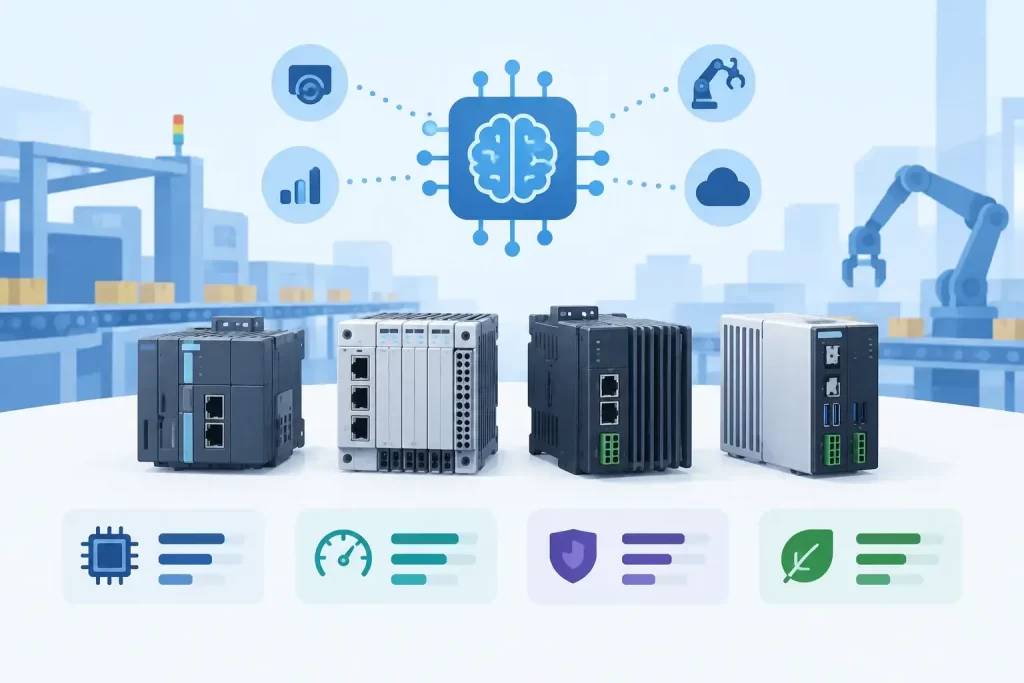
A packaging line can reject a damaged seal in milliseconds, but only if the recognition system can classify the image and deliver a usable control signal within the available machine cycle. A meaningful PLC AI modules comparison starts there: not with a generic AI benchmark, but with the timing, signal types, integration constraints, and failure modes of the equipment being automated.
For industrial teams, the choice is rarely between AI and no AI. It is usually a choice between adding limited recognition capability to a PLC, deploying a dedicated edge AI controller, or connecting the PLC to an industrial PC or server. Each architecture can be appropriate. The correct selection depends on whether the application needs deterministic I/O, high-throughput perception, local training, multimodal analysis, or a combination of these functions.
PLC AI Modules Comparison: Start With the Architecture
The term AI module covers several substantially different products. Treating them as interchangeable creates integration problems later, particularly when a proof of concept is moved to a production line.
An AI-enabled PLC or PLC expansion module places limited inference close to conventional ladder logic, function blocks, motion control, and discrete I/O. This arrangement is attractive when classification is a small part of a broader control task. Examples include sorting a small number of part types, identifying a simple assembly condition, or applying a pre-trained anomaly score to process data.
A dedicated edge AI controller separates perception from machine control. It receives images, audio, vibration, or other signals; performs recognition locally; and returns compact decisions, labels, confidence values, or alarms to the PLC. This design is often better suited to vision inspection, acoustic classification, and condition monitoring because the AI processor can operate independently of the PLC scan cycle.
Industrial PCs and server-based AI systems provide the greatest compute capacity and storage flexibility. They are appropriate for multi-camera systems, larger models, centralized data retention, and applications where several machines share analysis resources. Their trade-off is a larger software and cybersecurity footprint, plus more engineering work to preserve predictable response behavior at the machine interface.
The fundamental question is simple: should the PLC execute the intelligence, coordinate the intelligence, or consume its result? In most production environments, the PLC remains responsible for deterministic sequencing and safety-related logic. The AI component supplies a perception result that the control system can validate and act upon.
Compare Real-Time Behavior, Not Only Inference Speed
Published inference time can be useful, but it is not sufficient. A camera-based defect decision includes image acquisition, buffering, preprocessing, inference, thresholding, communication, PLC scan timing, and actuator response. A fast model can still produce a late reject if one of those stages introduces variable delay.
For time-critical applications, evaluate end-to-end latency under representative production conditions. Test with the target camera resolution, illumination, encoder rate, network traffic, and PLC program load. Measure worst-case latency as well as average latency. Average performance does not protect a line from an intermittent missed reject.
Determinism matters differently across applications. A vibration-monitoring system that updates a condition classification every second can tolerate more scheduling variation than a high-speed inspection station that must trigger an air jet at a precise encoder position. In the latter case, the AI module should return a result early enough for the PLC or motion controller to execute the physical response within the available window.
It is also useful to distinguish recognition throughput from control throughput. A system may classify 100 images per second, yet only need to transmit one pass/fail bit for each indexed part. Conversely, a diagnostic application may require feature values, confidence scores, time stamps, and waveform references for every event. The interface design should reflect the actual control and traceability requirements.
Training Workflow Is a Production Requirement
Many PLC-adjacent AI products focus on deploying pre-trained models. That can work well when the visual or signal environment is stable and the model is supplied by the vendor or a machine builder. It becomes restrictive when product variants change, new defect classes appear, or site-specific machine signatures must be recognized.
A trainable controller changes the evaluation criteria. The relevant questions become: who can create a category, how many examples are required, where are samples stored, how is the trained recognition set versioned, and how can a previous version be restored? These are operational questions, not data science details.
For industrial classification tasks, the fastest route is often supervised learning using representative examples captured at the installed machine. Good and bad examples must cover normal production variation: shifts in material finish, lighting drift, tooling wear, ambient noise, product orientation, and acceptable process tolerances. A model trained only on clean laboratory samples will create nuisance alarms when exposed to production variability.
NeuroMem-based neural controllers are particularly relevant where low-latency pattern recognition and local retraining are required without deploying a large GPU software stack. In an architecture such as the NT Industrial Automation platform, trainable recognition hardware can analyze free-form inputs including video, audio, vibration, and other sensor signals, then provide an actionable result to the surrounding automation system.
Training ownership should be explicit. Some facilities require a controls engineer to update classes during commissioning. Others require centralized engineering approval, audit trails, and locked production configurations. The module and its supporting software need to support the governance level appropriate to the process.
I/O and Protocol Fit Often Decide the Project
An AI module with strong recognition performance is of limited value if it cannot exchange data cleanly with the installed automation stack. Review supported industrial protocols, network topology, addressing limits, update rates, and diagnostic behavior before committing to a platform.
At minimum, define how the system will communicate its result. A simple application may use discrete outputs for ready, pass, fail, and fault. More capable deployments may require register-level access to class IDs, confidence values, counters, timestamps, model versions, and quality metrics. The PLC program should also know whether a result is fresh, stale, unavailable, or generated while the AI system was in a learning or maintenance state.
Physical interfaces deserve the same attention. Camera inputs, microphone interfaces, vibration sensor conditioning, encoder signals, digital triggers, and illumination control may be integrated, external, or unsupported depending on the module format. A PCIe card may fit an existing industrial PC architecture well, while a compact embedded controller may be preferable for a standalone inspection cell. Raspberry Pi-compatible formats can be useful for constrained embedded integration, but they should be assessed against the environmental and lifecycle requirements of the final equipment.
Evaluate Power, Thermal Design, and Serviceability
Edge AI is often selected to avoid continuous transfer of raw sensor data to centralized infrastructure. That benefit is most meaningful when the local controller also fits the power and thermal envelope of the machine.
Compare typical and peak power draw, startup behavior, enclosure requirements, operating temperature range, and cooling method. A fanless, low-power controller can simplify deployment in distributed cabinets or equipment-mounted enclosures. Higher-performance compute may be justified for complex inspection, but it can require thermal engineering, power budgeting, and maintenance access that were not part of the original machine design.
Serviceability is equally important. A production system needs clear fault indication, replaceable hardware, configuration backup, and a defined recovery procedure after a power loss or component replacement. Ask whether the trained model and operating parameters can be restored to replacement hardware without repeating the full commissioning process.
Comparison Matrix for Common Deployment Choices
| Evaluation area | AI-enabled PLC or module | Dedicated edge AI controller | Industrial PC or server AI | |—|—|—|—| | Best fit | Simple local classification tied closely to control logic | Real-time machine perception and multimodal sensing | High-compute, multi-camera, or centralized analysis | | PLC scan impact | Can compete for controller resources | Minimal when results are exchanged through defined interfaces | Minimal, but depends on network and software architecture | | Training flexibility | Often limited or model-specific | Strong when trainable recognition is built into the controller | High, with greater software engineering demand | | Power and footprint | Usually compact | Compact to moderate | Moderate to high | | Deployment complexity | Low to moderate | Moderate | Moderate to high | | Lifecycle burden | Familiar to controls teams | Requires AI and automation ownership | Requires IT, OT, and software lifecycle coordination |
No category wins universally. A PLC-resident module can be the most efficient answer for a constrained classification task. A dedicated controller is often the better engineering choice when recognition must process rich sensor data at the edge without consuming PLC resources. An industrial PC or server becomes justified when the system requires extensive compute, storage, orchestration, or model management across multiple assets.
Do Not Treat AI as a Safety Function
AI recognition can support quality control, machine condition decisions, and operator alerts, but its output should not be assumed to satisfy functional safety requirements. Where a decision affects personnel protection or hazardous motion, use certified safety hardware and a documented safety architecture. The AI system can provide an input to the process, while the safety function remains independent and validated.
The same discipline applies to false positives and false negatives. A defect detector that rejects too many good parts increases scrap and operator intervention. A detector that misses critical defects creates quality risk. Set acceptance thresholds from production data, record uncertain cases, and establish a process for periodic review as materials, equipment, and operating conditions change.
A useful final test is to run the proposed architecture against one real production decision: identify the input, define the maximum allowed decision time, specify the PLC action, and document what happens when the AI result is unavailable. If the system can answer those questions clearly, the module comparison has moved beyond features and toward an implementable industrial design.
