

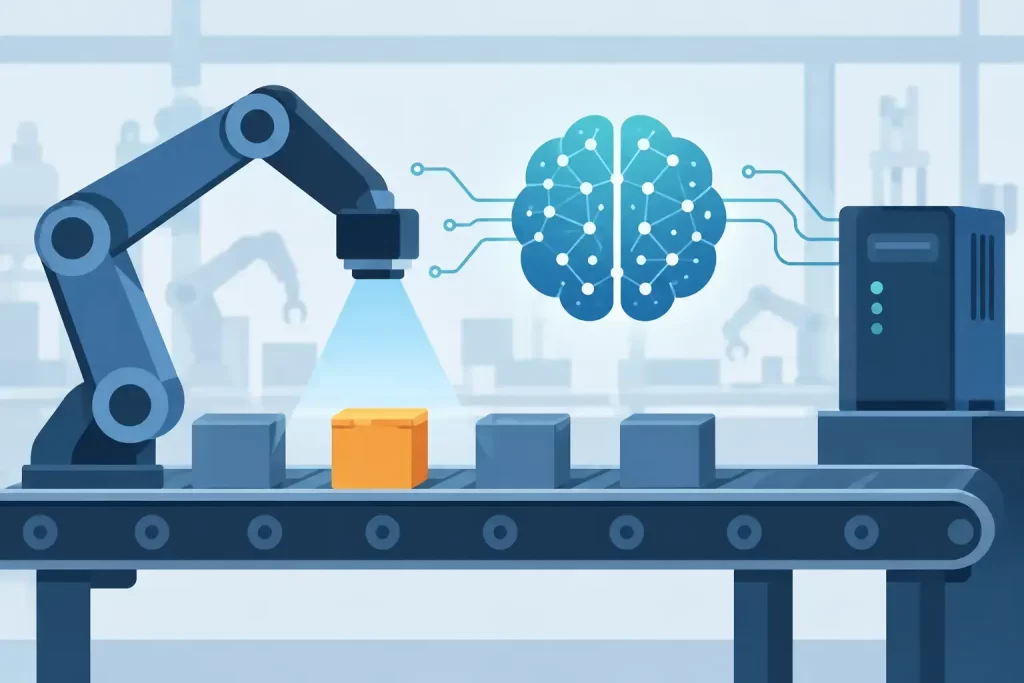
A production line does not have time to send every camera frame, acoustic event, or vibration signature to a remote server and wait for a classification result. When a bearing begins to degrade, a weld profile shifts, or an unexpected object enters a defined zone, the useful decision window may be measured in milliseconds. Neural controllers place trainable pattern recognition at the point where the signal is captured, allowing industrial systems to classify conditions and trigger actions locally.
What Neural Controllers Do
A neural controller is an embedded computing device designed to recognize learned patterns and convert that recognition into an operational decision. Unlike a conventional programmable logic controller, which follows explicitly defined rules, a neural controller can be trained with representative examples of the conditions it must distinguish. The resulting model can classify inputs that are variable, noisy, or difficult to describe through fixed thresholds.
That distinction matters in industrial sensing. A simple high-temperature alarm can be managed by a fixed limit. Detecting the early acoustic signature of valve leakage, identifying a surface defect across changing lighting conditions, or separating normal vibration variation from an emerging mechanical fault requires recognition of a pattern rather than a single value.
Neural controllers can process images, live or recorded video, audio, vibration, and other free-form sensor signals. Depending on the application, their output may be a class label, confidence value, anomaly indication, event trigger, or control signal sent to an existing automation system.
Why Edge Recognition Changes the Architecture
Industrial AI projects often fail at the architecture stage, not at the model stage. A high-accuracy model is of limited value if it requires excessive bandwidth, introduces unacceptable latency, or cannot be maintained on the target hardware.
Edge-based neural recognition addresses these constraints by keeping inference close to the source. The controller analyzes the incoming signal locally and transmits only the result, selected events, or compact metadata to supervisory software. This reduces network traffic and keeps primary decisions available when a connection to central infrastructure is limited or interrupted.
Latency is equally significant. In a quality inspection cell, a reject mechanism must receive a decision before the product reaches the actuator. In equipment protection, an abnormal vibration pattern may need to trigger a stop or reduced-load state before damage escalates. Local recognition avoids the variable delay associated with transmitting raw data, scheduling cloud computation, and returning a response.
Low-power operation is another design requirement. Embedded inspection stations, mobile equipment, distributed sensor nodes, and retrofit installations may have restricted thermal and electrical budgets. Specialized neural hardware can provide recognition performance without requiring a power-hungry general-purpose GPU at every sensing point.
Neural Controllers Versus Rule-Based Logic
Rule-based logic remains essential in automation. Interlocks, sequence control, safety circuits, setpoints, and deterministic machine behavior should remain explicit, testable, and predictable. Neural recognition is not a replacement for those functions. It is a practical extension for inputs where the condition cannot be reliably expressed as a small set of fixed rules.
Consider vibration monitoring. A rule-based system can alarm when amplitude exceeds a threshold in a particular frequency band. That approach works when the failure mode is well understood and signal conditions are stable. It becomes less reliable when machine speed varies, loads change, multiple components contribute overlapping frequencies, or normal operating states resemble a fault.
A trainable controller can learn examples of acceptable operating signatures and known abnormal states. It can then provide a classification output to the conventional control layer. The PLC, motion controller, or supervisory system retains responsibility for the final machine response according to defined operating and safety logic.
This separation is valuable for validation. Recognition identifies what the signal resembles. Industrial control determines what the machine is permitted to do about it.
Training for Real Operating Conditions
The quality of a neural controller depends on the quality and relevance of its training examples. Industrial data collection should represent the operating range, not only the ideal state. For machine vision, this includes realistic changes in lighting, orientation, surface finish, background conditions, and acceptable product variation. For acoustic and vibration monitoring, it includes normal load changes, startup behavior, environmental noise, and sensor mounting variation.
Training should also reflect the decision that matters. A defect classifier that groups several visually different defects into a single reject class may be sufficient for a high-speed sorting station. A maintenance program may instead need separate classes for imbalance, misalignment, looseness, and bearing damage because each leads to a different intervention.
False positives and false negatives must be evaluated in the context of the process. Missing a critical defect may be unacceptable in a safety or regulated application. Excessive false alarms can be equally damaging when operators begin to disregard the system or production is interrupted unnecessarily. The appropriate operating threshold depends on the cost of each error, available verification steps, and the response time of the equipment.
Hardware Format Is an Integration Decision
A neural controller is not only a recognition engine. It must fit the electrical, mechanical, and software architecture of the system being built. Board-level formats are often suitable for OEM designs and compact embedded installations. PCIe implementations can be appropriate when recognition acceleration must be added to an industrial computer or server. Standalone controller formats support distributed deployments where sensing and decisions occur near the equipment.
NeuroTechnologijos provides NT Adaptive controllers in formats including NT Adaptive .VASS, NT Adaptive PCIe, and NT Adaptive Raspberry Pi. These options support different integration paths while using trainable neural recognition for industrial sensing tasks.
Selection should begin with the signal and deployment requirements. Engineers should define sensor interfaces, input rate, recognition latency, available power, environmental conditions, host system compatibility, and the required output interface. A controller that is technically capable but difficult to connect to the existing automation stack creates unnecessary project risk.
The server layer also has a distinct role. Central software can manage recorded data, review recognized events, support model development, aggregate results from multiple stations, and provide operational visibility. The edge controller remains responsible for time-critical local inference. This division prevents central infrastructure from becoming a bottleneck while retaining the traceability needed for engineering and quality analysis.
Where Neural Recognition Produces Measurable Value
Machine vision is a common starting point because many inspection decisions depend on visual variation. Neural controllers can classify product presence, orientation, assembly completeness, surface condition, label placement, or component type without relying solely on rigid geometric rules. The practical advantage is often greater tolerance for normal variation, provided the training data represents that variation correctly.
Vibration and acoustic analysis are especially relevant for condition monitoring. Rotating equipment produces complex signatures influenced by speed, load, lubrication, mounting, and surrounding machinery. A trained recognition system can identify patterns associated with normal operation, process states, or emerging faults, then report the result to maintenance software or local control.
Multimodal applications can provide stronger evidence than a single sensor alone. A packaging machine, for example, may combine image recognition with motor current, vibration, and audio data. The correct design does not always require every available signal. Additional sensors add installation and maintenance work. They are justified when they materially improve classification reliability or provide coverage for failure modes that one signal cannot detect.
Engineering a Deployable System
Successful deployment begins with a narrow, measurable recognition task. Define the classes, the required response time, the accepted error rate, and the action that follows a result. Collect representative data, train against real operating conditions, and test the system at the line rather than only on archived samples.
Plan for change after commissioning. Products, tooling, suppliers, sensor positions, and operating conditions can evolve. A usable system needs a controlled method for reviewing uncertain events, gathering new examples, retraining when appropriate, and documenting model versions. This is not an argument for constant retraining. Stable applications should remain stable. It is a requirement to preserve recognition quality when the process changes.
Neural controllers are most effective when treated as an engineered sensing component, not as a black-box AI experiment. Place recognition where latency, power use, and signal availability demand it; keep final control actions within the established automation architecture; and train against the variation the equipment will actually encounter. That approach turns machine perception into a maintainable part of industrial operations.
