
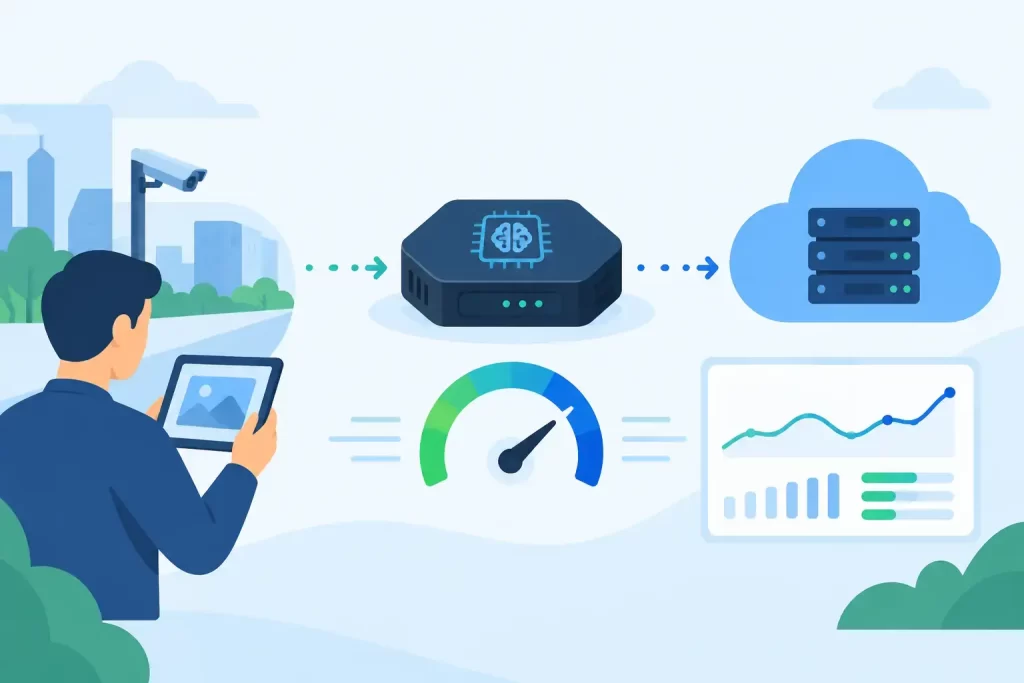
A defect-detection system that reports a result in 40 milliseconds may appear fast enough in a lab. On a production line moving at 1 meter per second, however, 40 milliseconds can represent 40 millimeters of travel – enough to miss a reject window, trigger an actuator late, or associate a classification with the wrong product. Understanding how to test edge inference latency means measuring the full decision path, not only the time required to execute a neural model.
For industrial AI, latency is an operating parameter. It determines whether a controller can inspect a part, classify a vibration event, recognize an acoustic anomaly, and produce an actionable output within the physical timing limits of the process.
Define what latency means in the application
Inference time is commonly reported as the interval between model input and model output. That metric is useful, but it is incomplete for an edge system connected to real sensors and machines. A camera frame, audio buffer, or vibration sample must first be captured, transferred, prepared for classification, processed, interpreted, and delivered to a control interface.
The more relevant measure is end-to-end decision latency. It begins when the physical event becomes observable at the sensor and ends when the industrial system receives a usable decision or output signal. Depending on the architecture, this path can include sensor exposure, analog-to-digital conversion, buffering, preprocessing, neural recognition, application logic, fieldbus transmission, PLC scan time, and actuator response.
Separate these components during testing. A low model execution time does not compensate for a camera pipeline that holds frames in a queue, an overloaded host processor, or network polling that adds unpredictable delay. For a controller operating directly at the edge, the objective is not merely low average latency. It is bounded latency under realistic operating conditions.
Start with a timing budget
A valid latency test begins with the process requirement. Work backward from the latest moment at which the action remains useful.
Consider a vision inspection station. If a product travels from the camera field of view to the reject mechanism in 180 milliseconds, the full system must recognize the condition, communicate the result, and actuate the reject device inside that window. If the pneumatic mechanism requires 45 milliseconds and the PLC logic plus output update requires 20 milliseconds, the AI sensing and decision subsystem has a maximum budget of 115 milliseconds. Engineering margin should reduce that target further.
The same method applies to condition monitoring. A vibration classifier used to stop a rotating machine may tolerate hundreds of milliseconds if the purpose is to raise an alarm. A controller detecting a transient event for synchronized motion control may need a deterministic response in microseconds or low milliseconds. The acceptable result depends on process physics, not on an arbitrary benchmark.
Document the budget by stage: acquisition, input preparation, inference, postprocessing, communications, and machine response. This turns a general performance claim into a verifiable system requirement.
How to test edge inference latency from event to output
The most reliable method is to inject a known physical or electrical event and measure when the system output changes. This avoids assumptions created by software timestamps, which may be affected by operating-system scheduling, clock drift, or asynchronous buffers.
For digital industrial inputs, use a pulse generator to create a trigger signal. Feed that trigger to the edge device and to a measurement instrument, such as an oscilloscope or logic analyzer. Configure the AI application to produce a digital output, serial message, or fieldbus signal when the expected pattern is recognized. The interval between trigger and output is the observed end-to-end latency.
For machine vision, place a controllable LED or visual target in the camera scene. The LED transition provides a precise event reference. Measure the time between illumination and the classification output. This captures camera exposure and frame delivery, which pure model timing excludes.
For vibration and acoustic applications, inject a repeatable test waveform through the acquisition path. Where a physical transducer must be included, use a synchronized reference channel to identify the actual onset of the event. Compare that onset to the recognition result rather than relying only on the timestamp assigned by the application.
Repeat the test over enough cycles to characterize distribution, not just a single favorable run. Record minimum, median, 95th percentile, 99th percentile, and maximum latency. In industrial control, the maximum observed delay and the upper-percentile behavior often matter more than the average.
Measure the pipeline stages separately
An end-to-end measurement identifies the system result. Stage-level instrumentation explains why it performs that way. Both are necessary.
Timestamp data at the boundaries of acquisition, preprocessing, inference start, inference completion, decision output, and external transmission. Use a monotonic high-resolution clock where software measurements are required. If components run on separate processors or devices, synchronize clocks or use a shared hardware trigger. Unsynchronized timestamps can create false latency readings that are difficult to diagnose.
Preprocessing deserves close attention. Resizing an image, converting color formats, calculating a spectral transform, filtering a signal, or copying data between memory regions can consume more time than neural recognition. This is particularly relevant when a compact edge accelerator executes recognition quickly while general-purpose software performs the surrounding pipeline inefficiently.
Also measure queue depth. A frame processed in 5 milliseconds may still be 60 milliseconds old when it reaches the model because earlier frames were waiting. For real-time inspection, it is often preferable to drop stale inputs rather than process every sample with growing delay. The correct policy depends on whether every event must be retained or whether the priority is the most current machine state.
Test under production load, not only benchmark conditions
A clean bench test establishes a baseline. It does not prove production behavior. Latency changes when sensor data becomes more complex, CPU utilization rises, storage activity occurs, network traffic increases, or the system performs logging and visualization at the same time.
Run tests with representative input dimensions, sampling rates, and model configurations. A vision system should use production exposure settings and expected scene complexity. A vibration system should use the actual window length, overlap, and filtering sequence. Testing a simplified input pipeline may produce a result that cannot be achieved after deployment.
Introduce realistic stress conditions. Run continuous acquisition for hours, activate communications traffic, write diagnostic logs, and execute the normal supervisory application. Observe whether latency remains within the budget as temperature changes and memory allocation stabilizes. On general-purpose computing platforms, background services and resource contention can create occasional timing spikes even when median performance appears acceptable.
Test startup and recovery behavior as well. An edge device may meet its target during steady-state operation yet delay decisions while reconnecting a sensor, loading a model, or restoring communications after a power interruption. These are operational cases, not edge cases.
Account for hardware, model, and integration trade-offs
Lower latency is not always achieved by selecting a smaller model alone. Reducing model complexity can improve execution time but may lower recognition accuracy, especially for rare defects or overlapping signal classes. Increasing input resolution can improve detection of small features while raising acquisition, memory, and processing costs.
Hardware architecture matters. A trainable neural controller that performs recognition close to the sensor can avoid network round trips and reduce host-processor load. Dedicated edge hardware can also provide more consistent timing than a shared software stack, particularly when recognition must occur continuously at low power. NeuroTechnologijos systems built around NT Adaptive controllers are designed for this type of embedded recognition task, where response time and integration format must match the industrial installation.
Communication choices also shape the result. A local digital output may provide the shortest and most predictable action path. Ethernet-based integration may be appropriate when the process tolerates the added protocol and PLC cycle time. Sending data to a remote server can support archiving and analysis, but it should not sit inside a time-critical control loop unless network behavior is explicitly budgeted and tested.
Build a latency acceptance test
A production-ready acceptance test should specify the stimulus, sensor configuration, model version, device firmware, application settings, load conditions, measurement equipment, and pass criteria. Preserve raw timing data alongside summary statistics. This makes later comparisons possible when a model, camera, controller, or software component changes.
Define failure criteria that reflect the process. For example, a system may require 99.9% of decisions below 25 milliseconds, no measured result above 35 milliseconds, and no queue backlog exceeding one sample during an eight-hour endurance run. Pair latency requirements with recognition-quality metrics. A fast response is not useful if false classifications create unnecessary rejects or missed faults.
Treat latency validation as part of system commissioning and change control. Any modification to input resolution, signal windowing, model structure, communication protocol, or host application can alter timing. The strongest edge deployments are measured as complete sensing-and-control systems, then tested again whenever the operating architecture changes.
The practical question is not whether the model is fast. It is whether the decision arrives early enough, consistently enough, to change the machine outcome. That is the standard an industrial edge inference test should prove.