
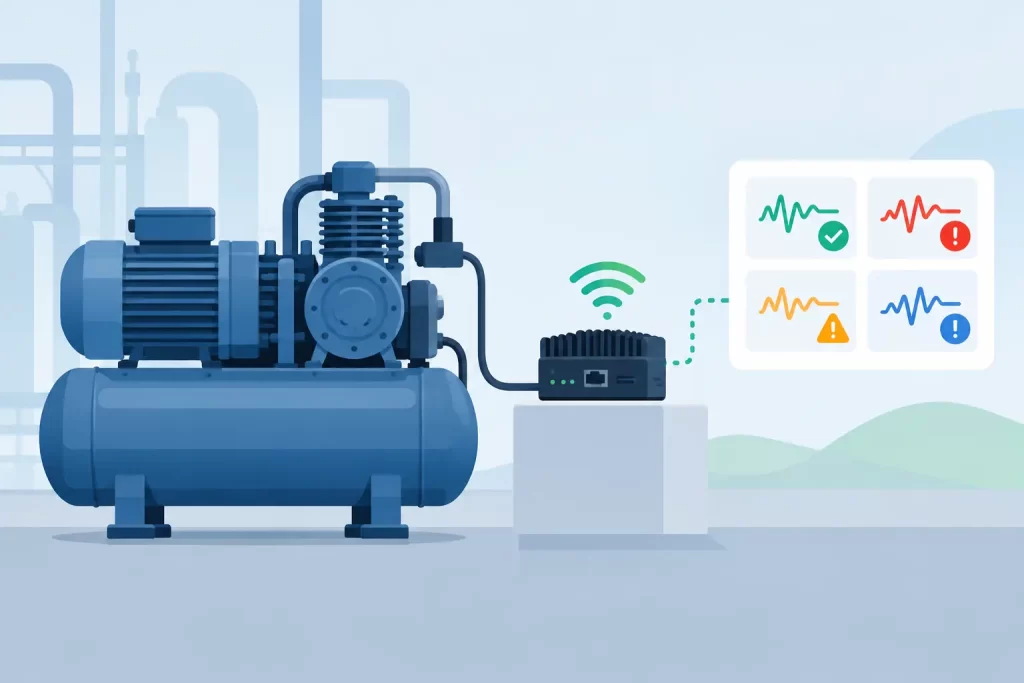
A compressor can remain within its pressure setpoint while its bearings, valves, or lubrication system are already moving toward failure. By the time a conventional alarm crosses a fixed threshold, the machine may be operating inefficiently, producing excessive heat, or damaging connected equipment. Compressor fault classification addresses this gap by identifying the condition represented by a live signal pattern, not just whether one measurement has exceeded a limit.
For industrial teams, the objective is not merely to collect more condition-monitoring data. It is to classify the operating state quickly enough to support a practical decision: continue operation, inspect at the next scheduled stop, reduce load, or intervene immediately. That requires a system that can distinguish fault signatures from normal changes in speed, load, ambient temperature, and process demand.
Why compressor faults are difficult to classify
Reciprocating, rotary screw, scroll, and centrifugal compressors produce different mechanical and acoustic signatures. Even within one machine family, the same fault can appear differently at different speeds, pressures, gas compositions, and mounting conditions. A rise in vibration amplitude, for example, may indicate bearing degradation, misalignment, looseness, pulsation, or a temporary operating transition.
Threshold alarms remain useful for process protection, but they are limited as a diagnostic method. They evaluate one variable against one limit. Fault classification evaluates relationships across a signal: frequency components, pulse timing, envelope shape, transient events, energy distribution, and changes relative to a known healthy baseline.
The classification problem is also affected by sensor placement. An accelerometer mounted near a drive-end bearing captures different information than one mounted on a compressor housing. A microphone may reveal valve leakage or impact events that are weak in vibration data, while motor current can expose electrical or load-related anomalies before a mechanical symptom is visible. The most effective design depends on the failure modes that matter most and the signals available at the installation point.
Compressor fault classification starts with operating states
A useful model does not treat every deviation as a failure. It first separates normal operating regimes from abnormal conditions. Startup, unloaded running, loaded running, speed ramping, recycle operation, and shutdown can each produce signal patterns that would look anomalous if compared against only one steady-state reference.
The classifier should therefore recognize both machine condition and operating context. A practical label set might include:
- healthy operation across defined speed and load ranges;
- bearing wear or lubrication-related degradation;
- valve leakage, valve impact, or flow restriction;
- shaft misalignment, imbalance, or mechanical looseness;
- abnormal electrical loading, motor defects, or drive-related events; and
- unknown or unclassified behavior requiring review.
The final category is essential. Industrial models should not be forced to assign every unfamiliar pattern to a known fault. An unknown-state output prevents false confidence when the machine encounters a condition absent from the training data, such as a new mounting resonance, an unusual process transient, or a sensor installation issue.
Fault classes must match maintenance actions
Classification granularity should follow the maintenance decision, not the theoretical number of possible faults. If a plant responds to several bearing-related patterns with the same inspection procedure, one bearing-condition class may initially be more valuable than several narrow defect labels. Conversely, valve faults may need separate classes when they require different parts, shutdown planning, or safety measures.
This is a trade-off between diagnostic detail and model reliability. More classes can improve failure specificity, but only when sufficient representative data exists for each class. Sparse labels increase confusion between similar conditions and can make a model appear accurate in testing while behaving unpredictably on live equipment.
Signals that carry useful diagnostic evidence
Vibration remains a primary source for mechanical condition monitoring. Raw acceleration can be analyzed in the time domain for impacts, crest factor, and periodicity, then transformed into frequency-domain features that expose rotational, bearing, gear, and structural behavior. Envelope analysis is particularly useful when high-frequency resonances are excited by repetitive impacts.
Acoustic sensing can add information that is difficult to obtain from structure-borne vibration alone. Leaking valves, gas pulsation, friction, and intermittent impacts may produce recognizable airborne or contact-acoustic patterns. Acoustic sensors require careful treatment of background noise, enclosure effects, and distance from the source, but they can be highly effective when the relevant sound signature is distinct.
Motor current, voltage, speed, pressure, temperature, and flow data provide operational context. Current signatures can reveal load changes, rotor-related effects, and drive behavior. Pressure and temperature trends can help distinguish a mechanical fault from a normal response to changing process demand. Combining these signals reduces ambiguity, provided that timestamps are synchronized and the acquisition system preserves enough bandwidth for the fault mechanisms of interest.
From raw signals to a trainable edge model
A production system generally begins with synchronized data acquisition. Sampling rate, sensor sensitivity, anti-alias filtering, and mounting method must be documented because they directly affect whether a trained model can be reproduced across machines. A model trained with a high-bandwidth accelerometer may not transfer to a lower-cost sensor with a different frequency response.
Next, recorded segments are labeled against maintenance records, inspection findings, operator observations, and known operating states. This stage often determines the quality of the final classifier. Maintenance logs may contain broad descriptions such as “high vibration” rather than confirmed root causes, so engineering review is needed before those records become training labels.
Feature selection depends on the application. Some systems use engineered features such as RMS level, kurtosis, spectral band energy, harmonics, sidebands, and pressure pulsation metrics. Others classify windows of raw or lightly processed signals. Either approach can work. Engineered features can reduce data volume and simplify interpretation; direct pattern recognition can preserve signal details that may be lost in manual feature extraction.
For edge deployment, the model must meet a stricter requirement than offline accuracy. It must classify within the required response time, operate within available memory and power limits, and maintain predictable behavior under continuous data flow. A low-latency embedded classifier can act on a short event window near the machine, while a supervisory system stores selected events and trends for engineering analysis.
NeuroTechnologijos systems based on trainable NT Adaptive controllers and NeuroMem digital neural network hardware are designed for this type of pattern-recognition workload, where rapid local decisions and low-power embedded operation are priorities.
Validate the classifier against real operating variation
Accuracy alone is not an adequate acceptance metric. A dataset with many healthy samples can produce a high overall accuracy even if the system misses rare but costly faults. Per-class recall, false-positive rate, confusion between fault categories, detection latency, and unknown-state behavior provide a more useful view of field performance.
Validation data should be separated by time, operating period, and preferably machine instance. Randomly mixing adjacent signal windows into training and test sets creates an overly optimistic result because nearly identical patterns can appear on both sides of the split. A stronger test evaluates whether the classifier recognizes a fault on a later production run or on a comparable compressor that was not used for training.
False alarms require special attention. If every load transition is classified as a developing fault, operators will stop trusting the output. If the model is made too conservative to avoid nuisance alarms, it may miss early degradation. The right balance depends on the criticality of the compressor, the cost of an unplanned outage, and whether classification triggers an automatic action or only a maintenance notification.
Integrating classification into plant decisions
The classifier output should be connected to a defined workflow. A healthy classification may update a condition trend. A suspected degradation class may create an inspection recommendation with supporting signal evidence. A high-severity class may initiate a controlled unload, alarm escalation, or protective interlock according to the site’s operating philosophy.
Integration also requires traceability. Store the classification result, confidence or similarity measure, timestamp, operating state, and representative signal segment. This gives reliability engineers the information needed to verify decisions, refine labels, and identify model drift. It also makes the system easier to defend during maintenance reviews because the result is tied to observable machine behavior rather than a black-box alarm.
Build for adaptation, not one-time deployment
Compressors age, sensors are replaced, process conditions change, and maintenance actions alter the machine signature. A fault classifier should therefore be treated as a controlled engineering asset. Baseline data should be refreshed after major overhaul work, new confirmed events should be reviewed for inclusion in the training set, and performance should be monitored for shifts in false alarms or unknown classifications.
The most useful compressor monitoring system is not the one that produces the most labels. It is the one that turns live vibration, acoustic, electrical, and process evidence into a timely, explainable action for the people responsible for keeping the machine available.