

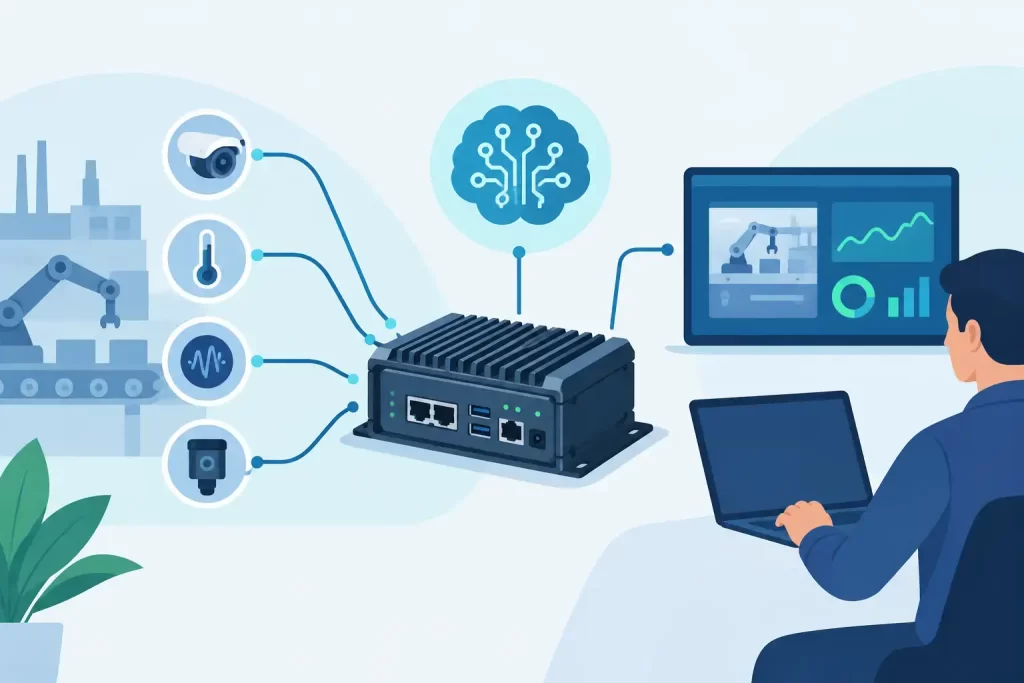
A controller that recognizes a bearing fault in a recorded test signal but misses it on a running production line is not configured for the real application. To configure adaptive controllers successfully, engineers must define the decision first, then align signal acquisition, training data, recognition settings, and output logic around that decision. The objective is not a generic AI demonstration. It is a repeatable edge decision that arrives within the available cycle time and behaves predictably under real operating variation.
For industrial teams, this work sits between instrumentation, automation engineering, and pattern-recognition design. A well-configured adaptive controller can classify vibration states, identify acoustic events, recognize visual defects, or distinguish valid and abnormal process patterns without sending every signal to a remote server. The configuration choices determine whether that capability becomes a reliable part of the machine or another source of uncertain alarms.
Start With the Decision, Not the Sensor
The first configuration question is simple: what must the controller decide, and what action follows? “Monitor motor vibration” is too broad. “Classify the motor as normal, imbalance, misalignment, or bearing degradation every 500 milliseconds and stop the line only after three consecutive critical classifications” is an engineering requirement.
Define the classes in operational terms. Each class should correspond to a condition that an operator, PLC, maintenance system, or supervisory application can act on. If two conditions require the same response, they may not need separate classes. If a condition cannot be confirmed during training, it should not be presented as a dependable class in production.
This definition also establishes timing. A high-speed packaging inspection may require a result within milliseconds. Condition monitoring may tolerate a longer observation window but require continuous coverage. Latency is not only the controller’s recognition time. It includes sensor acquisition, pre-processing, communications, output handling, and any PLC scan or application delay.
Select the Controller Format for the Integration Path
Adaptive recognition hardware should be selected based on where the intelligence must reside and how it will exchange data with the existing system. A server-attached PCIe format is appropriate when a host computer already manages multiple streams, operator interfaces, or recorded-data analysis. An embedded format is often better when recognition must live close to the sensor, with limited power and minimal network dependence.
NT Adaptive controller formats, including VASS, PCIe, and Raspberry Pi implementations, support different deployment constraints. The choice is not only about compute capacity. It affects enclosure design, maintenance access, operating-system dependency, field connectivity, and the division of responsibilities between the controller and host software.
Before installation, document the physical and logical interfaces. Confirm the signal source, sampling method, voltage or transport standard, ground reference, trigger behavior, and expected data rate. For a vision application, account for camera exposure, illumination stability, frame synchronization, and image transfer. For vibration and audio, verify sensor mounting, gain, bandwidth, anti-aliasing, and the time alignment between channels.
A recognition system cannot recover information that was never captured. Many apparent AI errors are acquisition errors: loose accelerometers, inconsistent lighting, clipped audio, changing camera focus, or an observation window that begins too late.
Build Training Sets That Represent Production
Trainable neural controllers recognize examples, not abstract descriptions. The training set must therefore represent the variation the controller will encounter after commissioning. Collect examples across normal shifts, product variants, machine speeds, environmental conditions, sensor positions, and expected background noise.
For each class, include enough variation to describe the class boundary without mixing unrelated conditions into it. A “normal” class deserves particular care. If normal training data includes early-stage faults, poor material, or unstable machine startup, the controller may learn that these conditions are acceptable.
Use recorded live signals whenever possible. Synthetic or bench-generated examples are useful for initial validation, but they rarely capture all production effects. In image inspection, include changes in surface finish, orientation, reflections, and acceptable manufacturing tolerance. In acoustic monitoring, include neighboring machines, compressed-air noise, and changes in load. In vibration analysis, record through speed changes and normal process transitions.
Keep a separate validation set that is never used for training. Test against this set after each model revision. The point is not to maximize a laboratory score. It is to expose confusion between classes before the model controls an operational decision.
Label by process state, not by file name
Traceable labels matter more than a large pile of poorly organized samples. Record the source asset, time, equipment state, sensor configuration, operator or automated labeling method, and reason for the label. A sample called “fault_27” has little engineering value without context.
Where a fault condition is rare, use a staged approach. Train normal operation first, then add confirmed fault patterns as evidence becomes available. This may be more practical than claiming early detection of every theoretical failure mode. The controller can still provide useful anomaly or pattern classification, but its alarms should reflect the evidence used to train it.
Configure Recognition Thresholds and Output Logic
A controller’s class response must become a control-system signal. This is where many deployments either create nuisance alarms or suppress meaningful events. Configure acceptance thresholds according to the cost of each error. A missed safety-related defect and an unnecessary operator inspection do not carry the same consequence.
Do not treat a single recognition result as a final machine command unless the application truly requires it. Industrial signals are often transient. Use persistence rules, majority voting across a defined window, or consecutive-event logic when the process permits. For example, a maintenance notification may require repeated abnormal classifications over several minutes, while an ejector in a high-speed inspection cell may require an immediate result for one item.
Define an explicit response for low-confidence or unrecognized patterns. This state should not silently become “normal.” Depending on the process, it can trigger sample capture, operator review, slower machine operation, or a noncritical alarm. Unknown-pattern handling is especially valuable after product changes, tooling replacement, sensor service, or a change in upstream process conditions.
Output mapping should be documented as carefully as electrical I/O. Specify which classes generate digital outputs, data messages, event records, visual annotations, or PLC tags. Include signal polarity, reset behavior, debounce timing, watchdog actions, and the expected behavior if communications are interrupted. A fast edge recognition result is useful only when the receiving system interprets it correctly.
Validate at Operating Conditions
Commissioning should proceed from recorded data to supervised live operation and then to production control. During the supervised stage, run the controller in shadow mode. It should classify real signals and log its decisions while operators or reference instruments retain authority. Compare outputs against verified process events, not assumptions.
Measure false positives, false negatives, recognition latency, output repeatability, and the number of unknown classifications. Review results by shift, product, machine speed, and environmental condition. Aggregate performance can hide a failure that appears only during a specific recipe or at the end of a production run.
A successful validation also tests failure behavior. Disconnect or degrade a sensor where safe to do so. Check startup and restart conditions. Confirm what happens when the controller receives incomplete data, loses a network connection, or encounters a signal outside its trained range. These checks belong in the acceptance test because the industrial system must remain understandable under abnormal conditions.
Maintain the Configuration as a Controlled Asset
Recognition performance changes when the physical process changes. New material suppliers, revised tooling, different lubricants, camera replacement, equipment relocation, and altered line speeds can all shift the input pattern. Configuration is therefore not a one-time training task.
Version the training data, class definitions, controller configuration, threshold settings, and deployed recognition model together. A recorded event should be traceable to the exact configuration that produced the decision. This enables engineers to determine whether a change in performance came from the equipment, the sensors, or the recognition logic.
Retrain only when evidence supports it. Adding every new sample automatically can dilute a useful model or normalize a developing fault. Review candidate data, validate the revised model against held-out and current production samples, then deploy it through a controlled change process. Keep the prior validated configuration available for rollback.
The most effective adaptive controller is not the one trained on the largest dataset. It is the one whose sensing, class definitions, thresholds, and automation response remain aligned with the physical process it is expected to control.
