

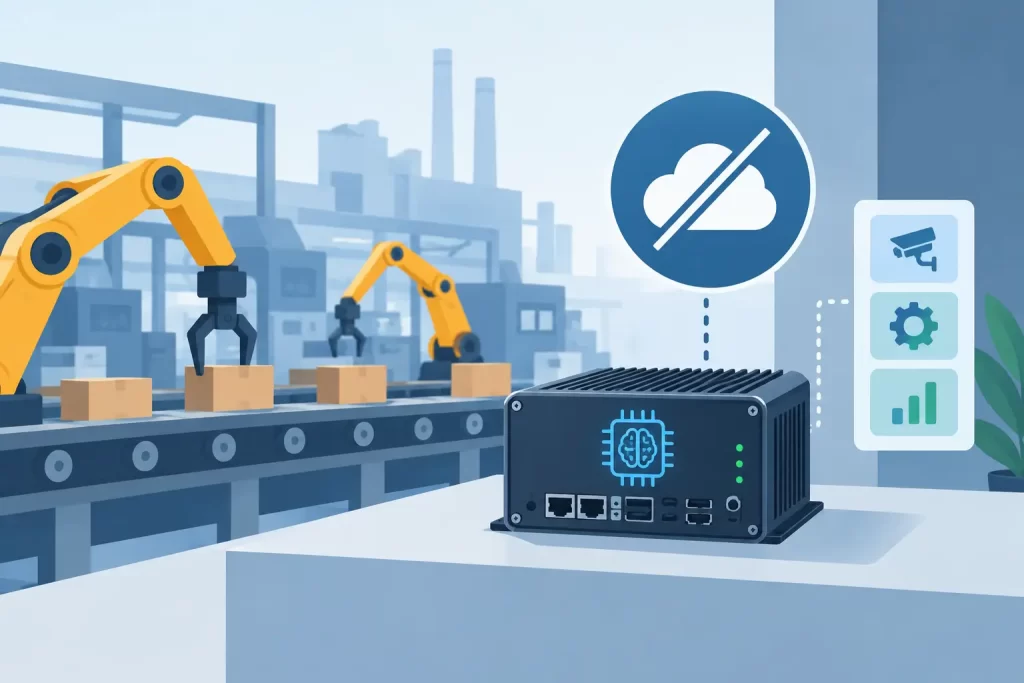
A camera on a production line identifies a surface defect in milliseconds. A vibration sensor detects a bearing signature before damage spreads. A controller stops or redirects the process immediately. None of those decisions should wait for a remote server response. So, does edge AI work offline? Yes – provided the model, recognition engine, and decision logic are deployed locally on the device or within the facility.
Offline operation is one of the defining reasons to use edge AI in industrial automation. It allows a machine vision system, acoustic classifier, or condition-monitoring controller to analyze live signals and act even when internet access is absent, unreliable, restricted by policy, or intentionally isolated.
Does Edge AI Work Offline? The Short Technical Answer
Edge AI works offline when inference occurs on local hardware. The input signal is captured locally, processed locally, classified locally, and passed to the automation system locally. The system does not need to transmit an image, waveform, vibration sequence, or feature vector to a cloud service for every decision.
This distinction matters because “AI” can describe very different architectures. A cloud AI application may use a local sensor but send data to a remote data center for analysis. That system is not truly offline-capable. An edge AI system places the trained model or neural recognition capability in an embedded controller, industrial PC, PCIe card, gateway, or other on-premises hardware. It can continue operating with no external network connection.
Offline edge AI does not mean the system can never exchange data. A plant may still use Ethernet, fieldbus networks, or an isolated local server for supervisory control, logging, configuration, and model updates. The key requirement is that recognition and time-critical control decisions remain available without depending on a WAN or cloud endpoint.
Inference Can Be Offline, While Training May Not Be
The most useful way to evaluate offline capability is to separate inference from training. Inference is the operational task: classify a vibration pattern, recognize a visual defect, identify an alarm condition in audio, or determine whether a process signal matches an accepted state. This can run continuously at the edge.
Training is the task of teaching the system new categories or refining existing recognition behavior. Depending on the platform and deployment method, training may occur on the same edge device, on an engineering workstation, or on a server within the facility. It does not inherently require public internet access either, although cloud resources are often used for larger development workflows.
For industrial deployments, this separation is practical. Engineering teams can collect approved examples, create or update recognition classes during scheduled maintenance, validate the change, and deploy the updated model to the production controller. The production system remains autonomous during normal operation.
Trainable neural controllers are particularly relevant when the recognized patterns are specific to a machine, material, product family, or operating environment. Instead of relying only on a generalized model trained elsewhere, the controller can be taught acceptable and unacceptable examples from the actual process.
What an Offline Edge AI Architecture Looks Like
A typical architecture begins with a local input source: an industrial camera, microphone, accelerometer, vibration sensor, thermal sensor, or data stream from existing equipment. The edge system acquires the signal, prepares it for recognition, and executes the neural model or classifier.
The resulting decision can then drive a PLC input, digital output, alarm, actuator, HMI message, machine-state change, or local database record. For example, a controller may reject a faulty part, flag a motor for inspection, or stop a process when a critical acoustic signature appears.
The architecture is not limited to one sensor modality. Industrial systems frequently combine visual, acoustic, and vibration evidence. A vision module may confirm component position while an acoustic classifier checks whether a fastening operation produced the expected sound. Local correlation of these signals can reduce false alarms without introducing cloud latency.
In an implementation based on dedicated neural hardware, the recognition workload is executed by the local accelerator rather than by a remote GPU service. NeuroTechnologijos applies this approach through trainable NT Adaptive controllers and embedded hardware formats intended for real-time industrial sensing and automation.
Local Interfaces Still Matter
“Offline” should not be interpreted as “disconnected from every system.” Most equipment needs a defined path to exchange data with nearby controls. The relevant question is whether those interfaces are local and deterministic.
An edge AI device may communicate with an industrial PC, PLC, SCADA layer, camera interface, or local server. If the external internet connection fails, those local functions can continue. System integrators should document which interfaces are necessary for recognition, which are used only for monitoring, and which are required for model administration.
That distinction prevents a common deployment error: installing an edge device but making the production decision dependent on a remote dashboard, license check, or cloud-hosted processing service.
Why Offline Operation Matters on the Plant Floor
Latency is the first reason. A process moving at production speed may allow only milliseconds for analysis and action. Sending high-resolution images or continuous sensor streams off-site introduces transmission delay, variable response time, and potential queueing. Local inference keeps the recognition path short.
Availability is equally important. Facilities can experience outages, bandwidth constraints, segmented networks, or security policies that prohibit external data transmission. An offline-capable controller continues recognizing patterns under those conditions. This is especially valuable at remote installations, mobile equipment, secure manufacturing environments, and legacy facilities where network modernization is incomplete.
Data governance also changes the calculation. Images of products, process audio, production recipes, and machine signatures may be sensitive intellectual property. Keeping raw data inside the facility limits exposure and reduces the volume of data that must be stored or transmitted. A system can retain only the events, classifications, confidence values, and selected evidence needed for quality documentation or engineering review.
Power consumption is another operational factor. A compact embedded accelerator designed for recognition can be more appropriate than maintaining a high-power server for a single inspection station or sensor node. The best fit depends on model complexity, input rate, environmental requirements, and the number of channels being processed.
Offline Does Not Remove Engineering Trade-Offs
Edge AI is not automatically the best architecture for every workload. Large foundation models, extensive historical analytics, or fleet-wide optimization may require server or cloud resources. The practical design is often hybrid: fast recognition and immediate control stay at the edge, while aggregated data is periodically transferred for reporting, traceability, or longer-term analysis.
Model capacity is another consideration. The edge hardware must have sufficient memory, compute performance, and interface bandwidth for the intended signal and response time. A small classifier identifying a limited set of known conditions has different requirements than multi-camera inspection with high-resolution imagery and many defect classes.
Offline systems also need a deliberate update process. If a model changes, the organization should version it, test it against representative production data, define rollback criteria, and record when it became active. This is not an argument against offline operation. It is an argument for treating the recognition model as a controlled part of the automation system.
Verify More Than the Demo
A vendor demonstration may show local recognition, but an engineering evaluation should confirm behavior under actual operating conditions. Test the system with the external network disconnected. Verify startup behavior, local licensing requirements, recovery after power loss, decision latency, signal throughput, and output behavior when an upstream system is unavailable.
Also test realistic variation: changes in illumination, background noise, vibration amplitude, product orientation, sensor drift, and machine operating modes. Offline inference is only valuable if recognition quality remains acceptable across the conditions the equipment will encounter.
For critical applications, define the fail-safe state before commissioning. A defect-detection cell may reject uncertain parts. A predictive maintenance system may raise a local warning and preserve an evidence sample. A safety-related function must be engineered according to the applicable safety architecture, rather than assuming an AI classification alone is a safety control.
Choosing an Offline Edge AI System
The strongest candidates are systems designed around local signal acquisition, local model execution, and direct industrial integration. Look for hardware formats that fit the deployment point, whether that is a panel-mounted controller, an embedded board, a PCIe-equipped industrial computer, or a compact device integrated into OEM equipment.
Ask specific questions: Can the device execute inference with no internet connection? Where are models stored? Can recognition classes be trained or updated on-site? What is the measured response time from input to output? Which camera, sensor, and control interfaces are supported? How are models versioned and backed up? Clear answers reveal whether the solution is truly edge-native or simply a cloud service with a local data collector.
The right offline edge AI design is not defined by isolation for its own sake. It is defined by keeping the recognition decision where the process needs it: beside the sensor, beside the machine, and available when the network is not.
