

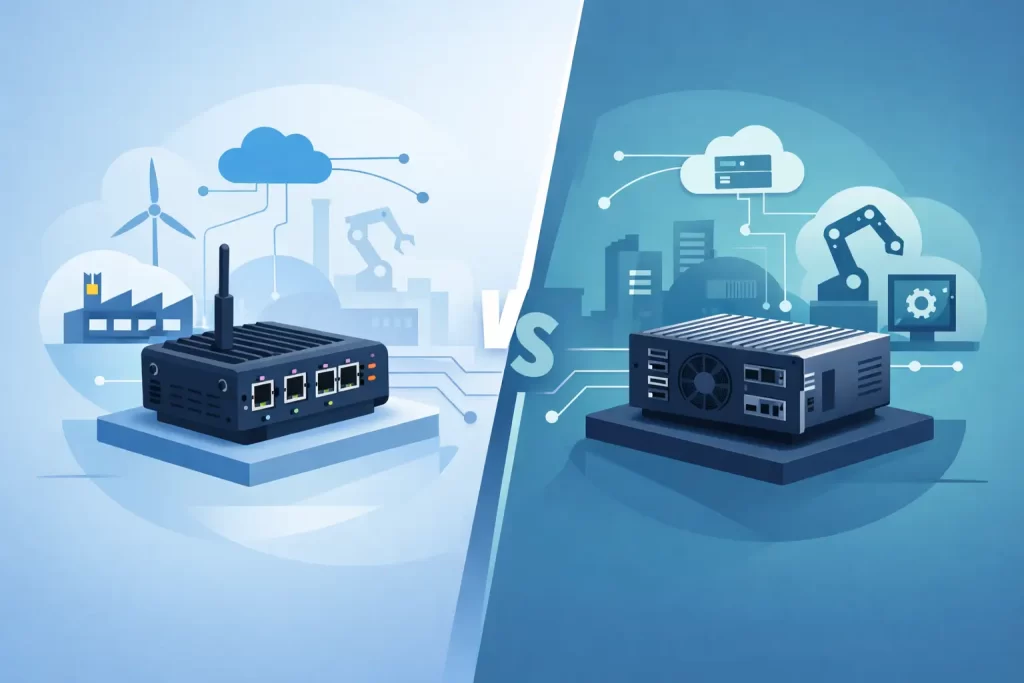
A vibration event may last milliseconds. A defective surface may pass a camera once. When recognition must trigger an actuator, reject a part, or raise an equipment alarm before the next machine cycle, compute architecture becomes an operational decision. In the debate over edge controllers vs industrial PCs, the relevant question is not which device has more general-purpose processing power. It is which architecture can execute the required sensing, recognition, control, and integration functions with predictable timing, power use, and maintenance burden.
An industrial PC is often the correct platform for data-heavy applications and broad software requirements. An edge controller is often the better fit when a defined recognition task must run locally, continuously, and with low latency. The distinction matters most in machine vision, acoustic and vibration analysis, condition monitoring, and automated classification of free-form signals.
Edge Controllers vs Industrial PCs: The Architectural Difference
An industrial PC is a general-purpose computing platform adapted for factory, field, or equipment environments. It commonly uses an x86 processor, a conventional operating system, memory, storage, and expansion interfaces. Its main advantage is flexibility. A system integrator can run multiple applications, connect databases, support complex user interfaces, process large files, and use software libraries designed for desktop or server-class computing.
An edge controller is designed around a narrower operational role: acquire local signals, execute a defined decision process, and communicate the result to the machine or supervisory system. Its architecture may combine embedded processing with dedicated acceleration for neural recognition, deterministic I/O, and compact deployment formats. Rather than allocating general-purpose compute cycles across many services, it directs resources toward a bounded inference and control workload.
This does not make one category universally superior. It changes where the system carries complexity. The industrial PC concentrates flexibility in software. The edge controller concentrates repeatable recognition performance and efficient local operation in purpose-built hardware and firmware.
Compute flexibility versus task determinism
Industrial PCs are appropriate when the application changes frequently, requires several third-party software packages, or needs substantial local visualization and data management. For example, a machine vision cell that performs image capture, high-resolution image archiving, reporting, operator interaction, and enterprise communication may need the memory, storage, operating system support, and expansion capacity of an industrial PC.
A dedicated edge controller is better aligned with a stable recognition task that must execute at the machine boundary. Consider a bearing-monitoring station that classifies vibration signatures into normal, warning, and fault conditions. The controller does not need to preserve every raw waveform locally or host a full analytics environment. It needs to classify the incoming signal quickly and reliably, then issue a machine-readable decision.
The difference is especially significant where neural models are trained for a specific set of patterns. Hardware designed for trainable neural recognition can provide a direct path from sensor input to classification without relying on a large CPU, discrete GPU, or permanent connection to remote compute resources.
Latency Is More Than Processor Speed
A specification sheet may show a high clock rate for an industrial PC and a lower one for an embedded controller. That comparison is incomplete. End-to-end latency includes sensor acquisition, preprocessing, model execution, decision logic, operating system scheduling, I/O transfer, and output signaling.
A general-purpose PC can achieve high performance, but timing may be influenced by background processes, driver behavior, storage activity, and the operating system. These factors can be controlled through careful engineering, but they remain part of the design effort. Real-time extensions and dedicated acquisition hardware may also be required when timing margins are tight.
An edge controller built for local recognition reduces the number of moving parts in that path. This is useful when an event must be recognized and acted on inside a fixed cycle time. Low latency is not simply a convenience in these applications. It determines whether the system can prevent a bad part from moving downstream, stop a machine before damage escalates, or sort objects at line speed.
For high-volume image classification, audio event detection, and vibration pattern recognition, the relevant metric is therefore decision latency under operating load. Engineers should measure it from physical signal arrival to usable control output, not from model invocation alone.
Power, Heat, and Mechanical Integration
Industrial PCs support demanding workloads, but higher compute capacity usually brings higher power consumption and thermal output. That may be acceptable in a cabinet with available power, cooling, and service access. It becomes less attractive in distributed sensing nodes, mobile equipment, enclosed housings, or installations with strict thermal limits.
Edge controllers are commonly selected for installations where power and space are constrained. A compact controller can be positioned near the sensor or machine subsystem, reducing cable runs and avoiding the need to transport continuous high-bandwidth data to a central computer. Local processing also reduces network dependency. The system can continue recognizing patterns even if an upstream server or plant network is temporarily unavailable.
Mechanical format matters as much as electrical power. A standalone industrial controller, a PCIe accelerator for an existing computer, and an embedded board for a compact host solve different integration problems. NeuroTechnologijos, for example, provides NT Adaptive hardware in standalone, PCIe, and Raspberry Pi-compatible formats, allowing recognition capability to be placed where the existing control architecture can use it most effectively.
Model Lifecycle and Data Requirements
Industrial PCs are often the stronger choice during development and model experimentation. They can support data labeling tools, large training datasets, engineering workstations, development frameworks, and version-control workflows. They are also useful when the application requires periodic retraining on site or extensive historical data analysis.
However, training and deployment do not have to occur on the same device. A practical industrial architecture often trains and validates a recognition model in an engineering environment, then deploys the resulting classifier to an edge controller close to the process. The edge system performs fast inference and communicates events, scores, or exceptions. A server or industrial PC receives selected records for audit, trend analysis, and model improvement.
This division is valuable when raw data is expensive to transmit or store. A camera system may inspect thousands of items per hour, while only uncertain classifications and detected defects need to be retained. Similarly, a vibration-monitoring installation may process continuous waveforms locally while reporting only identified fault signatures and relevant operating context.
The key question is whether the deployment endpoint needs to learn continuously, execute a trained model, or do both. If the endpoint primarily executes a trained recognition task, specialized edge hardware can reduce power and integration overhead. If it must host an evolving software stack and broad local analytics, an industrial PC may be justified.
Integration With Existing Automation Systems
A controller cannot be evaluated in isolation. It must connect to sensors, cameras, PLCs, motion systems, safety logic, operator interfaces, and plant software. Industrial PCs offer broad compatibility through standard operating systems, Ethernet interfaces, serial ports, fieldbus cards, and software drivers. That openness is valuable in heterogeneous installations.
Edge controllers should be assessed for equally practical reasons: supported acquisition interfaces, output timing, communication protocols, electrical characteristics, enclosure requirements, and diagnostic behavior. The right controller is not merely one that recognizes a pattern. It must deliver its decision in a form the surrounding automation system can consume without adding fragile conversion layers.
For a new OEM design, embedding an edge recognition module can simplify the finished machine by keeping sensing and classification inside the equipment. For a retrofit, a PCIe format may allow an existing industrial PC to gain dedicated neural acceleration without replacing the established HMI, historian, or supervisory software.
How to Choose the Right Platform
Start with the failure mode or production decision, not the processor. Define the input signal, required recognition accuracy, maximum acceptable decision latency, output action, expected environmental conditions, and data-retention policy. Those constraints usually reveal the appropriate architecture.
Choose an industrial PC when the project depends on multi-application software, substantial local storage, rich operator interfaces, frequent workflow changes, or large-scale data processing at the machine. It is also a sensible engineering hub for coordinating cameras, databases, visualization, and enterprise connectivity.
Choose an edge controller when the task is a focused local recognition or control function with tight timing, limited power, distributed placement, and a need to operate independently from cloud or server availability. It is particularly effective when a trained classifier must process images, audio, vibration, or other sensor patterns continuously at the point of generation.
In many installations, the most effective answer is a layered design rather than a forced choice. Let the edge controller make the immediate machine decision, and let the industrial PC or server manage visualization, records, engineering access, and longer-term analysis. That allocation keeps time-critical intelligence close to the process while preserving the computing resources needed to improve it over time.
