

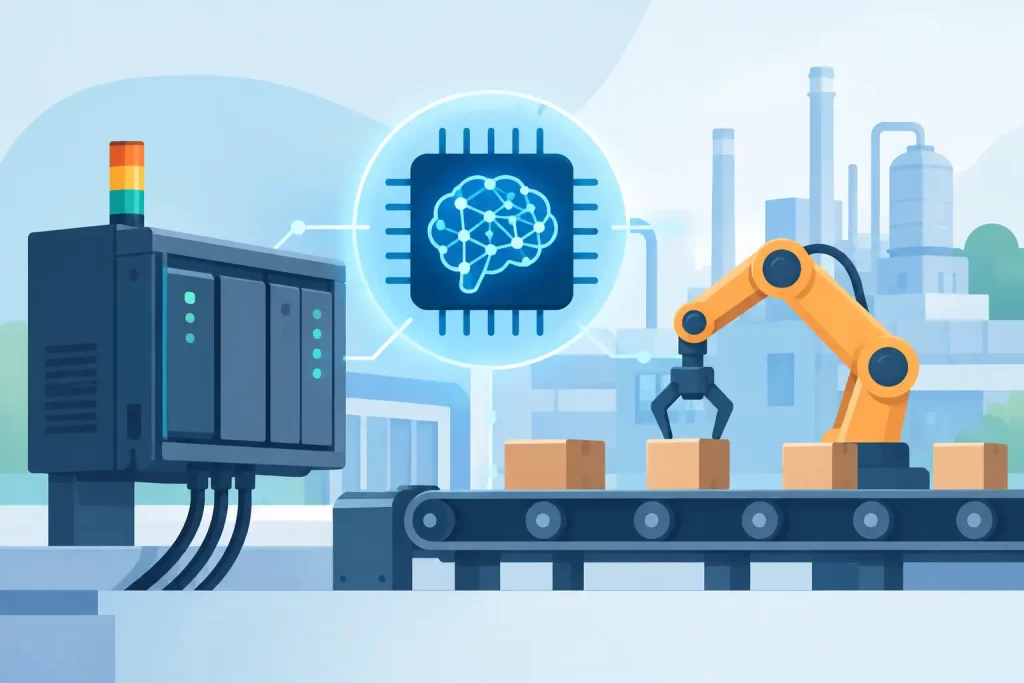
A production line does not wait for a cloud round trip. When a camera sees a surface defect, a microphone captures an abnormal acoustic signature, or a vibration sensor detects bearing wear, the decision may be needed within milliseconds. Embedded neural networks place trained recognition directly beside the signal source, allowing industrial equipment to classify patterns and trigger action without depending on a remote server.
For automation engineers and OEMs, the value is not simply that a neural model runs on a small device. It is that the recognition function becomes part of the machine architecture: local, predictable, power-aware, and available even when network conditions are limited or controlled by plant policy.
What Embedded Neural Networks Change
A conventional machine learning deployment often separates sensing, inference, storage, and analytics. A device collects data, transfers it to a server or cloud service, and waits for a model response. That architecture can work well for reporting, fleet analysis, and long-term optimization. It can be a poor fit for decisions that must occur at the machine edge.
Embedded neural networks execute inference in or near the controller, sensor gateway, camera system, or embedded computer. The input can be an image, a video region, an audio sample, a vibration spectrum, or another free-form signal. The output can be a class, a confidence value, an anomaly flag, or a control event sent to a PLC, actuator, database, or supervisory system.
This changes four operating characteristics at once. Latency is reduced because data remains local. Bandwidth demand falls because raw streams do not need continuous transmission. Privacy and data control improve because sensitive production imagery or process signals can stay on site. System availability also improves when recognition must continue during network outages or when external connectivity is intentionally restricted.
The edge is not a replacement for central computing. A server remains useful for model management, recorded-data review, reporting, and multi-site analysis. The engineering decision is about where each task belongs. Real-time recognition belongs close to the process when delay, bandwidth, or operational continuity matters.
The Architecture Behind Industrial Edge Recognition
An industrial embedded AI system is more than a model file installed on a processor. Its practical performance depends on the full path from sensor input to control output.
At the acquisition layer, the system receives data from cameras, microphones, accelerometers, encoders, measurement instruments, or existing industrial networks. Signal conditioning and preprocessing may isolate a region of interest, normalize a waveform, calculate features, or convert sensor data into a form suitable for recognition.
The neural controller then compares the incoming pattern with learned categories or prototypes. In a trainable architecture, engineers can build recognition behavior from representative examples instead of writing rigid threshold logic for every variation. This is useful when a defect, sound, or operating condition has visual or signal-level variability that conventional rules cannot represent efficiently.
Finally, the result is exposed to the automation environment. Depending on the installation, this can mean a digital output, a fieldbus message, a software API event, a quality record, or an alarm for an operator. The recognition result must be understandable within the existing control strategy. A high-confidence reject decision may stop a conveyor, while a low-confidence result may route a part to manual inspection rather than cause an unnecessary shutdown.
Deterministic Response Is an Engineering Requirement
Average inference speed is not enough for industrial applications. Engineers need to understand worst-case response time, input rate, processing queue behavior, and how the system behaves when data arrives continuously. A model that is fast in a demonstration but delays under real camera throughput or signal bursts can create false timing assumptions in the control design.
Embedded hardware acceleration addresses this requirement by executing recognition with dedicated resources rather than competing indefinitely with operating-system tasks, visualization software, or unrelated applications. Digital neural network hardware can be especially relevant where high-speed pattern comparison and low power operation are primary design constraints.
Training Must Match the Real Operating Envelope
The quality of an embedded neural system is determined by its examples. A visual inspection model trained only under ideal lighting may fail when optics become dirty, part orientation shifts, or material finish changes. An acoustic classifier trained during quiet test conditions may misinterpret signals after installation near other equipment.
Training data should represent normal variation as well as fault conditions: different production batches, expected environmental changes, allowable machine states, sensor placement variation, and realistic background noise. The goal is not to create a laboratory-perfect classifier. It is to establish a recognition boundary that remains useful in the physical operating envelope.
Where Embedded Neural Networks Deliver Value
Machine vision is a common entry point. A controller can recognize part presence, orientation, surface defects, labels, assembly completeness, or product categories at line speed. Local inference avoids transmitting high-volume image streams and supports immediate sorting or reject actions.
Condition monitoring is another strong fit. Vibration and acoustic signals contain patterns associated with imbalance, looseness, friction, bearing damage, tool wear, and abnormal cycle behavior. Rather than relying only on fixed amplitude thresholds, a trained neural controller can classify signal patterns that combine multiple characteristics. This is particularly useful when the same defect presents differently across load conditions or machine speeds.
Embedded recognition also supports operator and process monitoring. A system can identify states in recorded or live video, recognize recurring events, or classify nonstandard signal behavior for review. In these cases, edge processing reduces the volume of data sent upstream while retaining selected events, snapshots, and classifications for traceability.
For OEMs, the design advantage is product differentiation without requiring customers to deploy a separate AI server. A trainable controller or embedded board can be incorporated into equipment as a local intelligence layer. Hardware formats matter here. A PCIe implementation may fit an industrial computer, a Raspberry Pi format may support compact edge equipment, and a dedicated controller may suit a standalone automation enclosure.
Selecting the Right Embedded Implementation
The best implementation depends on the signal, required cycle time, integration environment, and maintenance model. A camera inspection station has different constraints than a battery-powered acoustic sensor or an industrial PC monitoring several channels.
Start with the decision, not the model. Define what the system must recognize, what action follows, how quickly the action is needed, and what outcome is acceptable when confidence is uncertain. This determines whether the application needs binary classification, multiclass recognition, anomaly detection, or a human-review path.
Then examine the data rate and interface requirements. Image resolution, frame rate, audio sampling frequency, vibration channel count, storage needs, and industrial communications all affect system design. A controller that recognizes one signal extremely quickly may not be the appropriate choice if the application also requires multi-camera recording, extensive visualization, or centralized data retention.
Power and thermal limits deserve equal attention. Low-power inference reduces enclosure cooling requirements and supports deployment in compact or distributed equipment. However, environmental rating, sensor quality, cable routing, electromagnetic compatibility, and service access can matter more than compute power in an actual plant installation.
Trade-Offs That Should Be Planned Early
Edge AI is not automatically the correct answer for every workload. Centralized infrastructure can be preferable when models are very large, training is frequent, decisions are not time-sensitive, or data from many sites must be analyzed together. The most effective systems commonly use both: local recognition for operational response and server-side software for oversight and continuous improvement.
Trainability also introduces governance requirements. Teams should control dataset versions, acceptance criteria, model updates, and rollback procedures. A new training set can improve recognition of one production variation while reducing accuracy for another. Validation should therefore include known good samples, known fault samples, borderline conditions, and production-rate testing.
False positives and false negatives must be evaluated against process cost. In a safety-critical or high-value application, a conservative classifier that requests manual review may be preferable to an aggressive automated decision. In high-throughput sorting, the economics may support a different threshold. There is no universal confidence value that fits every line.
Building a Deployable System
A practical project begins with a short measurement phase: capture representative signals, document operating states, and define the desired control response. Next, train and test recognition using data that reflects real conditions rather than selected examples. Integrate the controller with the target interfaces, then validate timing and accuracy under normal production load.
NeuroTechnologijos applies this approach through trainable NT Adaptive controllers and supporting software for images, video, audio, vibration, and other free-form signals. The intent is direct: move high-speed recognition from an experimental AI workflow into an industrial component that can be integrated with existing sensing and automation infrastructure.
The most useful embedded neural system is rarely the one with the largest model. It is the one that recognizes the relevant pattern at the required speed, fits the available hardware and interfaces, and gives operators and control systems a decision they can act on with confidence.
