

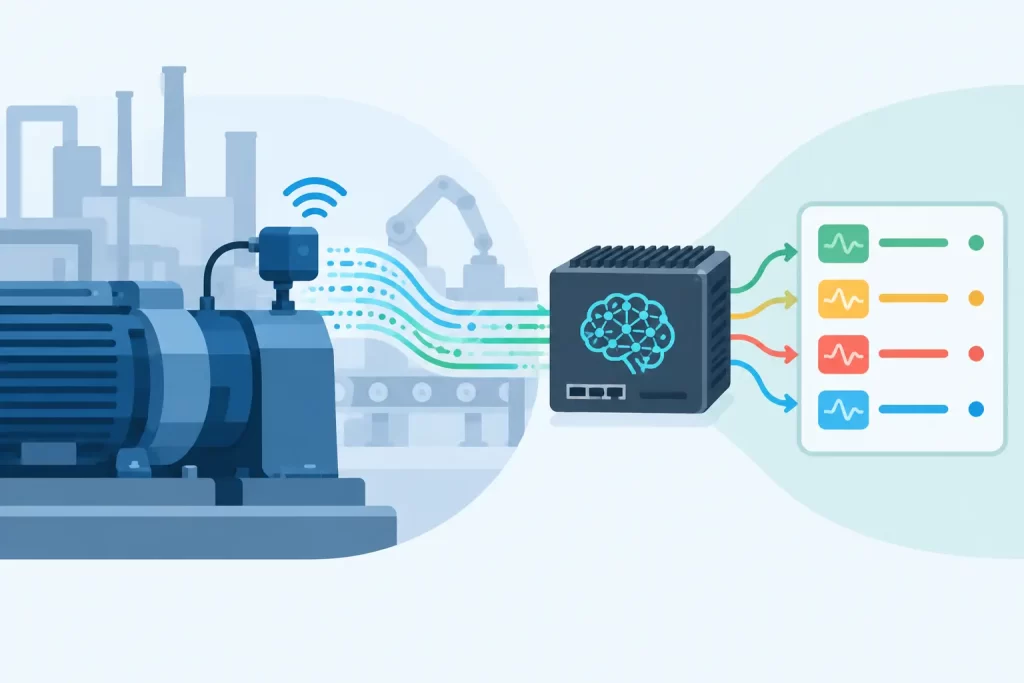
A vibration trace does not arrive with a label saying “outer race defect.” An acoustic recording does not identify a compressed-air leak, and a thermal signal does not explain whether a temperature rise is process-related or abnormal. That context must be created before a trainable recognition system can make dependable decisions. Knowing how to label industrial sensor data is therefore a core engineering task, not a data-preparation afterthought.
For industrial teams, useful labeling is less about producing the largest possible dataset and more about capturing operational meaning. Labels must reflect the decisions a controller, maintenance system, or operator needs to make in live conditions. A poorly defined label set can train a model to recognize collection artifacts, machine identity, or background noise instead of the actual condition of interest.
Start With the Operating Decision
Define the output action before reviewing a single signal. Ask what the system must do when it recognizes a pattern: raise an alert, reject a product, classify a machine state, adjust a process parameter, or route an event for human review.
This decision determines the right label taxonomy. A predictive-maintenance system may need labels such as normal operation, imbalance, misalignment, bearing degradation, lubrication issue, and unknown anomaly. A quality-control application may instead require acceptable, surface defect, dimensional defect, contamination, and inconclusive. These are different classification problems even when they use the same camera, microphone, or accelerometer.
Avoid labels that are technically interesting but operationally unusable. For example, separating twelve bearing-fault subtypes may be unnecessary if the maintenance workflow only requires a distinction between normal, monitor, and service-required. Conversely, a single “fault” label is too broad if corrective action depends on identifying the failure mode.
A practical taxonomy should meet three conditions. Each class must be observable in the available sensor data, distinguishable from nearby classes, and connected to a defined response. If one of these conditions is missing, the label is likely to create inconsistent training examples.
How to Label Industrial Sensor Data by Time Window
Industrial signals are continuous, but most recognition systems operate on discrete observations. The engineering question is where an event begins and ends.
For vibration, current, pressure, acoustic, and other time-series data, define a fixed or event-based analysis window. A window may represent one machine cycle, one revolution, two seconds of steady-state operation, or the period surrounding a detected transient. The correct duration depends on the physics of the signal and the recognition latency required by the application.
A short window improves response time but may not contain enough evidence to identify a low-frequency mechanical pattern. A long window can improve context but introduces latency and may mix multiple operating states. There is no universal duration. Test candidate windows against actual machine behavior, rotational speed variation, production cycle time, and the target edge hardware budget.
When an event has uncertain boundaries, do not force false precision. Mark the core event interval and preserve a boundary-confidence field. For example, an acoustic leak may emerge gradually above background noise. The label can identify the leak condition while metadata records whether the start point is confirmed, estimated, or ambiguous.
For image and video data, apply the same principle spatially and temporally. A defect label should state whether it refers to the full image, a region of interest, a tracked object, or a sequence of frames. A visual anomaly visible in only two frames should not be labeled as if every frame in a ten-second clip contains it.
Capture Context as Metadata, Not as an Afterthought
The class label alone is rarely enough for industrial AI. Sensor readings are shaped by process state, installation conditions, sensor configuration, material batches, and environmental changes. Store this context with every labeled record.
Useful metadata generally includes machine or asset identifier, sensor type and mounting location, sampling rate, gain or calibration setting, operating mode, load or speed, product type, timestamp, and source system. Where available, also capture maintenance history, confirmed failure reports, and operator observations.
This information serves two purposes. First, it lets engineers investigate whether a model is recognizing a true physical condition or a shortcut. If all examples of a fault were recorded from one machine at one speed, a high validation score may reflect machine-specific characteristics rather than fault recognition. Second, metadata supports later retraining when equipment, sensors, or production conditions change.
Do not place operating conditions inside the target class unless the condition itself is the desired output. “Normal at 1,800 RPM” and “normal at 2,400 RPM” are often better represented as the label normal plus a speed field. Splitting them into separate classes can create an unnecessarily fragmented dataset. However, if speed-dependent state recognition is the automation objective, distinct speed classes may be appropriate.
Build Label Definitions That Different Engineers Can Apply
A label specification should read like an engineering procedure. Every class needs a short definition, inclusion rules, exclusion rules, representative signal examples, and a process for uncertain cases.
Consider a label called “bearing degradation.” Without a definition, one reviewer may apply it to any elevated vibration level while another requires harmonics consistent with a known bearing frequency. The resulting dataset combines different phenomena under one class. A trainable controller cannot learn a stable pattern from an unstable concept.
Define at least four items for each class:
- The physical or process condition represented by the label.
- The observable evidence required in the signal, image, video, or audio stream.
- Conditions that look similar but must receive another label or be excluded.
- The evidence source used to confirm the class, such as inspection, maintenance records, calibrated test data, or expert review.
Include an “unknown,” “uncertain,” or “not classifiable” path. This is not wasted data. It prevents annotators from placing ambiguous examples into normal or fault classes just to complete a task. These records can later support anomaly detection, reviewer training, or expansion of the taxonomy.
Use Ground Truth Appropriate to the Risk
The strongest labels come from independent confirmation. A bearing condition confirmed during teardown carries more weight than an operator’s informal observation. A product defect verified by inspection is stronger than a visual guess from a camera frame. Yet confirmed failure data can be scarce, especially for high-value equipment where failures are intentionally prevented.
Use a hierarchy of evidence. Controlled test-rig data and post-maintenance verification can establish high-confidence reference patterns. Historical maintenance events may provide useful labels but require careful alignment between the recorded event and the sensor data. Operator annotations are valuable for collecting candidate events, though they should be reviewed before being treated as final ground truth.
This trade-off matters in edge deployments. A recognition controller can learn quickly from representative examples, but it cannot compensate for a label that is detached from the underlying physical condition. A smaller collection of confirmed examples is often more valuable than a large archive of weak labels.
Review Disagreement and Dataset Leakage
Label quality should be measured, not assumed. Send a representative sample to two qualified reviewers and compare their assignments. Repeated disagreement usually indicates a weak definition, insufficient signal context, or a category that combines multiple mechanisms.
Review errors at the class boundary. Normal startup behavior may resemble a fault transient. A product changeover can look like a process anomaly. A microphone may capture a nearby machine rather than the intended asset. These are not minor annotation issues. They are conditions that can create false alarms after deployment.
Also prevent dataset leakage. Do not randomly split highly similar windows from one continuous recording between training and validation sets. The model may see nearly identical patterns in both sets and appear more accurate than it will be on a new shift, machine, or production batch. Split data by time period, asset, batch, operating regime, or recording session according to the deployment scenario.
For example, if the controller will be installed on machines not represented in training, validate against entire unseen machines. If it will monitor one machine across seasonal conditions, reserve later time periods for validation. The validation design must imitate the operational change the system will face.
Design Labels for Edge Deployment
Edge AI introduces practical constraints that should influence the labeling plan. Recognition must fit within available memory, compute time, sensor bandwidth, and power limits. A label set with many visually or acoustically similar classes may be valid scientifically but unsuitable for a low-latency control loop.
Start with the smallest class structure that supports the operational decision. Expand it only when confusion analysis shows that additional distinctions improve action quality. This approach is particularly effective for embedded neural controllers that perform trained pattern recognition directly near the sensor source.
The same principle applies to multimodal systems. Combining vibration, audio, process values, and video can improve confidence, but only if their timestamps and labels are synchronized. If camera data is labeled per product while vibration is labeled per five-second interval, define the rule that connects them before training. Misaligned modalities create apparent contradictions that are actually annotation defects.
NeuroTechnologijos deployments can use trainable recognition at the edge to classify free-form industrial signals without sending every raw observation to a central server. That architecture increases the value of disciplined labels: the embedded system needs examples that map directly to real-time decisions under actual operating conditions.
Treat Labels as a Controlled Engineering Asset
Labeling does not end when the first model is trained. Equipment wears, sensors are replaced, materials change, and processes are retuned. Keep label specifications versioned, record who approved changes, and retain the original source data so classifications can be audited or revised.
Monitor live events that fall near decision thresholds or receive low recognition confidence. These are often the most valuable candidates for review. They reveal emerging operating states, sensor drift, and gaps between the original dataset and the real plant floor.
The useful target is not a perfectly annotated archive. It is a living, traceable dataset that gives an industrial recognition system enough evidence to make the right decision at the right time. When labels are tied to physical conditions, operating context, and verification evidence, every additional sensor record becomes a more reliable part of the automation system.
