

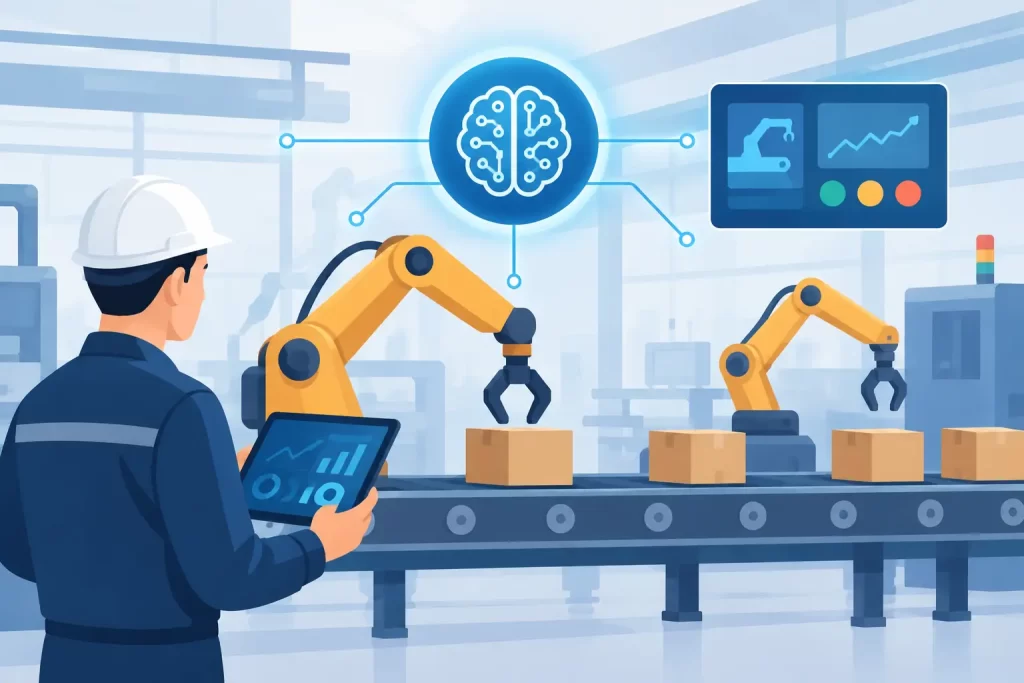
A production line can generate thousands of meaningful signal changes before an operator sees a single alarm. A bearing develops a new vibration signature, a camera detects a surface anomaly, an acoustic sensor captures an irregular impact, or a process waveform drifts outside its normal pattern. The operational challenge is not simply collecting this data. It is recognizing the relevant pattern early enough to act.
Industrial AI addresses that challenge by placing trainable recognition and decision capability close to the equipment, sensors, and control systems that produce the data. For automation engineers and OEMs, the value is measured in response time, false-positive control, integration effort, power consumption, and the ability to maintain reliable operation under real plant conditions.
What Industrial AI Does Differently
Enterprise AI is often designed around centralized datasets, high-capacity servers, and delayed analysis. That approach can be useful for reporting, fleet-level optimization, and model development. It is not always appropriate for a machine that must classify an event in milliseconds, continue operating during a network interruption, or fit inside a constrained embedded enclosure.
Industrial AI is engineered around the physical operating environment. It processes machine-facing inputs such as images, live and recorded video, audio, vibration, current signatures, and other free-form signals. The system identifies learned patterns and returns a classification, alarm, command, or control decision that can be consumed by existing automation infrastructure.
The distinction matters because industrial data is rarely clean. Lighting changes on a line. Product orientation varies. Motors operate across different loads. Sensor placement is imperfect. Background noise shifts between shifts and facilities. A useful AI system must recognize the pattern that matters without requiring a laboratory-quality input stream.
Recognition at the edge
Edge deployment keeps recognition close to the source of the signal. Instead of transmitting every video frame or high-frequency vibration sample to a remote service, an embedded controller can evaluate the data locally and transmit only the result, selected evidence, or an exception event.
This architecture reduces network dependency and can materially lower bandwidth requirements. It also supports deterministic response paths: sensor input, pattern recognition, control action. For machine protection, defect rejection, access control, and fast sorting applications, that path is often more relevant than the maximum throughput of a cloud-based model.
Local processing does not eliminate the role of servers. Server-based software remains valuable for configuring systems, reviewing recorded signals, organizing recognition tasks, and managing larger deployments. The design question is which functions require immediate local execution and which benefit from centralized visibility. The answer depends on latency, connectivity, data volume, and operational risk.
A Practical Industrial AI Architecture
A production-ready architecture begins with the signal and ends with an action that is understandable to the control environment. Between those points, the recognition layer must be trainable, fast, and deployable in hardware compatible with the installation.
At the sensing layer, the system may receive camera images, video streams, microphones, accelerometers, or process signals through industrial interfaces. Signal quality still matters. AI can tolerate variation, but it cannot compensate indefinitely for a poorly mounted sensor, an unsuitable lens, insufficient illumination, or an acquisition rate that misses the event of interest.
The recognition layer converts the input into a learned decision. Trainable neural controllers are particularly relevant where a fixed rule is too brittle. A traditional threshold may detect a severe vibration increase, for example, but it may not distinguish a normal load transition from the acoustic-vibration signature of a developing mechanical fault. Training allows the controller to associate representative examples with operational classes.
The output layer connects recognition to action. Depending on the application, that may mean setting a digital output, notifying a PLC, flagging a record in supervisory software, triggering a reject mechanism, or storing an event for engineering review. Integration should be planned early. A high-performing classifier has limited operational value if its decision cannot be passed reliably into the plant’s existing control and quality processes.
Hardware selection is an engineering decision
The form factor of the AI controller affects installation, maintenance, and system design. A compact embedded board may be the correct choice for an OEM product or a distributed sensor node. A PCIe format may suit an industrial computer performing higher-volume acquisition and local analysis. A standalone controller may simplify retrofit projects where existing machine hardware has limited compute capacity.
NeuroTechnologijos supports this range through NT Adaptive controller formats including .VASS, PCIe, and Raspberry Pi implementations. The common objective is not to force every application into one compute platform. It is to place trainable neural recognition where it can operate effectively within the electrical, mechanical, and software constraints of the equipment.
Specialized neural hardware can be especially relevant when low power and response speed are both requirements. General-purpose processors can execute AI workloads, but they may impose higher power draw, longer inference paths, or more software complexity than an embedded recognition task requires. The appropriate choice depends on the model, signal rate, environmental conditions, and expected lifecycle of the deployed system.
Where Industrial AI Produces Measurable Value
Machine vision is an obvious application, but it is only one part of the opportunity. On a packaging line, recognition can distinguish correct labels, cap positions, fill states, and surface conditions. In discrete manufacturing, it can identify missing components, assembly variations, and part orientation. The useful metric is not only detection accuracy. It is whether the system maintains that performance at line speed with an acceptable false-reject rate.
Condition monitoring benefits from the same pattern-recognition approach. Vibration and acoustic signals often contain early indicators that conventional point thresholds do not capture well. A trained system can classify operating states, identify abnormal signatures, and direct maintenance attention toward equipment that warrants inspection. This does not remove the need for engineering diagnosis. It makes diagnosis more targeted by separating meaningful changes from routine operational variation.
Industrial AI also applies to recognition tasks that combine modalities. A motor fault may present as a change in vibration, sound, temperature, and electrical behavior. Not every deployment needs all of these inputs. In fact, adding sensors without a clear failure-mode hypothesis can complicate the project. But when a single signal is ambiguous, combining complementary evidence can improve confidence and reduce nuisance alerts.
Training Must Reflect the Operating Envelope
A trainable controller is only as useful as the examples used to train it. Teams should capture representative samples across normal production variation: different products, machine speeds, lighting states, tool conditions, operators, and environmental conditions. They should also include the failure or anomaly classes the system is expected to recognize.
The difficult cases are usually the rare ones. A defect may occur only intermittently, and a serious machine fault may be unavailable as a training example because equipment cannot be intentionally damaged. In these cases, teams may begin with normal-state recognition, controlled test samples, historical recordings, or staged validation. The goal is not to claim certainty where data is limited. It is to define what the system can classify reliably and what should remain an operator or maintenance-engineer decision.
Validation should occur on data that was not used for training and, whenever possible, under live operating conditions. Engineers should examine false positives and false negatives separately. In quality control, a false accept may be more costly than a false reject. In predictive maintenance, excessive false alarms can erode operator trust and create unnecessary interventions. The correct decision threshold depends on the process consequence.
Deployment Requires More Than a Model
Industrial environments reward systems that are maintainable. That means retaining representative event data, documenting classes and outputs, establishing a retraining process, and defining who owns performance monitoring after commissioning. A classifier can degrade when the product, sensor, tooling, or process changes. This is not a failure of AI. It is a normal consequence of deploying recognition into a changing physical system.
Cybersecurity and network design also deserve early attention. Edge systems can reduce the amount of raw data leaving a machine, but they still need managed interfaces, access control, update procedures, and clear separation from safety functions. AI recognition can inform safety-related workflows, yet the safety architecture itself must remain designed and validated to the applicable industrial requirements.
The most effective projects begin with one measurable operational decision: reject this defect, classify this machine state, identify this sound pattern, or alert on this deviation. Define the acceptable response time, available signal, integration point, and cost of error. From there, industrial AI becomes a practical engineering layer that turns raw machine behavior into timely, actionable information.
