

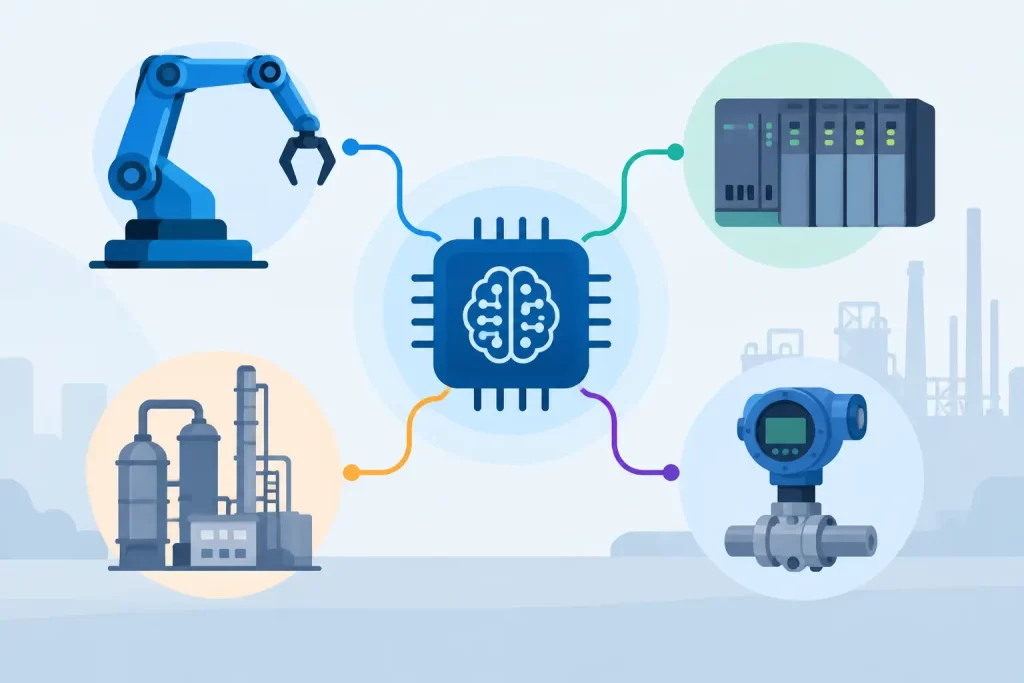
A vision or vibration classifier can identify a defect in milliseconds, but that result has little operational value if the controller cannot deliver it to the PLC, historian, alarm system, or machine interface that governs the process. Industrial protocol compatibility is therefore an integration requirement, not a secondary communications feature. It determines where an AI controller can be deployed, how quickly its output becomes actionable, and how much engineering effort is required to put it into service.
For industrial AI systems, compatibility is not simply a question of whether two devices can establish a network connection. The practical question is whether the system can exchange the right data, in the required direction, at the required rate, with behavior that plant engineers can validate and maintain.
What Industrial Protocol Compatibility Actually Means
Industrial communication protocols define far more than packet transport. They establish data models, timing expectations, device roles, addressing methods, error handling, diagnostics, and sometimes security mechanisms. A controller that can transmit a classification result over Ethernet is not automatically compatible with a production line that expects cyclic EtherNet/IP data, a PROFINET device model, or an OPC UA information structure.
Compatibility must be evaluated at three levels. Physical and network compatibility concerns interfaces such as Ethernet, serial communication, or fieldbus gateways. Protocol compatibility concerns whether the device can speak the required industrial language, such as Modbus TCP, OPC UA, EtherNet/IP, PROFINET, or MQTT. Application compatibility concerns the most overlooked issue: whether a receiving system understands what the data means and can use it safely.
Consider an edge AI controller monitoring a motor through vibration and acoustic signals. Its output may be a binary fault indication, a confidence score, a recognized condition class, or a set of extracted features. A maintenance system may need a timestamped condition event, while a PLC may need a single deterministic bit that triggers a controlled stop. Both are valid interfaces, but they are not interchangeable.
Why AI Adds a Compatibility Challenge
Traditional automation devices generally expose fixed states: temperature, speed, position, pressure, and discrete I/O. Industrial AI introduces recognition outputs that are probabilistic, configurable, and often trained for a specific operating context. That flexibility is valuable, but it requires disciplined interface design.
An AI device may recognize visual defects, anomalous vibration signatures, audio events, or process states from free-form signals. The integration layer must translate those recognition results into information that a plant system can act on. For example, a classification labeled “bearing degradation” may need to be converted into an alarm level, a maintenance code, an operator message, and a trend value. The right mapping depends on the production process and the consequences of a false positive or missed event.
Latency also matters. A quality inspection station rejecting a defective product may require a response within a tightly bounded machine cycle. Predictive maintenance monitoring can often tolerate seconds or minutes, provided timestamps and event histories are reliable. Protocol selection should follow the control requirement, not a preference for the newest or most familiar connectivity standard.
Determinism Is Not the Same as Low Latency
A fast recognition engine does not by itself create deterministic automation. Recognition may occur in microseconds or milliseconds, while the network path, gateway, PLC scan cycle, and output logic introduce additional delay and variation.
For closed-loop or safety-adjacent applications, engineers should calculate the full decision path: sensor acquisition, preprocessing, AI inference, result publication, PLC consumption, logic execution, and actuator response. The result must be measured under operational load, not assumed from a benchmark specification.
Where a decision is advisory rather than control-critical, asynchronous communication can be appropriate. OPC UA or MQTT may be effective for transferring rich diagnostics, images, model status, and maintenance events to supervisory systems. For time-sensitive machine action, a local hardwired output or a cyclic industrial Ethernet interface may be the better architecture. Many installations require both paths.
Protocol Selection Should Follow the System Boundary
The most effective architecture usually separates machine control from information exchange. At the machine boundary, the AI controller must provide outputs that fit existing automation logic. At the supervisory boundary, it should provide richer context for engineering, quality, and maintenance functions.
A packaging machine may use discrete outputs or a PLC-oriented network interface to accept pass, fail, and fault states from an inspection controller. The same inspection system may expose images, confidence values, recognition statistics, and configuration status through a higher-level interface for traceability. Trying to force every data type through one protocol often creates unnecessary complexity.
Protocol selection should also account for the installed base. A plant with Siemens PLCs, established PROFINET networks, and standardized diagnostics procedures has different integration constraints than an OEM building compact equipment around Ethernet/IP or Modbus TCP. Compatibility with the customer’s engineering tools, network policies, and commissioning workflow can be as consequential as raw throughput.
Do not assume that a gateway eliminates all compatibility risk. Gateways can solve physical and protocol translation problems, but they may limit diagnostics, add latency, obscure device states, or complicate support. They should be assessed as a system component with defined behavior during startup, communication loss, and recovery.
Define the Data Contract Before Selecting Hardware
The most reliable integrations begin with a data contract. This is a concise technical definition of what the AI system publishes, what the automation system writes back, and how both sides behave when communication is unavailable.
For a recognition controller, the contract should define the result format, valid state, confidence handling, timestamp source, update rate, and fault codes. It should specify whether a result remains latched until acknowledged, whether it is valid for one machine cycle, and what happens when a model is retrained or an input signal becomes invalid.
A useful contract also distinguishes between a no-defect result and an unknown result. If a camera is blocked, a vibration sensor is disconnected, or the incoming signal falls outside trained conditions, reporting “no fault” can be operationally dangerous. The PLC or supervisory system needs a separate quality or availability state so that machine logic can respond appropriately.
For applications that include recipe changes or product variants, define model selection explicitly. The automation system may need to request a specific trained model based on the active product, while the AI controller must confirm that the correct model is loaded and ready before production begins. This handshake is more valuable than an informal assumption embedded in operator procedure.
Commissioning Tests That Expose Integration Problems
Bench testing a protocol connection is necessary but insufficient. Industrial protocol compatibility should be verified against realistic conditions: network restarts, power cycles, controller restarts, invalid sensor data, PLC mode changes, and high message load. Engineers should observe not only whether communications resume, but whether the resumed data is current, correctly identified, and safe to act upon.
Test the behavior of stale values. A PLC retaining the last valid defect signal after an AI controller has gone offline can cause either unnecessary stops or missed defects, depending on the logic. Define watchdogs, heartbeat signals, sequence counters, and timeout behavior where the process requires them.
Diagnostics deserve the same attention as the primary result. A system integrator should be able to determine whether a fault originated in sensing, model operation, network communication, or downstream PLC logic. Clear diagnostic separation reduces mean time to repair and prevents a communications issue from being mistaken for an AI performance issue.
Edge AI Requires an Interface Built for Operations
Edge-based recognition is attractive because it places inference close to cameras, microphones, vibration sensors, and industrial equipment. This reduces dependence on cloud connectivity and can keep response times short. However, edge deployment does not reduce the need for a disciplined industrial interface. It increases it, because the device is now part of the operational technology environment.
NeuroTechnologijos designs trainable NT Adaptive controllers for embedded recognition of images, video, audio, vibration, and other free-form signals. In these applications, the value of fast, low-power neural processing depends on an equally clear path from recognition output to plant action. Hardware format, host interface, protocol support, and software integration should be reviewed together rather than treated as separate purchase decisions.
The right compatibility strategy is rarely the one with the longest protocol list. It is the one that gives the machine a dependable control signal, gives engineers usable diagnostics, and gives operations a maintainable path to scale the application across equipment and sites.
