

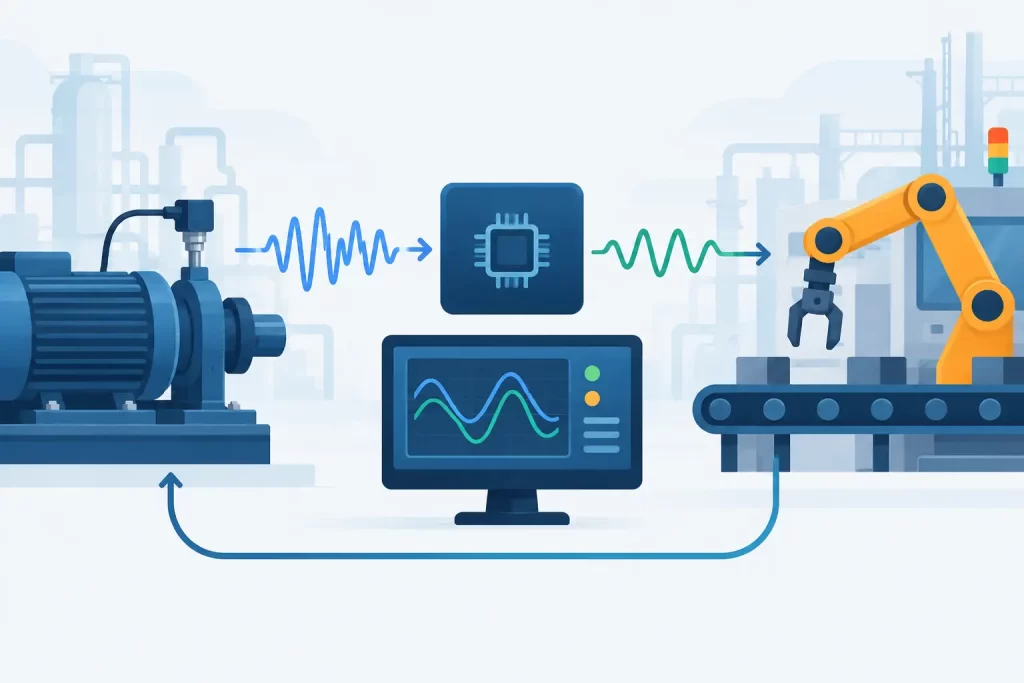
A bearing does not announce its failure in a maintenance report. It begins with a slight spectral change in vibration, an intermittent acoustic signature, or a current waveform that no longer matches normal load behavior. By the time a conventional alarm threshold is crossed, the useful warning window may be smaller than the maintenance team needs. Industrial signal processing is the discipline that turns those raw measurements into timely, actionable machine decisions.
For industrial operators, the requirement is not simply to collect more data. It is to classify relevant patterns accurately, at the point where the signal is produced, with predictable timing and without placing an unnecessary compute burden on the control network. That changes how a signal-processing system should be designed.
What Industrial Signal Processing Must Deliver
Industrial signal processing covers the acquisition, conditioning, analysis, and interpretation of data from physical processes. The data may be vibration from an accelerometer, audio from a microphone, imagery from a production line, electrical current from a motor drive, pressure from a hydraulic circuit, or a combined stream from several sensors.
Traditional systems often apply fixed methods such as thresholds, band-pass filters, fast Fourier transforms, and rule-based alarms. These methods remain valuable. A filter can remove known electrical interference, and a threshold can provide a direct safety limit. Their weakness appears when the pattern is variable: a fault evolves differently by machine, product, speed, ambient condition, or operating mode.
Trainable recognition adds another layer. Instead of defining every acceptable and unacceptable signal characteristic manually, engineers can provide representative examples and train a classifier to recognize the relevant classes. This is particularly useful when the difference between normal and abnormal behavior is distributed across a waveform, image sequence, or time-frequency representation rather than concentrated in one value.
The engineering objective is not to replace deterministic processing with AI. It is to combine signal conditioning, domain knowledge, and trained classification into an architecture that produces a usable decision within the process time available.
From Sensor Data to an Industrial Decision
A reliable system begins at the sensor interface. Sampling rate, resolution, sensor placement, mounting method, cable routing, and synchronization all affect what can be recognized later. A high-quality model cannot recover frequency content that was never sampled or correct a vibration sensor mounted on a flexible cover instead of a load-bearing structure.
Acquisition and conditioning
The first stage converts an analog or digital source into a usable data stream. Depending on the application, this can include anti-alias filtering, amplification, baseline removal, normalization, windowing, and synchronization with machine state. For vibration analysis, rotational speed or encoder position may be required to distinguish a true mechanical event from a change caused by operating speed. For vision, stable illumination and controlled exposure often matter as much as the recognition algorithm.
Conditioning should be purposeful. Excessive preprocessing can remove the weak characteristics that identify an emerging defect. Too little conditioning can force the classifier to learn irrelevant effects from electrical noise, lighting variation, or inconsistent gain. The correct balance depends on the source signal and the failure modes under examination.
Representation and feature selection
Some applications can be classified directly from time-domain samples. Others benefit from a representation that makes patterns easier to separate. Vibration and audio signals may be represented through frequency spectra, spectral bands, envelopes, or time-frequency maps. Image systems may use regions of interest, geometric measurements, or learned visual features. Current and voltage data may be evaluated in relation to load, motor speed, and switching behavior.
The key question is whether the representation preserves the information needed for a decision while meeting latency and memory limits. A detailed spectrogram can expose transient faults, but its calculation and storage requirements may not suit every embedded controller. A compact feature vector is efficient, but may conceal distinctions needed to separate early wear from normal process variation.
Recognition and control action
Recognition is only valuable when its output has a defined operational meaning. A classifier may assign a signal to normal, warning, defect, or unknown categories. The automation system must then determine whether to record the event, alert an operator, reject a part, reduce machine speed, request inspection, or stop the process.
This action layer needs safeguards. In many production environments, a recognition result should not directly initiate a machine stop without confidence limits, persistence rules, or confirmation from other sensors. Conversely, a defect-detection system on a fast line cannot wait for a remote server response before triggering a reject mechanism. Decision logic must reflect the cost of false positives, missed detections, and delayed action.
Why Edge Processing Changes the Architecture
Sending every video frame, waveform, and sensor channel to centralized infrastructure is expensive and often unnecessary. It consumes bandwidth, introduces variable latency, and can make an otherwise local machine function dependent on network availability. For high-rate signals, the transport problem can become larger than the recognition problem.
Edge processing places analysis near the equipment. A local controller receives the signal, executes preprocessing and recognition, and returns a result to the PLC, supervisory system, or machine interface. Only events, classifications, selected records, and diagnostic data need to move upstream.
This architecture supports predictable response times and keeps critical recognition operational during network interruptions. It also reduces the amount of raw process data exposed outside the production cell. The trade-off is that embedded hardware has finite compute, power, thermal, and memory budgets. Models and signal pipelines must be selected for the deployment target rather than developed only for a server environment.
NeuroTechnologijos addresses this requirement with trainable NT Adaptive controllers based on NeuroMem digital neural network technology. The available controller formats, including .VASS, PCIe, and Raspberry Pi implementations, allow integrators to align recognition hardware with the physical and software architecture of the machine. The practical advantage is not generic AI capacity. It is local pattern recognition designed to operate alongside industrial sensing and control systems.
Where Trainable Recognition Adds Value
Condition monitoring is a direct application. A trained system can distinguish normal vibration signatures from imbalance, misalignment, looseness, bearing degradation, or process-specific anomalies. It can also separate a real fault pattern from ordinary changes in rotational speed or product load when the training examples reflect those operating conditions.
Acoustic monitoring follows the same principle. Pneumatic leaks, valve actuation errors, gear contact changes, and incomplete assembly can produce sounds that operators recognize intuitively but conventional thresholds miss. A classifier can convert those recurring acoustic cues into a consistent automated decision.
In quality control, visual and multimodal inspection systems can recognize surface defects, missing components, incorrect assembly states, labels, markings, or packaging anomalies. Combining image data with process signals may improve discrimination. For example, an image of a questionable weld can be evaluated in context with power, force, or time-series data from the welding cycle.
There is no universal benefit to adding more sensor types. Each additional stream introduces integration, calibration, storage, and maintenance work. Multimodal analysis is justified when the new source resolves ambiguity that one signal cannot. If a camera already identifies a defect with the required accuracy and cycle time, vibration data may add cost without improving the decision.
Design for Change, Not Just Initial Accuracy
Industrial processes change. Tooling wears, products are revised, sensors are replaced, operating windows shift, and background conditions evolve. A recognition system trained only on ideal commissioning data can lose relevance after deployment. This is often called drift, but the operational issue is straightforward: the pattern seen in production no longer matches the pattern represented in the training set.
A maintainable deployment records representative examples, including uncertain cases and confirmed faults. Engineers should define how classifications are verified, when training data is updated, and how revised models are tested before release. Version control matters because a model update is a functional change to the automation system, not a minor software adjustment.
Performance should be measured beyond a single accuracy figure. Detection rate, false alarm rate, class-specific performance, inference time, end-to-end decision latency, and behavior under poor signal conditions all matter. A system that identifies defects accurately in a controlled test but misses the production cycle deadline has not met the industrial requirement.
The most effective industrial signal processing projects start with a concrete decision: identify a failing bearing before damage spreads, reject an incomplete assembly at line speed, or classify an abnormal machine sound before downtime occurs. From there, sensor selection, training data, edge hardware, and control integration can be engineered around the actual consequence of the decision. That focus keeps the system accountable to the machine, where the signal first becomes valuable.
