

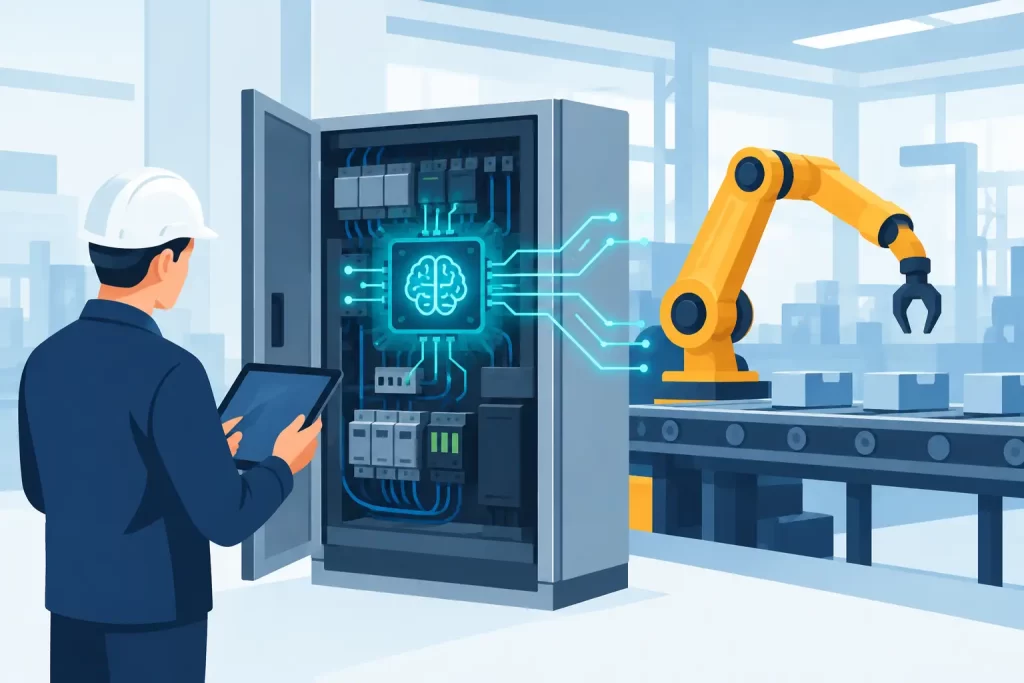
A neural controller retrofit is often the shortest path from conventional automation to machine perception. It adds trainable recognition at the edge while preserving the PLCs, drives, sensors, safety circuits, and supervisory systems that already run a production asset. For plants with long-lived equipment, this is usually more practical than replacing a working control architecture simply to introduce AI.
The retrofit question is not whether AI can be connected to a machine. It is whether it can make a useful decision at the required speed, with a defined signal path, under real electrical and environmental conditions. A successful design treats the neural controller as an industrial recognition layer: it observes images, video, vibration, audio, or other free-form signals; classifies relevant patterns; and sends a bounded result to the existing automation system.
Where a Neural Controller Retrofit Fits
Traditional industrial controls are highly effective when the process state is represented by fixed thresholds, discrete sensors, recipes, or deterministic motion sequences. They are less effective when the decision depends on a pattern that is difficult to describe with rules. A bearing may emit a changing acoustic signature before failure. A camera image may show an irregular surface defect. A vibration waveform may indicate a developing imbalance while remaining within an acceptable overall amplitude range.
These cases do not always require a cloud platform or a full replacement of the controls stack. They require a local recognition function that can be trained on representative examples and integrated with known machine states. The controller can classify a condition as normal, suspect, defect, alarm, or another application-specific category. The PLC remains responsible for the machine sequence, interlocks, and deterministic action.
This division of responsibility matters. It reduces integration risk and makes the retrofit easier to validate. The neural component provides perception; the established control system decides how the production process responds.
Suitable retrofit applications
Common applications include visual inspection, part or label recognition, vibration and acoustic condition monitoring, process anomaly detection, and classification of sensor signatures that cannot be reduced to a single limit value. In each case, the value comes from converting a complex signal into an actionable industrial output.
For example, an inspection station may already have a reject mechanism and encoder-based timing. Adding an edge neural controller can provide a defect classification result before the part reaches the reject point. A maintenance system may already collect accelerometer data. A trainable controller can classify operating signatures locally and issue a warning bit to the PLC or historian when a learned abnormal pattern appears.
Start With the Decision, Not the Model
Retrofit projects fail when the team begins with an AI model discussion before defining the operational decision. The first engineering task is to state precisely what the controller must recognize, what output it must produce, and what happens after that output is received.
A useful specification identifies the signal source, sampling or frame rate, expected classes, required response time, false-accept and false-reject consequences, and the machine states in which recognition is valid. It should also define the fallback behavior. If the camera is obscured, a sensor cable fails, or confidence is insufficient, the automation system needs a known response rather than an ambiguous result.
The required latency depends on the physical process. A slow condition-monitoring application may tolerate periodic classifications. A high-speed inspection or sorting operation may require a decision within a tightly bounded window after a trigger. Recognition speed must therefore be evaluated as an end-to-end path: sensor acquisition, preprocessing, inference, communications, PLC scan behavior, and actuator timing.
Engineering a Neural Controller Retrofit
The hardware architecture should be selected around the installation point and the available interfaces. A controller located near a machine may need direct access to cameras, analog acquisition hardware, digital inputs, industrial Ethernet, or serial devices. A controller integrated in an existing industrial PC may instead use a PCIe form factor. A compact embedded installation may favor a board-level option where power consumption and physical space are constrained.
NeuroTechnologijos supports these deployment paths through NT Adaptive .VASS, NT Adaptive PCIe, and NT Adaptive Raspberry Pi formats. The relevant choice is not simply processing capacity. It is the combination of signal connectivity, enclosure design, service access, power availability, operating environment, and the host system already present at the machine.
Preserve the control boundary
A neural controller should not be inserted casually into safety-related logic. Its classification output can inform an alarm, inspection result, maintenance request, or controlled process adjustment, but safety functions must remain implemented and validated within the applicable safety architecture. The same principle applies to emergency stops, guarding, and protective interlocks.
For ordinary machine control, define a clear interface contract. This may include a trigger input, a ready signal, a classification code, a valid-result bit, a fault indication, and timestamps or diagnostic data. A compact interface is easier to test than an uncontrolled stream of data passed between systems.
Communications also deserve early attention. Integrators should identify protocol requirements, network segmentation, address management, remote access policy, and how the controller will expose health status. In a plant environment, a correct classification has limited value if operators cannot distinguish a process alarm from a disconnected sensor or a network fault.
Training Data Must Match Production Conditions
A trainable neural controller is only as useful as the examples used to train it. Production data should include normal variation, not just ideal samples. For visual inspection, that can mean changes in position, illumination, surface finish, acceptable markings, and product batches. For vibration or audio, it can mean load changes, speed ranges, background noise, startup behavior, and variations among otherwise healthy machines.
The difficult class is often the one with limited examples. Actual failures and rare defects may be scarce, which makes a simple train-test split misleading. Engineers should supplement known fault samples with carefully planned collection during maintenance, controlled trials where appropriate, and a staged deployment that initially records classifications without automatically acting on them.
Training should remain traceable. Record the data source, operating condition, class definition, training version, acceptance criteria, and the reason for subsequent updates. This discipline is especially valuable when the process, tooling, material supplier, camera position, or machine speed changes. A change that appears minor to operations can alter the signal distribution seen by the controller.
Validate the Entire Installation
Bench accuracy is not an acceptance test for an industrial retrofit. The installed system must be tested at production speed and across meaningful operating states. Validate triggering, sensor timing, recognition output, PLC handling, fault recovery, and the physical response of the machine.
Acceptance criteria should be tied to the cost of each error. In some inspection systems, a false reject creates avoidable scrap and operator intervention. In others, a false accept risks shipment of a defective product. In predictive maintenance, an early warning may be preferable to a late but highly certain alert, provided the maintenance team has a workflow for reviewing it.
Run-time diagnostics are equally important. Monitor input availability, controller status, result validity, classification rates, and the distribution of recognized classes over time. A sudden shift toward one class may signal a real process change, but it may also indicate lens contamination, sensor drift, mounting movement, or a changed acquisition setting.
Plan for Serviceability and Cybersecurity
A retrofit becomes part of the production asset, so it needs the same maintenance discipline as other controls hardware. Document wiring, panel locations, firmware and configuration versions, training data versions, I/O mapping, network settings, and restore procedures. Keep a known-good configuration available for replacement hardware.
Cybersecurity should be designed into the installation rather than added after commissioning. Apply the site’s network zones and access rules, limit unnecessary services, control configuration changes, and define how software and trained recognition sets are updated. The controller may be local, but it still belongs to the plant’s operational technology environment.
Measure Value in Operational Terms
The business case for a retrofit is strongest when the recognition result is tied to a measurable operational outcome. That may be reduced manual inspection, earlier detection of equipment degradation, fewer process escapes, shorter response time to abnormal conditions, or the ability to automate a judgment that previously depended on an experienced operator.
Not every application merits neural recognition. If a stable threshold, conventional vision rule, or additional discrete sensor solves the problem reliably, it may be the better engineering choice. A neural controller earns its place when the signal contains a meaningful pattern that conventional logic cannot classify reliably enough at the required speed.
The practical next step is to select one bounded decision at one machine, capture representative operating data, and prove the complete sensor-to-action path. That evidence provides a sound basis for scaling a neural controller retrofit across similar assets.
