

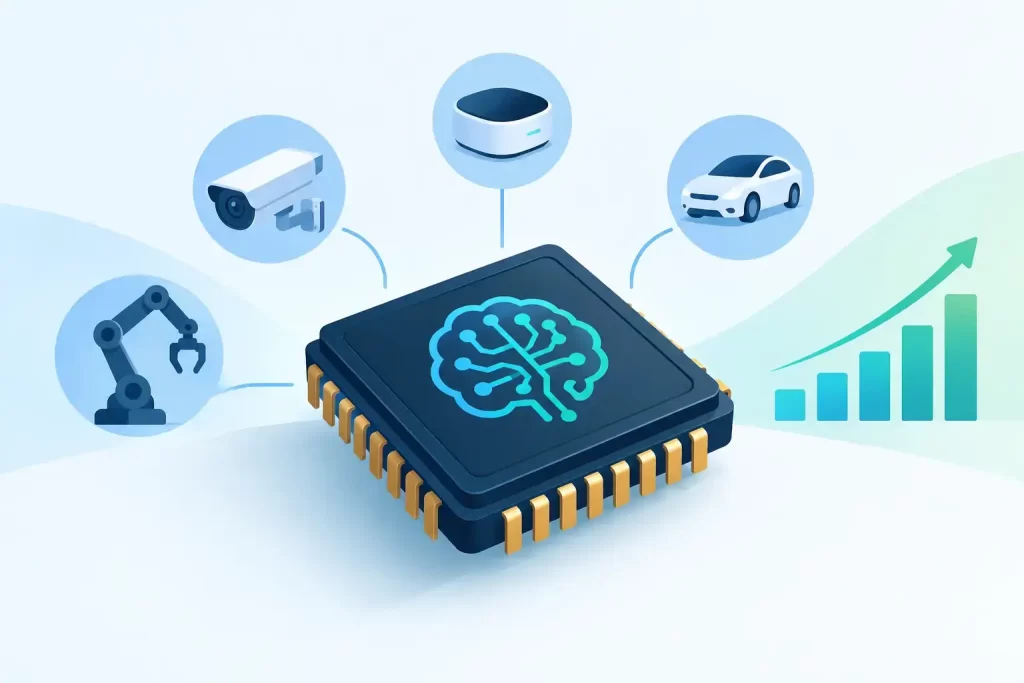
A production line cannot wait for a cloud round trip to decide whether a surface defect, abnormal bearing signature, or unsafe object is present. That operating constraint defines the value proposition examined in this NeuroMem chip performance review: fast, local pattern recognition with a hardware architecture designed for incremental learning rather than large-model inference.
For industrial teams, the relevant question is not whether a NeuroMem device can replace every AI accelerator. It cannot. The more useful question is whether its digital neural network architecture matches a recognition task with strict latency, power, integration, and retraining requirements. For many bounded classification and novelty-detection workloads, the answer can be yes.
What NeuroMem Performance Means in Practice
NeuroMem chips implement a distributed associative-memory approach. Input vectors are presented to a population of digital neurons, each of which stores a learned prototype and a programmable influence field. During recognition, the hardware evaluates the similarity of the input to stored prototypes and returns the best matching category, along with information that can indicate uncertainty or novelty.
This is materially different from running a convolutional neural network or transformer on a GPU, NPU, or server CPU. A NeuroMem controller is not intended to train deep feature extractors from raw, unprepared sensor data. It is generally most effective when the system has already produced a meaningful feature vector from an image, audio stream, vibration window, or process signal.
The architecture produces its best results when recognition is the primary bottleneck and the problem can be represented as compact, labeled examples. Typical industrial examples include classifying machine states from spectral features, identifying approved versus defective parts from visual descriptors, recognizing acoustic events, and detecting deviations from trained operating patterns.
Recognition Latency Is the Central Advantage
The principal performance characteristic is parallel comparison across stored neurons. Once a feature vector is available, recognition does not require a sequence of multiply-accumulate layers executed across a large model. Stored prototypes are evaluated concurrently, enabling low and predictable recognition latency.
That predictability matters in control systems. A machine-vision station may require an accept/reject decision before a part leaves a fixed inspection zone. A condition-monitoring controller may need to identify an abnormal vibration pattern before a fault progresses. In these cases, deterministic local recognition is often more valuable than high throughput measured under idealized batch conditions.
However, chip-level recognition speed should not be confused with end-to-end application latency. Camera exposure, image acquisition, signal conditioning, feature extraction, bus transfer, PLC communication, and actuator response can exceed the neural decision time. A realistic performance review must measure the whole pipeline, from sensor event to output action.
For image applications, this distinction is especially important. If a host processor spends tens of milliseconds resizing frames, extracting descriptors, or segmenting regions of interest, a fast NeuroMem classification stage will not by itself create a real-time system. The strongest design places preprocessing, feature generation, and recognition into a timing budget from the beginning.
Power Performance and Embedded Fit
Low power consumption is a practical advantage of dedicated associative-memory hardware. NeuroMem-based controllers can perform local recognition without maintaining a high-wattage GPU, running an operating system on a large server, or continuously transmitting raw sensor data to the cloud. This improves suitability for cabinet-mounted controllers, mobile equipment, remote monitoring nodes, and embedded OEM products.
Power savings depend on the full implementation. A system with multiple cameras, LED illumination, high-speed storage, and a general-purpose processor may still consume substantial energy. The chip reduces the cost of the recognition stage, not necessarily the cost of every subsystem around it.
The operational benefit extends beyond electrical consumption. Lower thermal load can simplify enclosure design and reduce cooling requirements. Local processing can also reduce network dependency, which is valuable where connectivity is intermittent, restricted, or reserved for supervisory data rather than raw streams.
Training Speed Is Useful, but It Has Boundaries
A major strength of NeuroMem technology is incremental training. New labeled patterns can be added directly to the controller without the long offline optimization cycles associated with many deep-learning workflows. For industrial engineering teams, this can shorten commissioning when equipment variants, materials, or environmental conditions change.
The practical outcome is not that data quality becomes irrelevant. It becomes more visible. Because the controller learns from supplied examples, training patterns must cover normal variation in lighting, part orientation, machine load, sensor mounting, temperature, and background noise. A narrow training set can create false confidence, regardless of how quickly examples were stored.
Class design is also critical. If two fault modes generate overlapping feature vectors, the controller may return ambiguous results or classify patterns into the nearest known category. In these cases, teams may need better features, additional sensor channels, narrower operating-state models, or a separate novelty rule.
A useful implementation pattern is to train known acceptable and unacceptable conditions, then define how the system handles uncertain responses. Rather than forcing every input into a known class, an industrial controller can route ambiguous events to manual review, log them for retraining, or trigger a conservative machine response. That policy often determines field reliability more than a laboratory accuracy figure.
Capacity and Feature Quality Set the Real Limits
NeuroMem performance is constrained by available neuron capacity, feature-vector dimensionality, category structure, and the distribution of real-world data. Adding many examples of nearly identical patterns may not improve coverage as much as adding examples from genuine process variation. Conversely, a highly variable visual inspection task may require more prototypes than an acoustic classifier operating in a controlled environment.
The chip does not eliminate feature engineering. For vibration monitoring, frequency-band energy, envelope statistics, and time-domain descriptors may separate machine states effectively. For vision, geometric, color, texture, or externally generated embedding features may be appropriate. The right representation should preserve the differences relevant to the production decision while suppressing nuisance variation.
This requirement is a trade-off. Deep neural networks can learn feature representations from large raw datasets, but they demand more compute, data management, and deployment effort. NeuroMem systems can train quickly and run efficiently when the input representation is well chosen. They are less suitable when the core technical challenge is learning a rich representation from unstructured raw data at massive scale.
NeuroMem Chip Performance Review Against Other Edge Options
Compared with a microcontroller running conventional rules, a NeuroMem controller offers a more adaptable way to recognize patterns that are difficult to define with fixed thresholds. A rule-based vibration alarm may detect excessive amplitude, while a trained neural pattern classifier can distinguish several operating signatures that overlap in individual measurements.
Compared with GPU or NPU inference, the advantage is not peak floating-point throughput. It is low-latency associative classification, on-device learning, and compact embedded deployment. A GPU or NPU remains the stronger choice for large neural networks, high-resolution object detection, segmentation, and workloads requiring modern deep-learning operators.
Compared with an FPGA, NeuroMem provides a shorter path when the required function is trainable pattern recognition rather than custom digital signal processing. FPGAs can achieve exceptional deterministic performance, but development and maintenance are typically more specialized. In some systems, the best architecture combines them: an FPGA or processor performs acquisition and feature extraction, while NeuroMem handles the final trainable recognition decision.
For deployment formats, boards and controller modules should be selected around the host architecture and environmental requirements. PCIe is appropriate when recognition is attached to an industrial PC. A compact embedded format can suit OEM equipment, while a standalone controller is useful where local I/O and cabinet integration matter more than host expansion. NeuroTechnologijos applies this approach across NT Adaptive .VASS, PCIe, and Raspberry Pi-compatible formats.
How to Benchmark a NeuroMem Implementation
A credible benchmark should use recorded production data and live conditions, not only clean training samples. Measure decision latency from sensor acquisition to output, recognition consistency across operating shifts, false accepts, false rejects, ambiguous classifications, retraining time, and power draw at the system level.
Test data must include the conditions likely to challenge the installation: component tolerances, sensor drift, lighting changes, tool wear, material lots, background noise, and machine-state transitions. If the task is safety-related or controls expensive equipment, evaluate failure behavior explicitly. Determine what the controller does when no learned pattern is sufficiently similar, when communications fail, and when an input falls outside the trained operating envelope.
The most favorable result is not necessarily the highest isolated classification percentage. It is a repeatable decision process that meets the required cycle time, identifies uncertainty honestly, and can be maintained by the engineering team responsible for the equipment.
A NeuroMem-based design is most compelling when fast local recognition, low power use, incremental training, and controlled integration outweigh the flexibility of a larger deep-learning stack. Start with the sensor and the failure mode, then choose the accelerator that can make the required decision at the point where it matters.
