

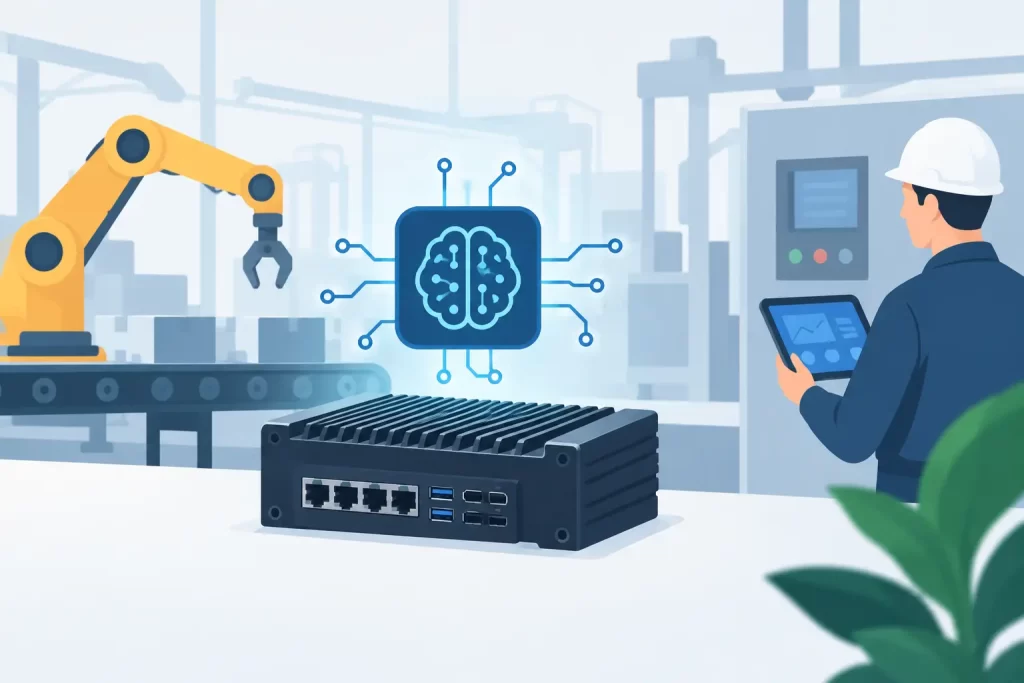
A vision station that misses a new surface defect, or a vibration monitor that cannot distinguish a bearing change from normal load variation, creates an operational problem at the point of production. Sending raw sensor streams to a remote system may add delay, bandwidth cost, and a new dependency on network availability. On device learning places the ability to train and recognize patterns directly near the camera, microphone, accelerometer, or control interface where the decision is required.
For industrial automation, the value is not simply that AI runs locally. The value is that a system can be taught relevant patterns in the operating environment, then apply that knowledge at deterministic speed without moving every image, audio sample, or vibration trace through cloud infrastructure.
What On Device Learning Means in Industrial AI
On device learning is the process of training, adapting, or updating a recognition model on the embedded device that receives the operational signal. It differs from conventional edge inference, where a centrally trained model is deployed to a device only for prediction. In an on-device learning system, the device can incorporate examples captured at the machine, line, or inspection cell.
That distinction matters when the signal is difficult to model in advance. A machine may produce a valid acoustic signature that differs by installation. Product appearance may change with material batches, lighting geometry, tooling wear, or acceptable cosmetic variation. Vibration patterns can shift as speed, load, and mounting conditions change. A model trained only on generalized data may require a lengthy data-collection and retraining cycle before it becomes useful on the plant floor.
Trainable neural controllers reduce that gap. An operator, process engineer, or integrator can present labeled examples of acceptable and unacceptable conditions, then put the learned categories into use close to the signal source. The controller does not need to reconstruct the full physics of the process. It needs to recognize the patterns that matter to the control decision.
This approach is particularly effective for classification tasks with clear operational classes: normal versus abnormal behavior, approved versus defective appearance, known machine states, material types, alarm conditions, or gesture and object recognition. It is less appropriate when the task demands large-scale generative modeling, extensive historical correlation, or continual retraining across thousands of distributed assets. The architecture should follow the decision, not the latest AI terminology.
Why Local Training Changes the System Architecture
A centrally managed AI workflow typically collects data, transfers it to a server or cloud environment, trains a model, validates it, and distributes an updated model to endpoints. That workflow can be necessary for fleet-wide analysis and complex model development. It can also be slow to respond to a local production change.
With on-device learning, the recognition path is compressed. The sensor signal is acquired, converted into a usable feature representation when required, presented to the local neural engine, and translated into a control-relevant output. Depending on the design, an authorized user can add or revise classes at the same endpoint.
The main architectural benefits are practical:
- Recognition latency is limited by local acquisition and processing rather than a round trip to a remote service.
- Raw high-rate data can remain inside the machine network, reducing bandwidth demand and exposure of proprietary process information.
- Operation can continue when external connectivity is unavailable or intentionally restricted.
- The trained behavior can reflect the actual installation, including its sensors, mounting conditions, and acceptable process variation.
Hardware acceleration is central to this model. General-purpose processors can run local models, but power budgets, response-time requirements, and integration constraints can make them unsuitable for embedded industrial deployments. Specialized digital neural network hardware is designed to store learned patterns and compare incoming data at high speed with low power consumption.
For example, a controller integrated through a PCIe interface may suit an industrial computer that already hosts vision or supervisory software. A compact embedded format can fit inside a standalone inspection device, while a Raspberry Pi-compatible implementation can support prototyping and smaller OEM systems. The learning method may be similar across these formats, but power, enclosure, I/O, environmental rating, and host software requirements are not.
Industrial Signals Are Not All Images
Machine vision often receives the most attention in edge AI discussions, yet industrial learning problems are frequently multimodal. The same local recognition principle applies to camera frames, recorded video, microphone input, accelerometer data, current signatures, and other free-form signals.
Consider condition monitoring. A vibration sensor may generate a signature associated with balanced operation, another with a loose component, and another with a developing bearing fault. A local controller can classify each observation and expose a result to a PLC, HMI, alarm subsystem, or data historian. The immediate decision does not require the raw waveform to leave the equipment.
In quality inspection, a system can learn examples of correct assembly, missing components, surface anomalies, or label placement. The objective is not always pixel-level segmentation. In many production cells, the more useful result is a fast classification that triggers a reject mechanism, stops a process, or requests human review.
Audio classification provides another example. Pneumatic leaks, relay actuation, motor noise, and impacts each produce recognizable signatures. When an acoustic model is trained at the installation, it can account for the background noise and mechanical characteristics of that location. This is often more operationally relevant than a model trained on clean laboratory recordings.
Engineering an On-Device Learning System
A successful deployment begins by defining the action the recognition result must support. The system designer should establish whether the output is advisory, an alarm, a process adjustment, a reject command, or a safety-related input. These choices determine acceptable latency, error tolerance, fail-safe behavior, and validation requirements.
Training data must represent real operating conditions, not merely ideal examples. For a defect classifier, that includes normal product variation, lighting variation, sensor noise, and borderline cases. For equipment monitoring, examples should span relevant speeds, loads, and operating modes. A model that learns only a narrow condition may appear accurate during commissioning and produce excessive false alarms after routine process changes.
Class definitions also need discipline. Categories should correspond to actions that operators or automation systems can take. Creating overlapping labels such as unusual sound, slightly unusual sound, and very unusual sound may not improve the decision. It can make training inconsistent unless the thresholds and response logic are explicitly defined.
Integration is the next engineering task. The recognition output must reach the systems that use it through appropriate industrial interfaces or host software. Timing, signal persistence, alarm acknowledgment, event logging, and fallback behavior should be specified before the model is placed in production. A fast classifier is only useful if the surrounding control system handles its result predictably.
NeuroTechnologijos applies this architecture through NT Adaptive controllers and supporting software modules designed for trainable recognition of images, video, audio, vibration, and other signals. The focus is not on replacing every centralized analytics function. It is on locating fast pattern recognition where industrial equipment needs it.
The Trade-Offs Require Clear Boundaries
Local learning is not a substitute for enterprise data management. A facility may still need central storage for traceability, reporting, model governance, and comparative analysis across machines. Local recognition and centralized analysis are complementary layers when they are assigned different responsibilities.
There is also a governance question. If endpoints can be retrained, organizations need controls for who can change classes, how training samples are recorded, and how a trained state is approved for production use. Version identification, test records, and rollback procedures are especially relevant when recognition affects product disposition or machine operation.
Model capacity is another constraint. Embedded neural hardware is optimized for specific recognition workloads and resource limits. That can be an advantage because it encourages concise, deterministic deployments. It also means designers should not assume that every large neural architecture used in a data center can be transferred directly to a controller.
The strongest projects define a narrow first decision with measurable value: detect a recurring assembly error, classify a machine state, identify an audible fault signature, or separate acceptable from unacceptable parts. Once the local recognition path is proven under production conditions, the same design discipline can extend to additional signals, stations, and equipment classes.
The useful question is not whether a machine can use AI. It is whether the machine can learn the patterns that matter and act on them fast enough to improve the process while the process is still happening.
