
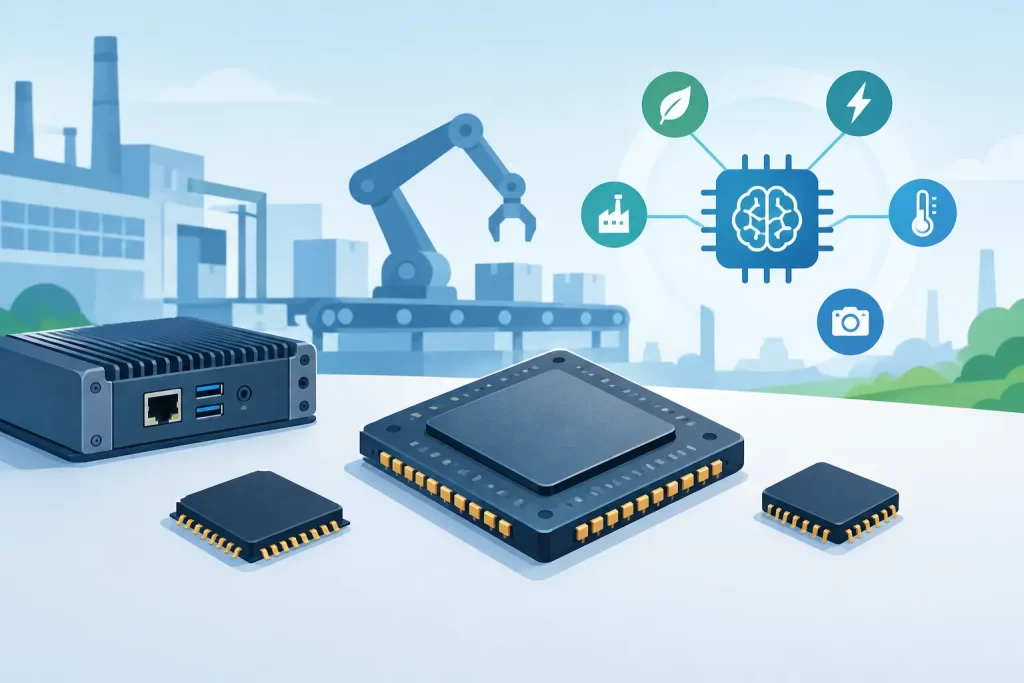
A camera at a production station, an accelerometer on a motor, and a microphone near a pneumatic valve all create decisions that cannot wait for a remote server. The top low power inference chips are therefore not defined by peak AI throughput alone. They are defined by how consistently they recognize the required pattern within a fixed power, latency, thermal, integration, and lifecycle budget.
For industrial buyers, this changes the evaluation process. A chip that leads a data-center benchmark may be poorly suited to a sealed control cabinet, a battery-powered sensor node, or a legacy machine with limited compute headroom. The correct device depends on the model architecture, sensor modality, response-time requirement, and whether the system must learn new recognition classes in the field.
What Low-Power Inference Means in Industrial Systems
Inference is the execution of a trained model against live input data. In an industrial application, that may mean classifying a vibration signature, detecting a surface defect, identifying an abnormal acoustic event, or recognizing an object in a video stream. Low-power inference hardware performs this work at the edge while limiting electrical consumption and heat generation.
Power must be considered as energy per useful decision, not as a single nameplate number. A processor drawing modest power but requiring multiple frames or long preprocessing cycles can consume more energy per accepted result than a purpose-built accelerator. Likewise, an accelerator that achieves high operations-per-second but cannot run the needed model without extensive conversion may not reduce system cost or integration risk.
The industrial requirement is usually deterministic performance. A recognition engine must continue operating through shift changes, vibration, electrical noise, temperature variation, and intermittent network availability. This favors hardware with predictable latency, stable software support, and a clear path from prototype to deployed controller.
Top Low Power Inference Chips by Architecture
There is no universal ranking because the architectures serve different workloads. The most useful comparison separates chips by the type of neural processing they accelerate and the integration model they support.
Digital neural network chips
Digital neural network chips, including NeuroMem technology, are designed around fast pattern-recognition operations rather than general-purpose parallel computing. Their value is particularly clear where an industrial system must compare live sensor patterns against learned categories with very low latency and low energy use.
This architecture is well suited to classification tasks involving images, video-derived features, acoustic signatures, vibration patterns, and other free-form sensor signals. A key distinction is trainability. For applications where new product variants, fault signatures, or environmental conditions must be added without rebuilding a large deep-learning pipeline, trainable neural controllers can offer a practical advantage.
The trade-off is scope. These devices are not intended to replace a high-end GPU for large transformer models or extensive batch analytics. They are strongest when the recognition problem is clearly bounded and the deployment requires compact, responsive hardware. NeuroTechnologijos applies this approach through NT Adaptive controller formats for embedded, PCIe, and Raspberry Pi-based industrial integration.
Dedicated AI accelerators and NPUs
Neural processing units, often called NPUs, are specialized accelerators optimized for common neural-network operations such as convolutions, matrix multiplication, quantization, and activation functions. Devices from vendors such as Hailo, NXP, Qualcomm, and other embedded silicon suppliers fall into this broad category, although their software stacks and target markets differ substantially.
NPUs are a strong fit for compact vision systems running optimized convolutional models. They can deliver favorable frames per watt when models are quantized and compiled for the device. Many also integrate with ARM CPUs, image signal processors, and hardware video codecs, reducing board complexity for camera-based equipment.
The main engineering question is model compatibility. NPU performance figures are usually quoted in TOPS, but TOPS does not directly predict defect-detection accuracy, end-to-end latency, or throughput for a specific network. Verify supported operators, memory limits, quantization behavior, input resolution, and the effort required to maintain the deployment toolchain over the product lifecycle.
Embedded GPU platforms
Embedded GPUs, particularly those used in NVIDIA Jetson-class systems, remain relevant where an application needs flexible model support, multiple high-resolution video streams, sensor fusion, or local visualization. Their CUDA-based ecosystem is familiar to many machine-vision teams, and the same platform can often run preprocessing, inference, tracking, and application logic.
That flexibility comes with higher power and thermal demands than many dedicated inference chips. An embedded GPU can be the right choice for a multi-camera inspection cell or an autonomous mobile platform, but it may be excessive for a single condition-monitoring channel. It also introduces operating-system, driver, and lifecycle-management considerations that should be accounted for early.
Vision processors and smart-camera silicon
Vision processors combine image signal processing, video encoding, CPU resources, and AI acceleration. Ambarella and similar suppliers are commonly evaluated for intelligent cameras, video analytics, and edge vision appliances. Their integrated architecture can reduce external components and simplify a camera-centric design.
These chips are most compelling when the image pipeline itself is central to the requirement. For example, a system that must acquire, enhance, encode, and analyze video at the edge can benefit from an integrated vision processor. They are less natural for vibration or audio classification systems where camera-specific hardware adds little value.
How to Select a Low-Power Inference Chip
Start with the decision, not the benchmark. Define the exact event the system must recognize, the acceptable false-positive and false-negative rates, and the maximum time from sensor capture to output. A bearing-fault classifier that runs every second has different hardware needs from a safety inspection system that must reject a defective part in milliseconds.
Next, measure the full power envelope. Include sensor acquisition, illumination, memory traffic, CPU preprocessing, communications, and thermal management. A chip that appears efficient in isolation may require a larger power supply, heat sink, or enclosure once the surrounding system is included. For remote or battery-backed equipment, idle consumption and wake-up behavior can matter as much as active inference power.
Then assess the learning workflow. Some applications rely on a fixed, centrally trained neural network that is updated through controlled firmware releases. Others need engineers to teach new classes at a line, tune thresholds, or adapt to changing materials and machine behavior. The latter case favors architectures that support practical, local training or rapid incremental recognition updates.
Integration is equally important. Industrial deployments may require PCIe for an existing computer, Ethernet-connected controllers, compact embedded boards, or integration with Raspberry Pi-class platforms for lower-cost edge stations. Evaluate electrical interfaces, I/O timing, enclosure requirements, operating temperature, and compatibility with PLC, SCADA, and industrial networking layers.
Finally, test with representative operating data. Public image datasets rarely reflect factory lighting, optical contamination, mounting vibration, machine noise, or the imbalance between normal and failure events. A short pilot using real signals will expose model drift, false alarms, data-transfer bottlenecks, and installation constraints that raw accelerator specifications cannot show.
Metrics That Matter More Than TOPS
TOPS can be useful for an initial filter, but it is not a deployment metric by itself. It says little about memory bandwidth, model compilation efficiency, preprocessing overhead, or whether the chip supports the network operators needed by the application.
For industrial inference, measure decision latency, decisions per watt, sustained throughput at the expected ambient temperature, and accuracy on real production data. Also measure recovery behavior after power interruption, inference consistency over extended operation, and the time required to update models or recognition categories.
A further consideration is data movement. Moving high-resolution images or continuous sensor streams between processors can consume more power and introduce more latency than the inference calculation itself. Hardware that places recognition close to acquisition can reduce bus traffic, simplify system architecture, and keep sensitive process data inside the facility.
When Purpose-Built Recognition Hardware Wins
Purpose-built low-power recognition hardware is often the better choice when the system has a defined classification task, strict response time, and limited thermal capacity. Typical examples include defect sorting, tool-condition monitoring, vibration-based predictive maintenance, acoustic leak detection, access recognition, and machine-state classification.
A more general NPU or GPU is preferable when the model changes frequently, the workload includes complex detection and tracking, or software flexibility outweighs power constraints. Neither approach is categorically superior. The correct choice follows the physical deployment and the recognition task, not the largest benchmark number.
The most effective edge AI system is the one that makes a reliable decision where the signal is created, within the power and latency the machine can support. Select the chip after defining that decision in engineering terms, and the hardware choice becomes substantially clearer.