

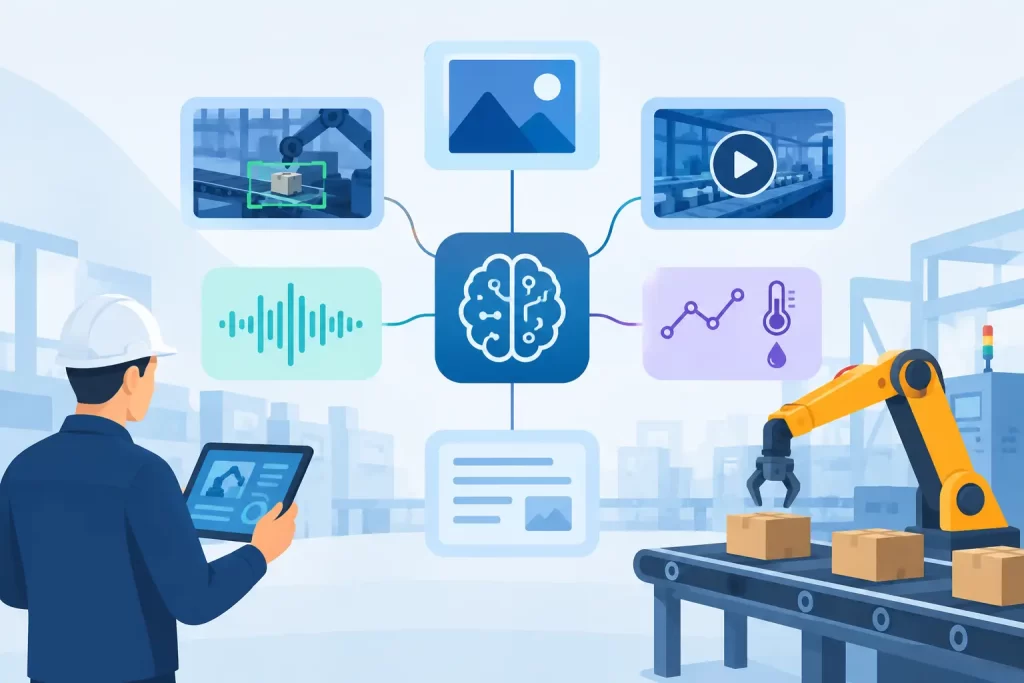
A failed bearing rarely announces itself through one sensor. A vibration signature may drift first, an acoustic pattern may change under load, and a thermal image may show the condition only after damage has progressed. Industrial teams need systems that can interpret these signals in context, not isolated analytics tools that generate another dashboard alarm. That is the operating requirement behind the best multimodal industrial AI solutions.
Multimodal industrial AI combines two or more data types, such as images, live video, audio, vibration, current, temperature, or other free-form sensor signals, to support a recognition or control decision. The value is not simply collecting more data. It is making a fast, traceable decision from the signals that matter at the point where the process is running.
For automation engineers and OEMs, the right solution is determined less by a broad AI feature list than by deployment architecture. Recognition latency, power budget, sensor interfaces, training workflow, and compatibility with existing control systems all affect whether an AI project becomes a production asset or remains a pilot.
What Makes a Multimodal AI System Industrial
An industrial multimodal system must function under real operating constraints: variable lighting, machine noise, electromagnetic interference, process-speed changes, imperfect sensor placement, and limited network availability. A model that produces strong results from curated cloud data may still be unsuitable when it must classify a signal within a fixed machine cycle.
Industrial AI also has a different definition of accuracy. A missed critical defect, a nuisance shutdown, and a delayed classification do not carry the same cost. A practical system needs decision thresholds, confidence handling, and outputs that can be connected to alarms, PLC logic, historian records, or supervisory software.
This is why edge processing is central to many deployments. Processing data near the sensor reduces transport delay and avoids making recognition dependent on continuous cloud connectivity. It can also reduce the amount of raw video or high-rate vibration data that must leave a production cell. Cloud resources still have a role in fleet analysis, archival, and model management, but they should not become a single point of failure for a time-critical control decision.
How to Evaluate the Best Multimodal Industrial AI Solutions
The best multimodal industrial AI solutions are not necessarily the systems with the largest pretrained models. They are the systems that fit the recognition task, hardware environment, and response time required by the operation.
Start with the decision, not the data volume
Define the output before selecting cameras, microphones, or accelerometers. The required decision may be pass/fail classification, identification of a known object, detection of an abnormal machine state, grading of surface quality, or routing of material to the next process step. Each decision has a different tolerance for latency and false positives.
For example, a packaging line may require recognition and actuator control within milliseconds. A maintenance system that trends gearbox condition may allow longer windows for signal acquisition, but it must distinguish a meaningful change from normal operating variation. Combining vibration and sound can improve confidence, yet only if both signals are synchronized to the relevant machine state.
A useful design question is: what action will the system take after recognition? If the answer is unclear, teams tend to collect excessive data and create models that are difficult to validate on the production floor.
Assess edge latency and deterministic behavior
For live inspection and machine control, average inference speed is not enough. Evaluate worst-case latency from sensor capture through preprocessing, recognition, output generation, and controller response. The system should continue to meet the required timing when input rates increase or when multiple recognition channels operate simultaneously.
Hardware acceleration matters here. Purpose-built neural hardware can execute trained recognition patterns locally with low power use and without placing the full workload on an industrial PC or remote server. This is especially relevant for embedded equipment, distributed sensor nodes, and retrofit projects where cabinet space and thermal capacity are limited.
The trade-off is that specialized edge hardware is typically selected for a defined class of recognition workloads. A general-purpose GPU platform can be more flexible for very large models or research-heavy development. For repetitive industrial recognition tasks that demand predictable timing, a trainable edge controller may be the more appropriate architecture.
Confirm that training matches plant reality
Industrial signals are rarely static. Product variants change, tooling wears, ambient noise shifts, and new materials enter the process. The training workflow should allow engineers to add representative examples, test recognition quality, set classes or thresholds, and deploy updates without rebuilding the entire automation stack.
Trainability is particularly valuable when the signal does not fit a standard computer-vision taxonomy. A controller may need to recognize a specific vibration pattern, a machine sound associated with a valve state, or an image feature unique to a customer product. In these cases, the ability to learn local patterns from labeled examples can be more useful than a generic pretrained model.
Validation should include normal process variation, not just clean examples of known faults. Test changes in illumination, speed, load, background noise, mounting position, and sensor aging. A system that succeeds only in a controlled demonstration has not yet been qualified for industrial use.
Check integration at the electrical and software layers
An AI controller must operate as part of the automation system, not beside it. Review the available hardware formats, power requirements, I/O capabilities, communication interfaces, mounting options, and environmental requirements. Also determine how recognition results reach PLCs, motion systems, HMIs, industrial PCs, or data platforms.
Integration requirements vary by application. A compact embedded board may suit an OEM device. A PCIe format may fit a machine-vision workstation or industrial server. A stand-alone controller may be preferable for a retrofit monitoring point. The correct form factor depends on the control cabinet, compute host, service model, and expected production volume.
Data governance is equally practical. Determine which raw signals are retained, where labeled samples are stored, how models are versioned, and how an engineer can trace a recognition decision after an event. For regulated or safety-sensitive processes, this operational record can be as important as the recognition score itself.
Common Multimodal Industrial AI Architectures
A camera-plus-controller architecture is often used for surface inspection, assembly verification, object identification, and occupancy monitoring. Image recognition provides spatial information, while discrete process signals can indicate which product variant or machine phase is active. This reduces ambiguity that vision alone may not resolve.
A vibration-plus-audio architecture is common for condition monitoring. Vibration captures mechanical dynamics through the structure, while audio can expose impacts, rubbing, leaks, or tonal changes. The two inputs are complementary, but their sensor placement and sampling windows must be engineered carefully. More modalities do not automatically improve results if they are poorly correlated or introduce noise.
Video-plus-signal architectures support complex process supervision. Live or recorded video can document events, while current, position, pressure, or vibration data explains machine state. These systems are useful when a visual anomaly must be associated with a specific sequence in the operating cycle.
NeuroTechnologijos addresses these architectures through NT Industrial Automation, combining trainable NT Adaptive controllers with software modules for image, video, audio, vibration, and other free-form signal analysis. Hardware options such as NT Adaptive .VASS, PCIe, and Raspberry Pi formats allow the recognition component to be placed where the application needs it: in a dedicated industrial node, an existing compute system, or an embedded device.
Where Projects Commonly Fail
The most frequent failure is treating multimodal AI as a data-science project rather than a controls-engineering project. Teams may prove that a model can classify recorded samples, then discover that the required sensor mounting, triggering, buffering, or output interface was never defined for the line.
Another issue is excessive model complexity. A larger model may show marginal gains in offline testing while increasing power consumption, latency, and maintenance burden. For a fixed recognition task, a smaller trainable system running at the edge may deliver a better operational result.
Finally, avoid assuming that one architecture fits every asset. A high-speed defect inspection station, a remote pump monitor, and an embedded OEM product have different requirements for processing power, enclosure design, connectivity, and service access. Standardizing the evaluation method is useful. Standardizing every hardware choice is not.
A successful industrial AI deployment begins with one measurable machine decision, representative multimodal data, and an edge architecture that can hold its timing under production conditions. Once that first recognition loop is dependable, additional sensors and use cases can be added with a clear engineering purpose.
