
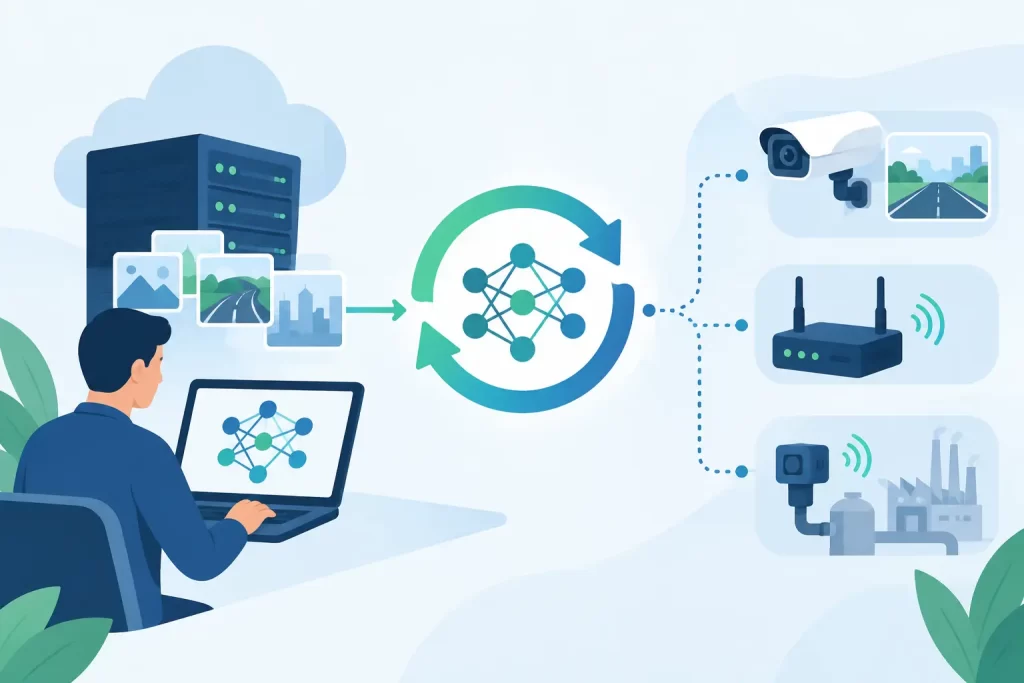
A model that passed acceptance testing can still become the weakest component in an industrial automation system. Changes in illumination, sensor mounting, machine wear, material batches, acoustic backgrounds, or operating recipes alter the signal distribution seen at the edge. Best practices for model retraining begin with treating these changes as controlled engineering events, not as an occasional response to poor accuracy.
For industrial AI, retraining is not simply a data science task. It affects recognition thresholds, controller behavior, operator trust, traceability, and production risk. The objective is to preserve fast local inference while updating recognition capability only when evidence shows the current model no longer represents the process.
Best Practices for Model Retraining Start With a Baseline
A retraining program needs a reference point. Before deployment, record the model version, training data source, class definitions, preprocessing steps, recognition thresholds, hardware target, and acceptance-test results. For a vision system, this includes camera position, lens settings, exposure, illumination, and image resolution. For vibration or acoustic recognition, document sensor type, placement, sample rate, filtering, and the machine state during collection.
This baseline separates true process change from configuration drift. A model may appear to degrade after a maintenance shutdown, for example, when the actual issue is a shifted camera, replaced sensor, modified gain setting, or altered trigger timing. Retraining a model to compensate for an installation error can conceal the real fault and create a less stable system.
Acceptance criteria should be tied to the operational decision. Overall accuracy alone is rarely sufficient. A defect-detection application may prioritize recall because missed defects are costly. A machine-stop condition may prioritize precision because false alarms interrupt production. Condition monitoring may require stable recognition across load ranges rather than maximum performance on a narrow test set.
Detect Drift Before It Becomes a Production Problem
Model drift has several forms. Data drift occurs when incoming signals differ from the training distribution. Concept drift occurs when the relationship between a signal and its correct label changes. Performance drift appears when validated outcomes show that the deployed model is making more incorrect decisions.
Industrial systems cannot always obtain immediate ground truth. A vibration classifier may flag an unusual condition, but confirmation may arrive only after inspection or maintenance. A visual inspection system may reject a part, while downstream quality checks determine whether the rejection was justified. Design the monitoring architecture around that delay rather than pretending every inference can be labeled instantly.
Track operational indicators that are meaningful for the application: class frequency, confidence distribution, rejection rate, unknown-pattern rate, false-trigger reports, and agreement with confirmed inspection results. A sudden increase in low-confidence classifications may indicate a new material surface or sensor contamination. A gradual change in vibration signatures can indicate equipment aging, but it can also reflect a sensor coupling issue.
Use drift indicators to trigger investigation, not automatic retraining. Automatically incorporating all new observations creates a feedback loop in which false labels, transient noise, and rare abnormal conditions can become accepted behavior. In production, an unknown pattern is often valuable precisely because it remains unknown until reviewed.
Define Retraining Triggers in Advance
Set quantitative and operational triggers before deployment. Examples include a sustained rise in confirmed false rejects, a drop in defect recall below the approved limit, a new operating recipe, replacement of a critical sensor, or a planned product change. Define the observation period, responsible reviewer, and required evidence for each trigger.
Thresholds should reflect process volatility. A packaging line with frequent artwork changes will need a different cadence from a motor-monitoring installation where signature changes develop over months. The right question is not how often a model should be retrained. It is what evidence is sufficient to justify a controlled update.
Build Training Data Around the Real Operating Envelope
The most common retraining failure is collecting more data without collecting more representative data. A large set of nearly identical images or waveforms adds little information. The training set must cover the range of conditions the system is expected to distinguish: normal variation, known defects, sensor noise, speed changes, load changes, ambient conditions, and approved product variants.
Keep the original validated data unless a documented reason requires its removal. Training only on recent samples can cause catastrophic forgetting, where the revised model performs well on the newest condition but loses recognition capability for earlier valid conditions. A balanced dataset preserves established classes while adding examples from the changed environment.
Label governance matters as much as volume. Define each class with operational language and include borderline examples in the labeling procedure. For example, a scratch class needs a measurable inspection rule, not a subjective description. For condition monitoring, distinguish a confirmed bearing defect from a transient impact, loose mounting, or process-induced vibration. If qualified reviewers disagree on a label, the model cannot be expected to learn a consistent boundary.
Maintain a quarantine set for questionable samples. These may be useful for investigation, but they should not enter training merely because they are available. In high-consequence applications, the quality of labels is usually a stronger performance lever than another uncontrolled batch of field data.
Validate the Retrained Model Against Production Risk
Validation must use data that the model did not see during training or tuning. It should also preserve time, machine, batch, and site separation where relevant. Randomly splitting nearly identical consecutive frames or recordings into training and test sets can produce optimistic results that disappear on the production line.
Test the candidate model against the current approved model on the same holdout dataset. Compare class-level precision and recall, confusion patterns, confidence behavior, and processing latency. A replacement model is not automatically better because its aggregate score is higher. It may improve a common class while increasing misses for a rare but critical defect.
Use challenge data deliberately. Include contaminated optics, lower contrast, off-angle parts, variable background noise, altered machine speeds, and samples near decision boundaries. The purpose is not to prove that the model is perfect. It is to identify where the decision logic must reject, request review, or remain conservative.
For edge deployments, validate the actual target architecture. A model tested on a development workstation may behave differently when paired with a field sensor, embedded preprocessing pipeline, controller interface, or timing requirement. Measure end-to-end latency from signal acquisition through recognition and output action. Verify memory use, power limits, startup behavior, and recovery after communication loss.
Control the Deployment, Not Just the Model File
Every approved update should have a versioned release package. It should identify the model, training dataset revision, preprocessing configuration, class map, thresholds, target hardware, test report, approver, and rollback method. This record allows an engineering team to reproduce a decision months later when a line condition changes or an audit requires evidence.
Deploy in stages when the application allows it. Shadow mode is particularly effective: the candidate model receives live signals but does not control the process. Its outputs can be compared with the active model and with confirmed outcomes. A limited rollout to one machine, one shift, or one product family provides another control point before wider release.
Rollback must be fast and tested. Retaining the previous approved model is not enough if operators cannot restore it without interrupting production or if configuration dependencies have changed. Document the procedure, verify it during commissioning, and define who has authority to initiate it.
NeuroTechnologijos deployments can keep recognition close to sensors and control equipment through trainable neural controllers and edge-oriented hardware formats. That architecture reduces dependence on continuous cloud connectivity, but it also makes release discipline more important: each local device needs the correct model, configuration, and traceable approval state.
Treat Retraining as Part of Change Management
A model update may coincide with mechanical service, a new supplier, software integration work, or a process recipe revision. Coordinate those changes. If several variables change at once, diagnosing a later performance shift becomes difficult. Where possible, introduce one controlled change at a time and retain the associated production records.
Operators and maintenance teams should know what the recognition system is expected to do after an update. Provide a clear procedure for reporting false alarms, missed events, and unknown patterns. Their feedback is not anecdotal noise. It is a source of labeled operational evidence when connected to an inspection and review workflow.
The strongest retraining programs are deliberately conservative. They capture meaningful field variation, protect validated knowledge, test against failure modes that matter, and release only when the production case is clear. That discipline turns retraining from a recurring correction into a controlled way to keep industrial intelligence aligned with the machine it serves.