
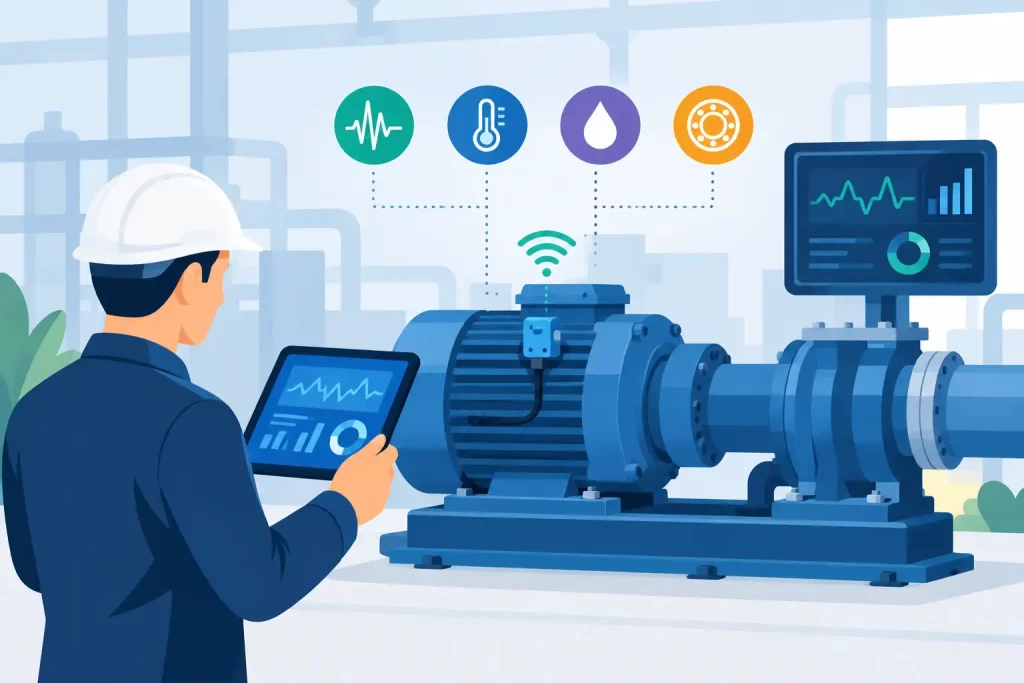
A bearing rarely fails without leaving evidence first. Its vibration spectrum shifts, the acoustic profile changes, temperature may rise, and the motor current signature can become less stable. The practical value of a machine condition monitoring guide is turning those weak, early signals into an actionable maintenance decision before a production interruption, damaged equipment, or safety event occurs.
Condition monitoring is not a single sensor or dashboard. It is an engineered measurement and recognition system: acquire the right signal, preserve the features that indicate degradation, classify normal and abnormal operating states, and deliver a decision quickly enough to affect operations. The architecture must also work under plant constraints such as electrical noise, intermittent connectivity, limited cabinet space, legacy controls, and varying loads.
What Machine Condition Monitoring Must Detect
The objective is not merely to collect more machine data. It is to distinguish a meaningful condition change from normal variation caused by product mix, speed, load, ambient conditions, or operator behavior. A useful system identifies the state of an asset, estimates whether that state is changing, and communicates the level of intervention required.
For rotating equipment, common targets include imbalance, misalignment, looseness, bearing defects, gear mesh damage, lubrication problems, cavitation, belt wear, and electrical faults. On process equipment, the target may be valve stiction, pump instability, compressor surge, blocked flow, abnormal combustion, or actuator degradation. The failure modes define the sensing method, feature set, sampling rate, and alarm logic.
The monitoring design must begin with a failure-mode review. A low-frequency vibration trend can reveal structural looseness, while early bearing damage often requires higher-frequency acceleration data or acoustic measurement. Motor current analysis can expose electrical and load-related changes without mounting a sensor directly on the driven component. Thermal sensing is useful for friction and electrical hotspots, but it is usually a slower indicator than vibration or acoustics.
No single modality is universally sufficient. A centrifugal pump in a variable-speed process line may benefit from vibration, suction and discharge pressure, motor current, and operating speed. A gearbox may require high-bandwidth acceleration, tachometer reference, and oil debris data. The correct sensor set depends on the fault physics and the access available on the machine.
Machine Condition Monitoring Guide: Build From the Asset Out
Start by separating assets according to criticality. A low-cost fan with installed redundancy can be monitored with simple periodic measurements. A high-speed compressor that constrains an entire production line requires continuous sensing, immediate analysis, and a defined response path. Criticality determines how much sensing, compute capacity, validation effort, and system redundancy are justified.
Next, establish a baseline across representative operating conditions. This is where many projects fail. A model trained only when a machine runs at one speed or produces one product will flag legitimate production changes as anomalies. Capture data during normal starts, stops, steady-state operation, expected load ranges, and known process transitions. Record maintenance actions and confirmed faults where possible. Those records create the ground truth needed to evaluate detection quality.
Baseline data should include both raw signals and machine context. For example, vibration measurements without shaft speed, load, and process state can be misleading. A rising vibration amplitude may be an actual defect, or it may be a normal effect of increased speed. Context channels allow analytics to compare like with like.
Sensor installation quality is as important as sensor selection. Accelerometers mounted with loose magnets or on thin, resonant guards can generate data that reflects the mounting arrangement rather than the machine. Permanent stud mounting generally supports better high-frequency response than temporary mounting, but it is not always practical. Cable routing, grounding, ingress protection, temperature range, calibration procedures, and connector selection all affect data reliability in industrial installations.
Choose Sampling and Features for the Fault
Sampling too slowly discards diagnostic content. Sampling everything at maximum resolution, however, increases storage, network traffic, and processing cost without necessarily improving maintenance decisions. The target fault frequency and the desired analysis method should determine the acquisition strategy.
Time-domain features such as RMS, peak, crest factor, kurtosis, and trend slope are effective for many screening applications. Frequency-domain analysis identifies harmonic content, bearing-related frequencies, gear mesh components, and sidebands. Envelope analysis can improve sensitivity to repetitive impacts from rolling-element bearing defects. Order tracking is valuable when rotational speed changes. For acoustics, spectral signatures and transient events can identify leaks, impacts, friction, or unstable operation.
Feature engineering remains useful, but it is not the only path. Trainable pattern recognition can classify complex signal shapes directly from selected windows, spectra, images, or fused sensor features. This is particularly valuable where a conventional threshold cannot separate normal process variation from a real condition change.
Decide Where Recognition Runs
Cloud analytics can support fleet-wide comparison, long-term storage, and centralized reporting. It is less suitable when decisions must be made in milliseconds, connectivity is limited, raw signal transfer is expensive, or operational data cannot leave the facility. Many industrial systems therefore use a layered architecture: acquisition and first-pass recognition at the edge, supervisory visualization on a local server or control network, and optional higher-level aggregation elsewhere.
Edge recognition reduces latency and prevents continuous streams of high-rate vibration or audio from saturating the network. It also allows a machine to remain monitored during a network outage. For safety-adjacent or production-critical actions, the edge device should provide deterministic interfaces to alarms, PLCs, drives, or supervisory systems while preserving event data for later engineering review.
NeuroTechnologijos applies trainable neural controllers to this type of requirement, supporting embedded recognition of vibration, audio, video, and other free-form industrial signals. Hardware choice still depends on the installation. A PCIe format can suit an industrial computer or server, while an embedded controller or Raspberry Pi-based format may fit a distributed sensing node. The selection should follow required channels, signal bandwidth, environmental conditions, interface needs, and maintenance access – not a preference for a particular compute platform.
Use Models and Thresholds Together
Thresholds are transparent and easy to validate. They work well when a known variable has a clear operating limit, such as bearing temperature, overall vibration severity, or pressure differential. Their weakness is that fixed limits do not adapt well to changing speed, load, or product conditions.
Anomaly detection and trainable classifiers can recognize patterns that exceed simple rules. They require disciplined training data and ongoing validation. A model that detects every unusual pattern may create too many alarms unless it is conditioned on operating state. A model trained only on normal operation may identify a deviation but not its failure type. A supervised model can distinguish fault classes, but it needs labeled examples that may be difficult to obtain.
The most effective deployments commonly combine methods. Use deterministic limits for immediate equipment protection, condition trends for maintenance planning, and pattern recognition for early or ambiguous signatures. Each alert should state the measured evidence, confidence or severity, machine operating context, and recommended next action.
Design the Alarm Workflow Before Deployment
An alarm without ownership is only a notification. Before commissioning, define who receives each alert, what inspection is expected, how findings are recorded, and when the model or threshold is adjusted. Maintenance teams need evidence they can use: a spectrum change, waveform excerpt, trend history, comparison with baseline, or identified condition pattern. They do not need an unexplained score.
Alarm strategy should include at least advisory, action, and critical states. Advisory alerts can trigger increased observation. Action alerts should create a planned inspection or work order. Critical alerts may require an immediate operating change, controlled shutdown, or escalation to engineering. The response must reflect the asset’s criticality and the confidence of the detection.
False positives damage trust, but suppressing alerts too aggressively can hide early faults. Track precision, missed detections, alert frequency, time from alert to confirmed finding, and avoided downtime where records are available. Review these measures after changes in machinery, materials, operating schedules, or maintenance practices. Condition monitoring is a maintained engineering system, not a one-time installation.
Integrate With Existing Industrial Systems
A monitoring node must coexist with the plant architecture. Confirm available power, Ethernet or fieldbus connectivity, cabinet constraints, time synchronization, cybersecurity policy, and data-retention requirements before selecting hardware. Verify how the system will exchange status with PLCs, SCADA, historians, maintenance software, and operator interfaces.
Interoperability should be specified early. Decide whether the monitoring system publishes discrete alarms, analog values, feature vectors, event files, or all of them. Use timestamped events and retain sufficient pre-trigger and post-trigger signal history to support diagnosis. If a controller initiates an automated response, document the fail-safe state and ensure the action can be tested without exposing personnel or equipment to unnecessary risk.
Commissioning should include deliberately introduced or simulated conditions where feasible, plus comparison against handheld measurements and expert inspection. The goal is not to prove that the system can display data. It is to prove that it detects a relevant change, communicates it correctly, and leads to an appropriate response.
The best monitoring system is the one that gives maintenance teams enough warning to act while the equipment is still under control. Start with the failure modes that matter most, preserve the signal detail needed to recognize them, and make every alert traceable to evidence a technician can verify.